

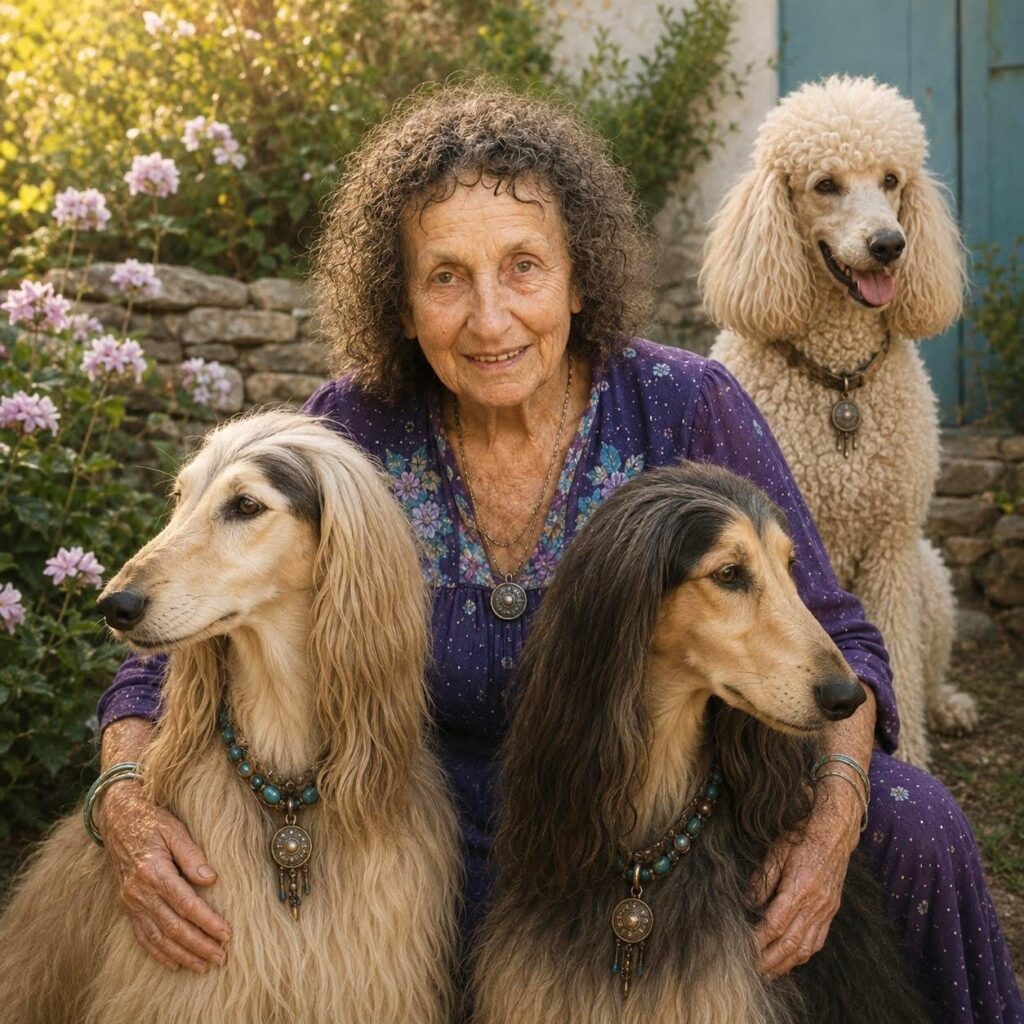
After writing yesterday’s post I kept thinking about how many people have probably seen Juliette de Bairacli Levy quotes shared online without ever really understanding who she actually was, what world she lived in, what hardships she worked through, why her observations mattered historically, or why her work still keeps resurfacing decades later whenever conversations about Natural Rearing, vitality, constitution, chronic disease, and biological resilience begin reappearing inside modern dog culture.
Most people today encounter her through isolated little excerpts floating around social media attached to earthy wellness branding and aesthetic “natural living” imagery, yet Juliette’s actual story feels far less like modern holistic culture and far more like someone stepping away from an increasingly artificial system because she became convinced something foundational about life itself was quietly being lost underneath industrial progress.
What fascinates me most is trying to imagine the WORLD she was actually working inside because people forget how radically different life looked during the years Juliette was traveling, breeding, writing, observing, and corresponding with breeders around the world.
NO internet
podcasts
social media
AI
online breeder groups.
overnight raw food shipping.
No chest freezers packed full of pre-made meals sitting conveniently in garages.
Or endless stream of experts building platforms through algorithms and emotional marketing.
People today can pull out a phone and access more information in ten minutes than entire generations once had access to in years, yet somehow modern culture often feels LESS capable of sitting deeply with information long enough for understanding to form underneath it.
Back then breeders wrote LETTERS.
Actual handwritten letters traveling across countries and continents discussing constitution, fertility, movement, disease resistance, nervous-system stability, structure, feeding practices, parasite problems, maternal health, kennel conditions, and bloodlines in long thoughtful conversations because knowledge moved slowly enough for people to actually THINK before responding.
Weeks passed before replies arrived.
Sometimes months.
Observation mattered because people could not instantly outsource confusion to a search engine every time uncertainty appeared.
Critical thinking was survival back then.
Honestly, I think that part alone is deeply uncomfortable to compare against modern culture because today people often build certainty faster than they build understanding. A thirty second reel, a viral quote, a charismatic personality, a large following, or aesthetically pleasing branding can suddenly create authority overnight even when long-term biological proof barely exists underneath it.
Juliette’s credibility did not emerge from visibility.
It emerged from EXPERIENCE.
She originally entered veterinary studies in England during a period when medicine itself was becoming increasingly standardized, intervention focused, pharmaceutical driven, and progressively separated from environmental biology. The deeper she moved into that world, the more uncomfortable she became with how disconnected many approaches felt from nature itself, so instead of fully embedding herself into institutional veterinary culture she stepped away and spent years traveling through shepherd villages, Romani settlements, Bedouin camps, remote agricultural communities, and traditional working animal cultures observing dogs still living under environmental conditions radically different from modern pet culture.
That part matters enormously because she was not theorizing from comfort.
She lived among working dog cultures.
She watched shepherd dogs move livestock across rough terrain for enormous distances while remaining mentally stable, structurally sound, environmentally adaptive, fertile, resilient, and behaviorally balanced without endless pharmaceutical maintenance, processed feeding systems, behavioral intervention programs, or constant medical management.
Village puppies developed surrounded by older stable dogs instead of inside carefully sterilized developmental bubbles disconnected from meaningful environmental exposure.
Brood bitches moved through sunlight, changing weather, varied terrain, instinctive movement, fresh air, and outdoor rhythms throughout pregnancy instead of spending most of life sedentary indoors beneath artificial lighting and environmental monotony.
Even feeding itself looked completely different during that era. People did not have the convenience modern raw feeders now have where large amounts of food can be frozen, stored long term, shipped nationally, vacuum sealed, freeze dried, and delivered to front doors through online orders. Feeding often depended heavily upon local availability, season, climate, hunting, livestock practices, fresh sourcing, practical preservation, and observational husbandry instead of modern commercial convenience.
Life moved slower.
Observation moved deeper.
People learned differently because they HAD to.
And honestly, I think many people misunderstand Juliette because modern culture tends to reduce her philosophy down to “raw feeding and herbs,” when in reality her writings revolved around something much larger underneath all of it.
Development.
Constitution.
Inheritance.
Environmental influence.
Maternal vitality.
Nervous-system stability.
Biological rhythm.
Functional preservation.
Long-term resilience.
Her observations repeatedly circled back toward one uncomfortable realization modern culture still struggles to fully face:
The organism reflects the conditions within which it develops.
That single idea sits underneath nearly everything she wrote.
One thing people also forget is that Juliette was not speaking from fantasy or from some untouched romantic world where disease and hardship did not exist. She lived through devastating disease outbreaks and distemper epidemics during periods where veterinary intervention options were far more limited than what exists now. Entire kennels could collapse. Bloodlines could disappear permanently. Rebuilding took YEARS, not a quick online purchase and overnight shipping order.
Yet instead of becoming more dependent upon industrial management alone, her observations pushed her further toward studying vitality itself.
Constitution.
Environmental conditions.
Fresh feeding.
Sunlight.
Movement.
Emotional steadiness.
Maternal health.
Resistance.
Recovery.
Resilience.
She was discussing health from hardship.
That difference matters enormously.
And despite living during periods of enormous disease pressure, despite traveling through difficult conditions, despite working without modern conveniences, despite functioning in a world without endless technology and instant information, Juliette still went on to build internationally respected Afghan Hounds admired for vitality, type, beauty, and soundness while influencing generations of breeders around the world because the DOGS themselves reflected many of the principles she spent her life describing. One of her Turkuman Afghan descendants, Turkuman Nissim’s Laurel, went on to win Westminster Best in Show and was later featured on the cover of Life magazine, which matters because it reminds people that Juliette was not simply writing romantic philosophical ideas detached from reality. Dogs connected to her breeding program were being publicly recognized at the highest levels during periods where life itself was far harsher, slower, less convenient, and biologically more demanding than what most modern breeders experience now.
That is the part modern culture keeps skipping.
Proof mattered.
The dogs mattered.
The long-term outcome mattered.
Today people can build enormous platforms online without ever proving consistency over generations because visibility and authority are no longer always connected to demonstrated biological results. Emotional marketing often replaces observation. Aesthetic branding replaces substance. Viral content replaces long-term stewardship. People become trusted because they are loud, polished, emotionally persuasive, or algorithmically successful instead of because they produced decades of consistent constitutional soundness under real-world conditions.
And honestly, I think that is part of why Juliette’s work still feels so uncomfortable today.
Her writings force people back toward BIOLOGY itself.
Not branding.
Or trends.
Nor follower counts.
Not emotionally satisfying labels.
Biology.
One of the most important sentences in her work honestly contains more wisdom than entire modern wellness movements combined:
“The object of all breeding should be to produce naturally healthy stock.”
Read that sentence carefully because it immediately places HEALTH at the point of CREATION rather than merely at the point of maintenance.
That distinction changes everything.
Modern dog culture spends enormous energy discussing how to manage dysfunction after it already appears while Juliette’s framework kept returning toward developmental foundations shaping vitality long before visible disease ever emerges.
Strong constitutions were never viewed as something installed afterward through products.
Vitality was cultivated developmentally.
Inheritance mattered.
Environmental conditions mattered.
Nervous-system regulation mattered.
Maternal stability mattered.
Movement mattered.
Sunlight mattered.
Fresh air mattered.
Instinctive living mattered.
One of the strangest parts about rereading her work today is realizing how many things she observed decades ago are now resurfacing through modern scientific language.
Circadian biology now studies sunlight rhythms and hormonal regulation she repeatedly emphasized.
Developmental neuroscience now explains how profoundly early environmental conditions shape lifelong nervous-system function.
Stress physiology demonstrates how emotional state alters digestion, immunity, inflammation, fertility, and behavior.
Microbiome science validates maternal transfer, environmental exposure, and digestive ecology.
Endocrinology now shows how artificial lighting, chronic stress, sedentary living, toxins, sleep disruption, and metabolic dysfunction alter hormonal stability across the organism.
Scientific vocabulary expanded enormously over the decades while the biological organism underneath it continued functioning according to the same foundational laws.
And honestly, this is where modern conversations around Natural Rearing start becoming uncomfortable because original Natural Rearing depended heavily upon STEWARDSHIP, preservation, constitutional continuity, developmental soundness, and long-term vitality across generations while much of modern commercial dog culture revolves around scalability, market demand, emotional branding, rapid production, consumer preference, and carefully curated online identity.
Those are not biologically identical systems even if both sides borrow similar language.
The organism never cared about branding.
Biology always remained biology.
And perhaps the strangest part of all is that despite modern culture surrounding itself with more technology, more products, more diagnostics, more pharmaceuticals, more specialists, more processed feeding systems, more behavior programs, more convenience, and more information than ever before, the modern dog population simultaneously keeps becoming increasingly fragile physically, emotionally, hormonally, reproductively, immunologically, and neurologically.
Sometimes I honestly sit there rereading Juliette’s letters and observations wondering how a woman working during war eras, disease outbreaks, limited technology, difficult travel conditions, handwritten correspondence, and harsh environmental realities somehow still seemed more connected to biological truth than many modern systems surrounded by endless convenience and information.
Maybe that is because critical thinking itself has become endangered.
Maybe modern culture became so distracted by managing dysfunction that it forgot how to recognize vitality when it was standing right in front of it.
That may be why Juliette’s work still feels so alive despite the enormous passage of time separating her world from ours because underneath all the husbandry observations, feeding discussions, and herbal recommendations sat something much deeper:
Relationship.
The relationship between organism and environment.
The relationship between development and vitality.
The relationship between maternal stability and future resilience.
The relationship between rhythm and physiology.
The relationship between preservation and lasting soundness across generations.
The deeper I study her work, the more convinced I become that Natural Rearing was never originally intended to become a decorative wellness identity detached from biological stewardship and developmental integrity.
It demanded something much harder.
Long-term responsibility.
Generational awareness.
Biological understanding.
Developmental stewardship.
The recognition that health does not suddenly begin once puppies leave for new homes because life is already being shaped long before the eyes ever open.
And honestly, I think modern dogs are revealing that truth more loudly every single year. ❤️🐾❤️


Leave a Reply