

This is the possibility that stayed with me long after I finished Michael’s article.
The more I reflected on Michael’s observations, the more I began to wonder whether this conversation had ever really been about dog shows alone. History has a way of repeating itself, even when the industries look completely different. Agriculture, medicine, aviation, engineering, manufacturing, and scientific research all depend on the same underlying principle. Healthy systems improve because experience continually informs the next decision. When that feedback weakens, old mistakes are repeated, knowledge fragments, and progress gradually slows.
Dog breeding is no different.
Think about a farmer who never evaluates the harvest before planting next year’s crop. Or a physician who never follows up with a patient after treatment. Or an engineer who never learns how a bridge performed years after it was built. Every one of us immediately recognizes those as incomplete systems because the information needed to improve never makes its way back to the next decision.
I have started wondering whether we sometimes confuse the purpose of the show ring with the purpose of breeding itself. It is to consistently produce dogs that are healthy, functional, mentally stable, recognizable as their breed, capable of doing the work they were developed to do, and able to reproduce those qualities in future generations. Championships may recognize excellence in an individual.
Preservation asks whether that excellence can be reliably passed on.
Every breeding decision creates information that should shape the next one. Imagine planning a litter using only show results. Now imagine doing the opposite and ignoring structure altogether.
Health testing, pedigree research, puppy development, owner feedback, performance, longevity, and production all answer different questions. None of them was ever intended to stand alone.
Only when those pieces are considered together does a breeder have enough information to make the next decision wisely.
Looking back, I do not think the system failed because its individual parts disappeared. It changed because the connections between them gradually weakened. Conformation became one conversation. Health another. Genetics another. Public education another. Mentorship another. Every piece still has value, but each increasingly evolved in isolation rather than informing the others.
Before I go further, I want to mention something. Reading the comments on my earlier articles, I noticed many people naturally looked for solutions in kennel clubs, institutions, or repairing relationships between breeders. Those are important discussions, but they also inspired what has become my favorite article in this series. Michael’s work, together with some remarkable lessons from history, led me to a different way of thinking about cultural change. I’ll share those ideas in the next article. For now, I’d like to stay focused on one question: what if the first step is simply reconnecting the breeding cycle?
The answer, then, is not to replace the system.
It is to reconnect it.
At its best, the breeding cycle looks something like this:
Thoughtful breeding decision → Evaluation in the show ring → Health and functional assessment → Lifetime follow-up → Honest analysis of offspring → Better breeding decisions for the next generation
The ribbon was never meant to complete the cycle. It was meant to inform the next step.
If that understanding is correct, every improvement should strengthen one of those connections.
- Return the Show Ring to Its Original Purpose
Young dog enters the ring → Structure and breed type are evaluated → Results guide breeding decisions → Time tests those choices
Somewhere along the way, many of us began treating a championship as the destination rather than one step in a much longer process.
Conformation was designed to help breeders make better decisions. Bringing dogs together under the eyes of experienced judges allows structure, movement, balance, breed type, condition, and overall quality to be evaluated against the written standard and against other representatives of the breed. That perspective is invaluable because familiarity with our own dogs can easily become blind spots. An independent evaluation helps confirm strengths, identify weaknesses, and challenge assumptions before another breeding is planned.
The value of that opinion reaches far beyond appearance. Correct anatomy supports efficient movement, physical endurance, soundness, and the ability to perform the work the breed was originally developed to do. Every thoughtful evaluation becomes another piece of information available to the breeder before deciding what should, or should not, be carried forward.
Even the best judge can assess only what stands before them that day.
Everything else belongs to time.
Maturity reveals whether soundness endures. Daily life exposes temperament in ways the ring never can. Reproductive ability proves itself only when breeding is attempted. Health becomes clearer over the years, and longevity cannot be measured until life has been fully lived.
Another stage begins once offspring arrive.
Repeated virtues strengthen confidence in earlier decisions. Unexpected faults encourage a different direction. Similar patterns appearing across several litters often reveal more than any individual winner ever could. Success confirms judgment, while disappointment provides equally valuable lessons when approached with honesty instead of denial.
Viewed within the entire breeding cycle, a championship becomes exactly what it was always meant to be: one important piece of evidence rather than the final verdict.
The ribbon contributes one piece of evidence.
Lifetime observation adds another.
Production determines whether those original impressions truly benefited the breed.
Only after all three come together can a breeder answer the question that matters most.
Did this decision leave the next generation stronger than the one before it?
- Measure Breeding Programs, Not Only Individual Dogs
One outstanding dog → Consistent generations → Proven breeding program → Stronger breed
A beautiful dog can capture a judge’s attention in a single afternoon.
Its breeding program reveals its true value only through time.
Producing one exceptional individual is a wonderful accomplishment, but preservation has never depended on isolated success. The real challenge begins when a breeder attempts to repeat those qualities again and again while steadily reducing weaknesses, protecting breed type, maintaining soundness, and leaving each generation stronger than the one before it.
That is where the breeding cycle begins to prove itself.
Every carefully planned litter becomes another opportunity to ask whether previous decisions accomplished what they were intended to achieve. Did the strengths remain? Were faults reduced? Has temperament become more predictable? Are health, longevity, reproductive ability, and structural soundness moving in the right direction? Each generation answers the questions raised by the one before it, providing the information needed to make wiser choices in the future.
Consistency is not an accident.
It is evidence that observation, honest evaluation, careful record keeping, and thoughtful selection are working together.
Much of our recognition naturally follows the individual standing in the winner’s circle. Championships, rankings, Best in Shows, and memorable campaigns deserve celebration because they identify outstanding dogs. Preservation, however, asks a different question.
There is a simple reason this matters. Every system gradually moves toward what it chooses to recognize and reward. In education, students study for the exams that determine their grades. Businesses invest in what customers value. Scientific research follows the questions that receive funding. Human behavior naturally responds to incentives. Dog breeding is no different. When recognition focuses primarily on individual achievement, attention naturally follows exceptional individuals. Preservation, however, depends not only on exceptional dogs, but on breeding programs capable of producing exceptional generations. If our long-term goal is stronger breeds, then consistency across generations deserves to become just as visible as success achieved by a single dog.
Can excellence be reproduced?
That answer cannot be found during a weekend of competition. It develops over years of following families of dogs, studying offspring, comparing generations, acknowledging mistakes, and adjusting future plans according to what life continues to teach.
Perhaps our greatest recognition should extend beyond remarkable individuals to the breeding programs that consistently produce healthy, stable, functional dogs across generations.
Those breeders are doing more than creating beautiful animals.
They are building predictable families, preserving valuable bloodlines, and providing the next generation with a stronger foundation than the one they inherited.
That is how the breeding cycle moves forward.
Every promising young dog represents more than today’s potential. It represents tomorrow’s breeding decisions.
- Bring the Next Generation Back into the Spotlight
Young breeding prospects → Careful evaluation → Better selection → Stronger future generations
Every breeding program eventually reaches the same point.
The puppies grow up and enter the ring.
Years of planning suddenly become visible. Pedigrees have been studied, bloodlines carefully selected, strengths weighed against weaknesses, parents chosen with purpose, litters thoughtfully raised, and countless decisions quietly tested for the first time against the written standard.
That moment carries tremendous value because it provides the earliest opportunity to discover whether those decisions are moving the breed in the right direction. Structure, movement, balance, breed type, temperament, and overall quality begin revealing which qualities deserve to be preserved, which require further improvement, and which combinations should never be repeated.
Dogs that have already earned championships deserve admiration for what they accomplished, but preservation depends just as much on carefully evaluating the generation still finding its place. One reflects past success. The other shapes everything that follows.
Breed clubs could strengthen this part of the process by giving greater visibility to developing breeding programs, encouraging thoughtful conversations after judging, expanding educational evaluations, and using specialty catalogs to explain the purpose behind each breeding instead of presenting only names and titles.
Those changes would create benefits far beyond another weekend of competition. Beginning breeders would gain confidence through education. Experienced breeders would discover fresh perspectives. Judges would better understand the direction different programs are taking. Most importantly, everything learned from those young dogs would return to the breeder before the next mating is planned.
That is how the breeding cycle stays connected.
The young dogs standing in today’s classes will eventually become tomorrow’s breeding stock. Paying attention to them is how preservation stays one generation ahead.
- Connect Titles with Lifetime Information
Conformation evaluation → Lifetime follow-up → Offspring evaluation → Better breeding decisions
A championship captures the first piece of evidence.
It should never be the last.
When a judge points to a winner, that dog has earned recognition for representing its breed well on that particular day. That evaluation matters because it provides an independent assessment of structure, movement, balance, breed type, and overall quality. It answers an important question.
Should this dog be considered for the future of the breed?
From that point forward, a different kind of evaluation begins.
Years reveal what a weekend never can. Health, longevity, fertility, temperament, working ability, and the effects of aging slowly become visible. Eventually the offspring arrive, and with them comes the most important report card of all. Which virtues were consistently passed on? Which weaknesses continued to appear? Did the breeding accomplish what the breeder hoped it would?
This is where the cycle reconnects.
Information gathered throughout a dog’s lifetime should flow back to the breeder and shape the next decision. Every puppy placed in a home becomes another opportunity to learn. Owners observe health, behavior, soundness, longevity, and quality of life in ways no judge or breeder can see alone. When those observations return, they become part of the knowledge guiding the next generation.
Without that feedback, the cycle remains incomplete.
Imagine how valuable a championship would become if it remained connected to everything learned afterward. Health records, reproductive history, longevity, performance, temperament, cause of death, and production would no longer exist as scattered pieces of information. Together they would form a complete picture of a dog’s true contribution to its breed.
That benefits everyone.
Breeders make wiser breeding decisions.
Judges gain perspective on the long-term influence of the dogs they reward.
Researchers recognize patterns that improve future populations.
Families better understand the generations behind the puppy they welcome into their home.
Most importantly, each generation leaves knowledge behind for the next one. In hindsight, that may be the greatest purpose of a championship: not to end the conversation, but to begin a lifetime of observation that ultimately leads to better breeding decisions.
Knowledge moves through people.
Reconnecting the breeding cycle requires more than better information. It also requires stronger relationships. Information cannot flow unless people remain connected long enough to share it. The next part of the cycle depends less on dogs themselves and more on the people who care for them, learn from them, and pass those lessons forward.
- Bring Breeders Back Into the Public Conversation
Visible education → Informed families → Better placements → Lifetime feedback → Stronger preservation
One of the greatest changes over the past forty years happened long before anyone stepped into the show ring.
It occurred in the relationship between breeders and the public.
Families once looked to experienced breeders for guidance when choosing a puppy. Over time that connection weakened. Public criticism grew louder, misunderstandings became more common, and many preservation breeders quietly withdrew from conversations they no longer wished to defend. Their absence created space for others to define responsible breeding instead.
Commercial producers and designer-dog marketers recognized that opportunity. They learned how to communicate directly with families through polished websites, emotional stories, immediate availability, and simple promises. The conversation continued, but many of the people with the deepest knowledge were no longer leading it.
That disconnect reaches far beyond marketing.
When families cannot recognize thoughtful breeding, they cannot support it. Carefully planned litters become difficult to find, responsible breeders struggle to reach suitable homes, and decisions based on generations of experience are often overlooked in favor of convenience or clever advertising.
Education reconnects that missing link.
Long before anyone joins a waiting list, people should have the opportunity to understand pedigrees, health testing, temperament, structure, preservation, and the countless decisions that shape a litter long before puppies are born. Learning should never feel like a sales presentation. Curiosity grows through honest conversation, transparency, and a willingness to explain not only what we do, but why we do it.
That is why I keep returning to the idea of roadside stands.
Every responsible breeder, breed club, and preservation community should maintain a visible place where families can ask questions, compare ideas, and learn how thoughtful breeding really works. Those conversations do more than help someone choose a puppy. They build relationships that often last for the lifetime of the dog, allowing health, temperament, longevity, and countless other observations to find their way back to the breeder.
That is how another part of the breeding cycle reconnects.
Understanding leads to better choices.
Better choices create stronger partnerships.
Stronger partnerships produce better information.
Better information leads to wiser breeding decisions.
Preservation has always depended on that conversation continuing from one generation to the next.
- Prepare the Next Generation of Breeders
Knowledge gained → Mentorship shared → Better breeders → Stronger future generations
Every preservation breeder eventually arrives at the same question.
Who will continue this work?
Pedigrees can be archived. Frozen semen can preserve valuable genetics. Health records can be stored for decades. Experience is different.
The ability to recognize a promising puppy, understand a family of dogs, evaluate structure, interpret a pedigree, manage a whelping, recognize maternal instincts, or know when not to breed comes only through years of observation, difficult decisions, successes, disappointments, and lessons repeated across generations. Much of that knowledge exists nowhere except in the minds of the people who earned it.
When those lessons are not passed forward, an irreplaceable part of the breed disappears.
Preservation has never been limited to protecting bloodlines. It also means protecting the wisdom required to manage them responsibly.
Every completed breeding cycle leaves behind more than another generation of dogs. It also leaves behind another generation of experience. Every carefully planned mating, every success, every disappointment, every health outcome, every puppy that exceeds expectations, and every breeding that falls short teaches the breeder something that could not have been known beforehand. Over time, that accumulated judgment becomes one of the most valuable assets any breeding program possesses.
Every experienced breeder carries something worth handing to the next generation. Sometimes it is a family of dogs. Sometimes it is a method of evaluating movement. Sometimes it is an understanding of temperament, reproduction, puppy development, or pedigrees that cannot be learned from a textbook because it was shaped through decades of lived experience.
Mentorship reconnects another part of the breeding cycle.
Knowledge gathered from one generation of dogs should guide the next generation of breeders just as surely as successful breeding decisions guide the next generation of puppies. Without that transfer, each newcomer is forced to begin almost from the beginning, repeating mistakes that could have been avoided and rediscovering lessons that should never have been lost.
I wonder whether succession deserves to be viewed as one more breeding decision.
Choosing who carries the work forward may influence the future of a breed just as profoundly as choosing the next sire or dam.
The greatest legacy a preservation breeder leaves behind is not measured only by the dogs that remain.
It is measured by the people prepared to continue protecting them long after the original breeder is gone.
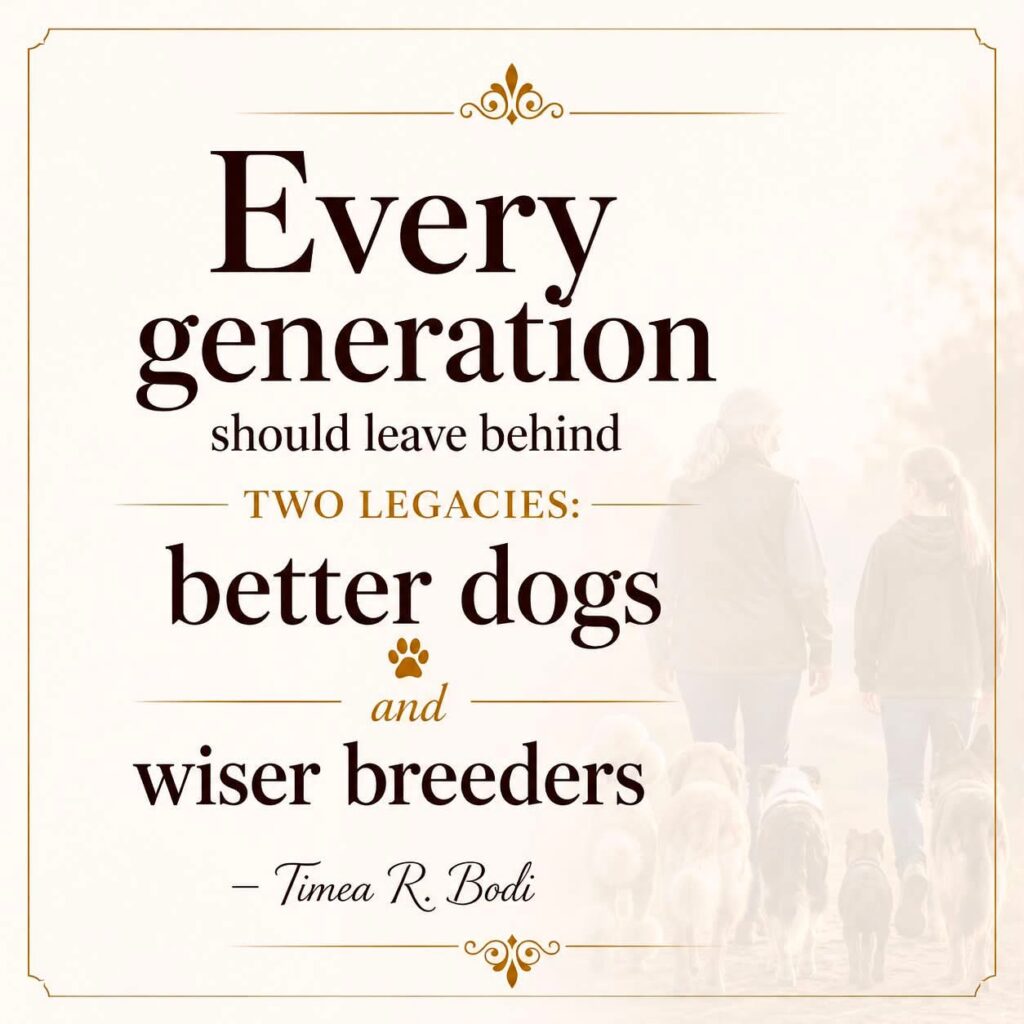
Every generation should leave behind two legacies: better dogs and wiser breeders.
- Build Partnerships Instead of Silos
Shared knowledge → Collaboration → Better decisions → Stronger breeds
Perhaps the greatest lesson I took away from Michael’s article is that no single person, organization, or discipline can restore what has gradually become disconnected.
Every participant sees a different part of the same picture.
A judge evaluates structure and breed type. A breeder studies generations. A veterinarian recognizes patterns of health and disease. A geneticist follows inheritance. Performance enthusiasts understand function. Natural-rearing breeders observe maternal health, nutrition, development, and environmental influence. Families contribute something equally valuable by living with these dogs through every stage of life, often revealing qualities that cannot be measured inside a show ring or a breeding kennel.
Each perspective adds another piece of the puzzle.
None tells the whole story.
Somewhere along the way, many of those conversations drifted apart. Conformation developed its own community. Health research followed another path. Genetics, reproduction, behavior, nutrition, longevity, puppy development, and performance each became separate discussions, even though every one of them influences the same breeding decision.
Reconnecting those conversations may be one of the most important forms of preservation.
When breeders listen to veterinarians, health becomes part of selection. When judges understand long-term outcomes, ribbons gain greater meaning. When geneticists appreciate breed type, diversity and preservation become partners rather than opposing ideas. Families who remain connected throughout a dog’s life provide observations that return valuable information to the breeder. Every exchange strengthens the next decision.
That is how another part of the breeding cycle reconnects.
Knowledge should never stop moving once a puppy leaves home or a championship is earned. Information gathered from every discipline ought to flow back toward the breeder, where it becomes part of the next mating, the next litter, and ultimately the next generation.
No one carries the future of a breed alone.
Stewardship grows stronger every time experience is shared, curiosity replaces certainty, and people with different expertise choose to learn from one another.
Healthy breeds are built exactly the same way.
One thoughtful decision at a time, informed by many voices working toward the same future.
- Where Does Change Begin?
One thoughtful decision → A stronger breeding cycle → A healthier culture → A stronger future
Looking back over everything Michael wrote, I no longer see declining registrations, shrinking entries, rankings, Grand Champion titles, or changing show formats as the central issue. Those developments point toward something much deeper. Over time, the connections that once held the breeding cycle together gradually weakened until many of the people working toward the same goal were no longer working together.
Rebuilding those connections does not depend on waiting for a committee, a parent club, or AKC to redesign the system. Culture has always changed because individuals chose to approach familiar work differently, and enough of those individual choices eventually reshaped the whole.
A breeder can enter the ring looking for information instead of another ribbon. Follow-up can continue long after puppies leave home. Records can guide future matings instead of collecting dust in a file. Experience can be shared with newcomers rather than disappearing into retirement. Honest conversations can replace silent assumptions. Families can become partners in preservation instead of simply customers. None of those decisions requires permission, yet each strengthens another part of the breeding cycle.
That, to me, is where hope lives.
The show ring becomes more valuable when it informs better breeding decisions. Lifetime observation gains meaning when those lessons influence the next generation. Public education matters because informed families support thoughtful breeders. Mentorship protects knowledge that cannot be found in books. Collaboration allows every discipline to contribute something another cannot.
Viewed together, those pieces no longer feel like separate ideas.
They become one system working toward one purpose.
The ribbon was never meant to be the destination.
Neither was a ranking, a title, or another advertisement.
Success is measured by something far more enduring: a breed that remains healthy, functional, recognizable, mentally stable, genetically resilient, and deeply valued by the families who will care for it long after we are gone.
Michael’s article kept me awake because I cannot accept that system decay is inevitable. Living systems drift when connections are neglected. They recover when those connections are restored.
I think preservation has never been about protecting dogs alone. Perhaps it has always been about protecting the entire process that allows good dogs to continue existing. Stewardship is not a single breeding decision. It is the willingness to learn from every generation, pass that knowledge forward, and leave the system stronger than we found it.
These reflections are simply my attempt to begin that conversation.
Now I would love to hear yours.
How do we reconnect the breeding cycle so every decision leaves the next generation stronger than the one before it?


Leave a Reply