

Every generation inherits something it did not create: a language, a piece of music, an old cathedral whose stones have stood quietly for centuries, a family recipe copied by hand through generations, or sometimes an entire breed of dog. None of us begins with a blank page. We inherit the work of people we have never met, whose thousands of careful decisions eventually became something recognizable, predictable, and worth preserving, benefiting from their patience without ever witnessing the sacrifices that made our inheritance possible.
History has never asked only what each generation can create. It has also asked what it will protect.
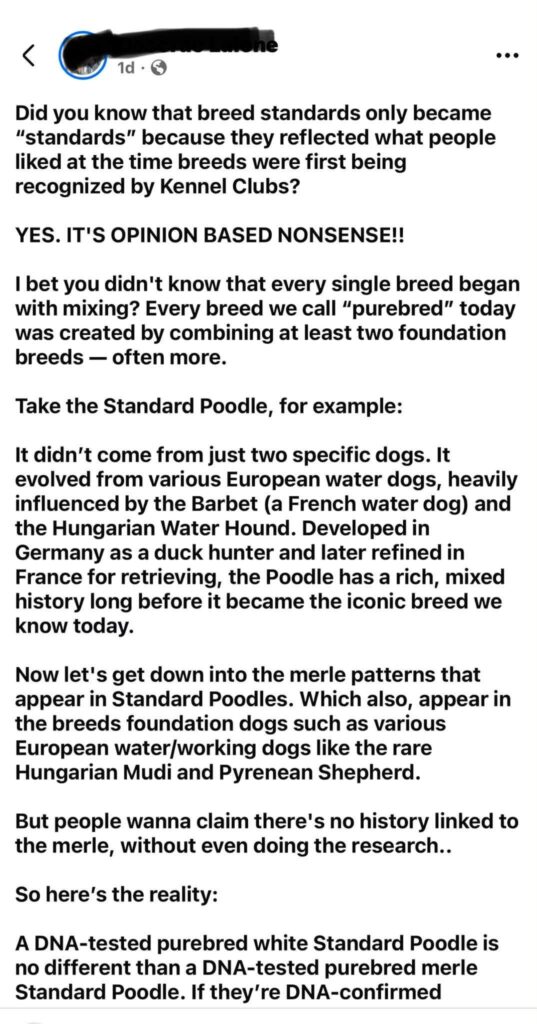
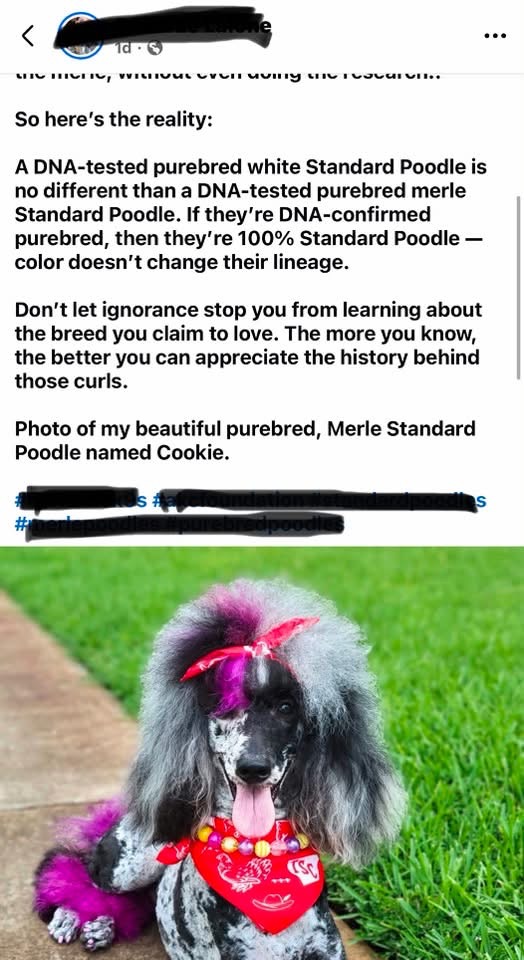
That question returned to me recently when I encountered yet another social media post claiming that merle has always belonged in the Poodle.
Ordinarily, I might have continued scrolling. Social media has never suffered from a shortage of confident opinions presented as settled fact, and this post offered no forgotten breeding records, newly discovered historical documents, museum paintings, early pedigrees, kennel archives, or genetic evidence demonstrating that merle existed within the historic Poodle population.
What it offered instead was something far more persuasive: a story assembled from statements familiar enough to sound conclusive. Breed standards were written by people. Modern breeds developed from older canine populations. European water dogs share ancient ancestry. Some European breeds carry the merle mutation. Modern DNA tests may identify merle dogs as overwhelmingly Poodle.
Each statement contains some element of truth. Arranged in exactly the right order, however, they gently lead the reader toward a conclusion that none of them establishes: therefore, merle has always belonged in the Poodle.
It is an elegant piece of historical choreography. Unfortunately, moving the facts into an attractive formation does not make them prove something they never demonstrated individually.
This does not mean merle dogs are unworthy, nor does it require assuming that everyone repeating the argument is deliberately dishonest. It means only that history cannot be established by collecting interesting facts until they point toward a conclusion we already prefer.
One of the oldest forms of persuasion is not an outright lie, but the careful arrangement of true statements until an unsupported conclusion begins to feel inevitable. Human beings are naturally drawn to coherent narratives, instinctively filling the gaps between related ideas, and once we become emotionally invested in an explanation, our minds readily reinterpret earlier information as though it had always supported the ending.
None of us is immune, which is precisely why serious disciplines insist upon evidence rather than confidence. A convincing story may suggest a possibility. It cannot document an event.
The standard remains very simple: show the evidence.
Credible evidence might include securely dated pedigrees, breeding records, early written descriptions, authenticated photographs or paintings, preserved specimens, population-level genetic research, or documented lines tracing the mutation within Poodles before the suspected modern outcrosses. Repeating that related European breeds carry merle is not equivalent to demonstrating that Poodles did.
That principle will guide this discussion. Agreement has never been the standard for truth; evidence has.
Before considering merle, DNA testing, or written standards, we first need to understand how breeds came into existence, because preservation debates frequently begin halfway through the story and then wonder why history appears so accommodating.
𝑾𝒉𝒆𝒓𝒆 𝒕𝒉𝒆 𝑺𝒕𝒐𝒓𝒚 𝑹𝒆𝒂𝒍𝒍𝒚 𝑩𝒆𝒈𝒊𝒏𝒔
One of the post’s central claims is also one of the most common in the preservation debate:
“Every breed began with mixing.”
The sentence sounds devastating because it compresses several thousand years of canine development into five convenient words. Compress history far enough, and almost anything becomes easier to defend.
The problem is not that the statement contains no truth, but that it removes the distinctions necessary to understand what actually happened. To recover them, we must return to a time before kennel clubs, pedigrees, written standards, or the modern breeds we now recognize by name.
None of those breeds yet existed as formally defined populations. There were dogs shaped by work, geography, climate, and human necessity. Some hunted, guarded livestock, drove cattle, followed fishermen into icy rivers and marshes, or worked among mountains, forests, villages, and coastlines.
A traveler moving through Europe a thousand years ago would not have encountered anyone introducing an AKC Champion Poodle. He would have met hunters who valued dogs capable of retrieving birds, shepherds who depended upon animals that could gather livestock, and fishermen whose working dogs entered cold marshes without hesitation. These dogs existed because they performed necessary work.
Appearance mattered insofar as it supported function. Dense, water-resistant coats protected dogs in dangerous temperatures, powerful hindquarters improved swimming ability, and intelligence combined with cooperation made a retriever useful to the people relying upon it.
Across generations, people practiced what we now call selective breeding, keeping dogs that worked successfully and removing those that did not. They knew nothing of genes, inheritance coefficients, or molecular testing, but they understood the practical lesson familiar to every farmer: capable parents were more likely to produce capable offspring.
Over centuries, those repeated decisions gradually produced local populations that became increasingly predictable.
Historians and biologists often describe such locally adapted populations as landraces: groups shaped over long periods by geography, climate, function, environment, and repeated selection rather than by registries or committees. They were not modern breeds, but neither were they random collections of interchangeable dogs. Nature and human choice worked together until recognizable regional populations gradually emerged.
That distinction matters because the phrase “every breed began with mixing” creates the modern impression that people selected two clearly defined breeds, crossed them together, and announced the arrival of a third. History was rarely so tidy. The ancestors of modern breeds were often broad regional populations that overlapped, separated, exchanged genes, and gradually diverged as different communities continued selecting for different work.
Calling that entire process “mixing” is rather like describing the development of European civilization as “people moving around.” Technically difficult to dispute, historically insufficient, and wonderfully convenient when details become troublesome.
Language offers a useful comparison. Latin eventually developed into Italian, French, Spanish, Portuguese, Romanian, and other languages that share ancient ancestry without becoming interchangeable. No historian would argue that because Spanish and Romanian descend from related roots, every modern Spanish word must therefore have belonged in Romanian all along.
Shared ancestry explains relationship. It does not erase separate development.
Ancient European water-dog populations undoubtedly shared ancestry, exchanged genes at various points, disappeared in some regions, and became increasingly distinct in others. Once particular populations became recognizable and predictable, however, something profound changed.
People gradually stopped asking how to create that kind of dog and began asking how to prevent it from disappearing.
𝑻𝒉𝒂𝒕 𝒊𝒔 𝒘𝒉𝒆𝒓𝒆 𝒑𝒓𝒆𝒔𝒆𝒓𝒗𝒂𝒕𝒊𝒐𝒏 𝒃𝒆𝒈𝒊𝒏𝒔.
Preservation did not emerge because breeders suddenly became hostile to change. It began because generations of selection had finally produced something sufficiently distinct to protect.
A person who spent three centuries developing a grape capable of producing exceptional wine would not continue crossing it indiscriminately with every available variety merely because all grapes share ancestry. The purpose has changed. Creation expands variation; preservation protects identity. Confusing those stages is one of the central errors in modern discussions about purebred dogs.
Using the formative centuries of a breed to justify introducing new genetics into an established population is rather like arguing that because a cathedral was once under construction, replacing its original stained-glass windows with modern tinted panels must qualify as preservation.
It may qualify as change. Whether someone enjoys the result is a separate question. Preservation and modification are not interchangeable simply because both involve human decisions.
𝑾𝒉𝒂𝒕 𝑲𝒆𝒏𝒏𝒆𝒍 𝑪𝒍𝒖𝒃𝒔 𝑨𝒄𝒕𝒖𝒂𝒍𝒍𝒚 𝑫𝒊𝒅
The distinction becomes clearer once we understand what kennel clubs actually did. They did not invent most of the breeds they later recognized. By the time organizations such as The Kennel Club in England or the American Kennel Club began registering many breeds, recognizable populations and breeding traditions already existed, although formal registration, written standards, and closed studbooks would later make their boundaries more explicit and sometimes influence their continued development.
Registration did not summon the Poodle into existence, nor did a committee meeting create the Labrador Retriever. Kennel clubs did not create those dogs from nothing. They inherited recognizable populations, formalized their descriptions, recorded ancestry, and established clearer boundaries around their continued development.
Pedigrees became important because they preserved the written memory of those populations. A pedigree cannot create quality, but it records where a dog came from, connects present animals to earlier breeding decisions, reveals recurring strengths or failures, and prevents every generation from beginning almost entirely from scratch.
Without records, mistakes become invisible and stewardship becomes guesswork.
𝑾𝒉𝒂𝒕 𝑩𝒓𝒆𝒆𝒅 𝑺𝒕𝒂𝒏𝒅𝒂𝒓𝒅𝒔 𝑾𝒆𝒓𝒆 𝑴𝒆𝒂𝒏𝒕 𝒕𝒐 𝑷𝒓𝒆𝒔𝒆𝒓𝒗𝒆
This brings us to the post’s next claim: breed standards are merely opinions. The idea has become popular largely because once standards are dismissed as arbitrary preference, any excluded characteristic can be recast as the unfortunate victim of outdated taste.
Yet a breed standard was not intended to tell breeders what to invent. It was written to describe what they had inherited.
The post argues that breed standards became standards merely because they reflected what people liked when breeds were first recognized by kennel clubs.
Of course people wrote breed standards. Dogs have historically shown very little interest in drafting official documents.
Yet the fact that human beings wrote a standard does not establish that its contents were arbitrary. Constitutions, medical references, engineering specifications, and musical scores were also written by people. Authorship alone tells us nothing about whether a document records personal whim, accumulated knowledge, or an existing reality.
The important question is not who held the pen, but what they were attempting to preserve.
Imagine archaeologists uncovering the ruins of a Roman villa. They measure its walls, document its mosaics, record the placement of its columns, and describe the materials from which it was built. They have not created the villa. They have documented what already existed so that others may understand and preserve it.
Breed standards serve a similar purpose. They attempt to describe an existing population accurately enough that future generations can continue recognizing it.
That is why serious standards describe far more than color or grooming. They address proportion, structure, movement, temperament, dentition, feet, shoulders, topline, chest, tail carriage, coat texture, expression, balance, and purpose, because each feature forms part of the recognizable whole.
The Poodle illustrates this clearly. Its dense, curly coat developed in association with water work rather than because someone found curls fashionable. Its balanced, approximately square outline supports athletic efficiency, correct angulation contributes to economical movement, and the breed’s intelligence and trainability made it extraordinarily versatile as a retriever. Even the clips now associated with exhibition grew from practical working adaptations before becoming increasingly decorative.
Once that history is understood, the standard looks less like an aesthetic shopping list and more like a record of function preserved through generations.
None of this means every interpretation of every standard is perfect. Judges reward exaggeration, breeders chase fashion, language is revised, and knowledge develops. Human failure, however, does not make the underlying concept meaningless. A map may contain an error without proving that maps have no purpose.
Many exaggerations criticized today did not arise because breeders followed standards too faithfully, but because competitive culture rewarded increasingly extreme interpretations of them. The document may say “moderate” while the ring rewards “more,” and after enough generations moderation quietly disappears.
That is not evidence that the standard was arbitrary. It is evidence that human incentives are powerful.
Curiously, breed standards are rarely dismissed as meaningless when they describe traits someone already wishes to preserve. They become “mere opinion” with remarkable punctuality when they obstruct the trait someone wishes to introduce.
Preservation breeding is not the preservation of random preferences but of populations shaped by real demands. Shepherds valued endurance because exhausted dogs lost sheep. Hunters valued retrieving ability because unrecovered game represented wasted food. Fishermen valued protective coats because freezing water killed working dogs. Sound structure mattered because an animal unable to perform efficiently across a lifetime could not fulfill its purpose.
These preferences were not arbitrary. Reality imposed them.
Function came first, followed by consistent selection, recognizable populations, written descriptions, and only much later the influence of competitive exhibition upon aesthetic interpretation.
Compressing those stages into a single sentence makes history appear much simpler than it was, which is extremely useful when one hopes to make a modern conclusion look ancient.
𝑪𝒓𝒆𝒂𝒕𝒊𝒐𝒏 𝒂𝒏𝒅 𝑷𝒓𝒆𝒔𝒆𝒓𝒗𝒂𝒕𝒊𝒐𝒏 𝑨𝒓𝒆 𝑵𝒐𝒕 𝒕𝒉𝒆 𝑺𝒂𝒎𝒆 𝑨𝒄𝒕𝒊𝒗𝒊𝒕𝒚
Once standards are reduced to opinion and breed formation is reduced to crossing, the introduction of almost any modern trait can be presented as history merely continuing its natural course. It is an elegant argument, provided one overlooks the moment when a developing population became an established breed and creation gave way to preservation.
History explains where a breed came from; preservation influences where it goes next. These are not competing ideas but consecutive chapters, and blurring them allows ancient gene flow among developing populations to be used as justification for introducing modern traits into an already established breed.
That logic sounds reasonable only until we remember that breed recognition marked the point at which a population had become sufficiently predictable to preserve.
Studbooks eventually closed not because breeders suddenly became elitists or opposed improvement, but because endless outside introduction would gradually dissolve the very population being recognized. A boundary cannot preserve identity while remaining meaningless whenever someone prefers what lies beyond it.
A restored cathedral does not retain its historical identity merely because someone installing aluminum windows announces that buildings have always changed.
Conservation biology follows the same logic. No wildlife biologist argues that because wolves and coyotes share ancient ancestry, preserving wolves requires continual coyote introduction. No museum conservator restores a Rembrandt by painting over portions of the canvas while explaining that artists have always experimented.
Controlled outcrossing may sometimes be undertaken transparently for a documented population-level need, followed by careful evaluation and recordkeeping, but that is entirely different from introducing a commercially desirable novelty and then retroactively declaring it historical.
Preservation does not prohibit every change. It requires distinguishing changes that protect identity from those that replace it.
History and breed development explain why preservation matters. Modern DNA testing answers a different question altogether, and confusing those two questions has become one of the most common sources of misunderstanding in discussions about merle.
𝑾𝒉𝒂𝒕 𝒂 𝑫𝑵𝑨 𝑷𝒆𝒓𝒄𝒆𝒏𝒕𝒂𝒈𝒆 𝑪𝒂𝒏 𝒂𝒏𝒅 𝑪𝒂𝒏𝒏𝒐𝒕 𝑷𝒓𝒐𝒗𝒆
The appeal to modern DNA ancestry testing deserves separate attention because a result identifying a merle dog as overwhelmingly Poodle can appear, at first glance, to settle the question. It does not.
An ancestry estimate compares a dog’s genome with present-day reference populations and reports which population the dog most closely resembles overall. It does not travel backward through pedigrees, identify the precise generation in which every mutation entered, or establish that each individual variant originated within the historic population named on the report.
After repeated breeding back to Poodles, the overwhelming majority of an outcrossed dog’s genome can become Poodle while a deliberately retained mutation remains. The arithmetic is not mysterious, although it is occasionally treated as if percentages possess historical memory. With every generation of backcrossing, the proportion inherited from the original outside ancestor becomes smaller, while the selected trait can continue passing from parent to offspring.
A dog may therefore be genetically Poodle in nearly every measurable respect and still carry a mutation introduced through an outcross many generations earlier. The test answers a present-day ancestry question: what population does this dog most closely resemble now? It does not automatically answer the historical question at issue here: was the merle mutation part of the established Poodle population before modern introduction?
Those are different questions, and a percentage cannot be used as a time machine simply because the result is convenient.
𝑻𝒉𝒆 𝑸𝒖𝒆𝒔𝒕𝒊𝒐𝒏 𝑴𝒆𝒓𝒍𝒆 𝑪𝒂𝒏𝒏𝒐𝒕 𝑨𝒗𝒐𝒊𝒅
Preservation does not prohibit every change. It requires distinguishing changes that protect identity from those that replace it.
Controlled outcrossing may occasionally be undertaken transparently to address a documented population-level need, followed by careful evaluation, long-term recordkeeping, and open acknowledgment of what was done. That is fundamentally different from introducing a commercially desirable novelty and then retroactively declaring it part of the breed’s ancient history.
This discussion has never truly been about merle alone. Merle is simply the current example. Tomorrow the same reasoning may be used to defend another fashionable color, exaggerated structure, altered coat, or profitable novelty.
The enduring question is not whether a particular trait attracts buyers or whether someone personally enjoys it. The question is what we are trying to preserve.
If preservation means maintaining the historic genetic identity of the Poodle, then any newly introduced characteristic carries the burden of demonstrating that it belonged within that historic population. That burden does not arise from personal dislike or fear of change. It arises because historical claims require historical evidence.
That is ultimately where the argument fails, not because every statement is false, but because the conclusion rests entirely upon the space between them.
Breed standards were written by people, ancient canine populations shared ancestry, some European breeds carry merle, and modern ancestry tests may identify a merle dog as overwhelmingly Poodle. Every statement may be accurate, yet together they still fail to demonstrate that the merle mutation belonged to the historic Poodle population before modern outcrossing.
𝑻𝒉𝒆 𝒓𝒆𝒒𝒖𝒊𝒓𝒆𝒅 𝒆𝒗𝒊𝒅𝒆𝒏𝒄𝒆 𝒏𝒆𝒗𝒆𝒓 𝒂𝒑𝒑𝒆𝒂𝒓𝒔.
Readers are instead asked to exchange documentation for association, probability for possibility, and history for a story persuasive enough to make the missing proof feel unnecessary.
Once conclusions are accepted without evidence, preservation becomes impossible because every future novelty can be defended through another appealing narrative. The question quietly changes from “What did history preserve?” to “What story can justify what we want today?”
One approach begins with evidence and allows the conclusion to follow. The other begins with the desired conclusion and searches backward for agreeable fragments of history.
Only the first deserves to be called preservation.
The second is revision wearing a vintage costume.
The Legacy We Leave
None of us truly owns this breed.
We are merely its temporary custodians.
We inherited it from people who devoted their lives to preserving its soundness, temperament, structure, and identity, and one day someone else will stand where we stand now, holding the lead of a dog descended from decisions we are making today.
That future dog will quietly carry every choice we made, whether it reflected patience or impatience, discipline or convenience, courage or compromise, stewardship or fashion, because breeding is one of the few places in life where tomorrow is already taking shape inside the decisions we make today.
That is the legacy every breeder leaves behind.


Leave a Reply