

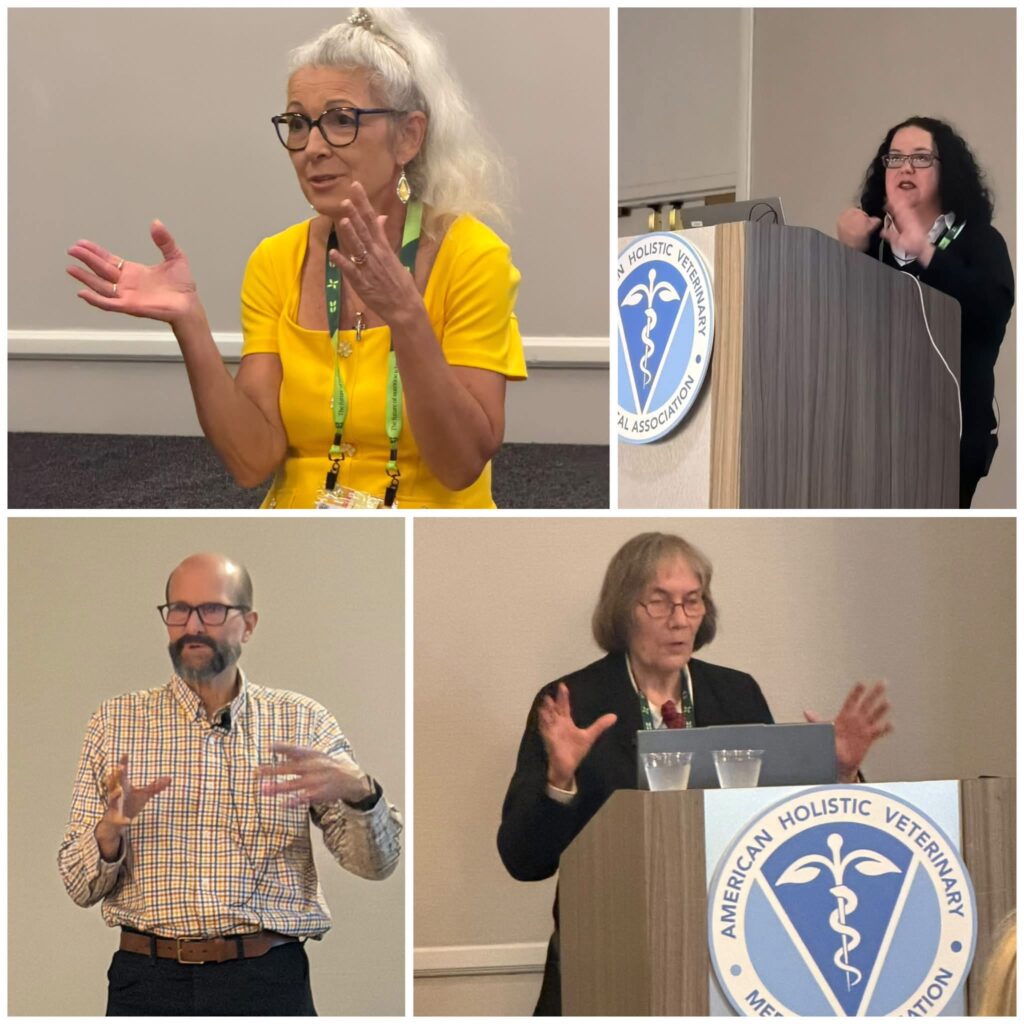
🐾 I PROMISED TO KEEP MY PEEPS UPDATED, SO HERE I AM, ONE DAY INTO AHVMA AND ALREADY WISHING I HAD PACKED A SECOND BRAIN.
My dogs probably think I have gone to California to find more food, and considering what happened when I entered the vendor hall, I cannot entirely fault their reasoning. I came here with a notebook and good intentions, but after a full day of lectures, I am beginning to suspect that the notebook needs its own continuing education certificate and “I’m only looking” should be classified as something I say immediately before making a purchase.
I am still here in San Diego, this was only DAY ONE, and tomorrow brings another full day, so settle in, because I promised to share what I am learning and today gave me far more than a few pretty conference photographs.
My day took me from Dr. Judy Morgan to Jim Skoien, back to Morgan, then to Dr. Nancy Scanlan, and finally through two sessions with Rita Hogan. We moved through indoor air quality, pain, commercial influence, cellular communication, plant preparations, and the endocrine changes following sterilization, and somewhere along that route I found myself thinking about how easily we make decisions about one part of an animal while overlooking the life happening around it.
As a veterinary technician, canine and feline nutritionist, and Natural Preservation Breeder, I carry these conversations straight into the lives of my dogs. I think about puppies growing into their bodies, adults whose health I want to preserve, and older dogs whose comfort depends on someone noticing a small change before it becomes a large problem. A lecture feels different when you can picture the animal waiting at home who may eventually depend on what you understood in that room.
🏠 DR. JUDY MORGAN: THE HOUSE BELONGS IN THE HEALTH HISTORY
Morgan opened with indoor air quality, which sounds fairly uneventful until you begin mentally walking through your own house with your dog’s nose a few inches above the floor. She brings decades of veterinary clinical experience, along with training in acupuncture, chiropractic care, and food therapy, and she made a subject we encounter every day feel suddenly impossible to overlook.
We will spend an evening investigating every ingredient in a food, then plug a fragrance dispenser into the wall beside the dog’s bed, spray the carpet where he sleeps, and wash the floor with something he will walk through before licking his paws. Everything smells lovely, the room looks immaculate, and the animal has been living in an environment we barely considered while congratulating ourselves on the cleaning.
That was the first uncomfortable little lightbulb of the day.
Morgan discussed volatile organic compounds, household fragrances, cleaning products, carpet treatments, paints, furnishings, smoke, mold, and renovation exposures, with slides showing environmental chemicals detected in dogs and cats. What stayed with me was the animal’s physical relationship with those exposures, because a dog lives close to surfaces where dust settles and a cat spends considerable time grooming whatever lands on its coat.
Our animals experience the house from a position we rarely occupy, unless we have dropped an earring or are crawling under the sofa to retrieve something they have stolen.
The dog cannot relocate the plug-in beside his bed, and the cat cannot explain that the carpet now smells like a perfume counter having a nervous breakdown. They live with what we choose, and a product becoming familiar to us does not tell us how it fits into their daily environment.
Morgan also discussed essential oils, bringing attention to the active substances in plant-derived products and the differences between species. Birds received particular attention, including fumes associated with overheated nonstick cookware, while cooking emissions, gas appliances, fireplaces, cigarette smoke, moisture, and hidden mold all became part of the conversation.
Then came renovations, and I began thinking about the owner who says, “Nothing has changed,” while standing on a new floor beneath freshly painted walls. Paint, adhesives, dust, and disturbed materials may have changed the animal’s surroundings considerably, even though the food bowl is still in the same place and the bag of food has the same label.
When a dog develops a problem, the timeline deserves a closer look. A new cleaning product, construction project, carpet treatment, or damp area in the house may be worth mentioning alongside a food change or a new medication, because those details belong to the animal’s life too.
Morgan discussed supportive approaches she considers in practice, but the point I kept returning to was wonderfully practical: examine what the animal is encountering before assuming the next answer must be something else to add. That leaves an owner with real observations to make, and it made me want to walk through my own home with much fresher eyes.
📍 JIM SKOIEN: THE DOG WE CALL STUBBORN MAY BE TRYING TO AVOID PAIN
Jim Skoien’s session required a different kind of concentration, because he took us into the way he organizes pain treatment within traditional Chinese medicine, drawing on decades of acupuncture practice, training in China, and experience teaching veterinary acupuncture internationally.
His material included Qi stagnation, blood stasis, Bi patterns, deficiencies, and attention to the Shen, and I will be honest: this is the sort of lecture where my brain has to sit up straight and participate. Familiarity with a few words does not mean I have absorbed the clinical reasoning, and some of these notes will be getting a second and third visit.
What caught my attention was how much detail he brought to the description of pain. His teaching examples included an acutely painful neck, chronic knee pain, and pain involving the lower back, hips, buttocks, and lower extremities with muscle spasms, with the approach changing according to the presentation and the tissues involved.
He discussed local and distant acupuncture points, channel relationships, muscle motor points, and electroacupuncture, then followed the lower-back and hip example into the gluteal muscles, hamstrings, and soleus, along with remedial exercises such as isometric holds. His herbal material added formulas chosen within that framework for different patterns of discomfort, weakness, and spasms, showing how much reasoning sits behind a treatment choice.
For me, the most immediate connection was to the dogs whose pain arrives in the conversation wearing a behavioral label.
An older dog hesitates at the stairs, becomes less patient when another dog bumps into him, resists grooming in a particular area, or begins hanging back on a walk, and somebody decides he is becoming difficult. We know his personality so well that we can accidentally use it to explain away a change, especially when the change happens gradually enough to become part of the routine.
That is a thought I want owners to carry away from this section: when a familiar dog begins behaving differently, look carefully at what has become harder for him to do. A movement he once made effortlessly may now cost him something, and his attempt to avoid it can look like reluctance long before we recognize discomfort.
Skoien’s attention to the Shen also brought emotional well-being into the discussion, which matters because comfort affects how an animal moves through its whole day. The dog who feels vulnerable when touched or jostled may experience the household very differently from the dog who can get up, stretch, and join the activity without hesitation.
🔥 BACK TO DR. JUDY MORGAN: THE RECOMMENDATION HAS A HISTORY TOO
When I returned to Morgan, she moved from what surrounds our dogs at home to the commercial relationships surrounding veterinary care, and this was the session that made me think somebody should have checked whether the room had a fire extinguisher.
She challenged the influence of pharmaceutical companies, pet food manufacturers, and corporate ownership, asking us to consider the money behind education, research, professional relationships, and product recommendations. Her delivery had the force of someone willing to say the uncomfortable part out loud and remain standing there while people reacted.
One of her stories involved a two-doctor practice where, according to her account, Hill’s diets were sold in extraordinary volume, with her boss receiving company-paid travel, including trips to Australia, associated with those sales. I kept picturing the owner leaving the clinic with a bag of food, believing they understood the entire recommendation, while knowing very little about any relationship surrounding it.
That information matters to the person paying for the food and feeding it every day. An owner should be able to ask about the reasoning behind a recommendation and understand any relevant commercial context without feeling as though they have committed a social offense.
Morgan discussed the history of Hill’s Prescription Diet, including Dr. Mark Morris Sr.’s kidney diet for a guide dog, and then challenged what the word “prescription” communicates when a food contains no medication. She wanted attention paid to the studies supporting the particular diet, the explanation given to the owner, and the reasoning that makes it appropriate for that individual patient.
She described raising questions in a meeting where consumer advocates, in her account, were heavily outnumbered by corporate and regulatory representatives, and said people behind her laughed. That detail stayed with me, because asking for an explanation of something you are expected to purchase and feed to an animal for months or years should be a perfectly ordinary part of healthcare.
Her discussion of nutrition education felt especially relevant to my work. She shared an encounter with a veterinarian educated abroad who described learning to formulate diets for multiple species, and used that account to question how education prepares a practitioner to understand a diet, build one, and evaluate it beyond selecting a familiar commercial product.
When you spend time studying nutrition and preparing food, you know how much thought goes into those decisions. Hearing that subject discussed so directly made me want owners to feel more comfortable asking what the person recommending a diet can explain about it, particularly when the recommendation comes with the expectation that every other option should disappear from the conversation.
Morgan then turned to diet-associated dilated cardiomyopathy, strongly criticizing the emphasis on boutique, exotic-ingredient, and grain-free diets. She questioned case selection, breed predispositions, how reported numbers were presented, and the fear created among owners who began returning foods or changing diets because they believed they might be harming their dogs.
She also alleged that the controversy damaged Champion Petfoods, the company behind Orijen and Acana, before its acquisition by Mars, and questioned who benefited commercially. These were her arguments about the events, and they formed part of her broader challenge to examine the way information reaches owners and influences what happens next.
That conversation has emotional weight because owners are trying to protect someone they love. Tell a person that the food they carefully chose may hurt their dog, and you have reached straight into their fear, guilt, and sense of responsibility; the way that concern is communicated can reshape feeding decisions almost overnight.
Morgan applied her criticism across the market, including fresh food. She discussed The Farmer’s Dog’s investment in veterinary research and training, welcomed the growing professional conversation around fresh food, and still said she does not personally recommend that brand because of concerns she expressed about its formulation, including carbohydrates and added vitamins and minerals.
Her account of young veterinarians waiting in long conference lines for giveaways provided some humor, although apparently a fanny pack possesses enough gravitational force to alter an afternoon’s schedule. The larger point was that companies understand the value of access, familiarity, and professional relationships, and they invest in becoming part of the veterinarian’s everyday world.
Then the session became more personal as she described the hostility she says she experienced after publicly discussing reports of animals becoming ill or dying while eating Purina products in 2024. Her account included attacks on her professional standing, statements that she should lose her license, a former classmate telling her she should no longer call herself a veterinarian, and being spat at.
Hearing that was unsettling. An owner watching a professional face that kind of hostility may learn to keep quiet about their own concern, and that is a terrible place for a health conversation to end up, because observations about a sick animal need somewhere to go where they can receive serious attention.
Morgan also discussed speaking fees, travel, consulting arrangements, samples, research funding, and publication practices, arguing that commercial interests influence which questions are studied and which messages receive the greatest attention. Her presentation extended into allegations about the suppression of inexpensive repurposed treatments, including fenbendazole and ivermectin, within that broader criticism of commercial influence.
What I want to carry into my own conversations is the practical demand underneath all of this: explain the recommendation thoroughly enough that the owner can participate. Discuss the intended benefit, possible adverse effects, available alternatives, and what to watch for if the animal does poorly, because the owner becomes the person observing that dog between appointments.
By the time Morgan finished, I had enough notes for several posts and a renewed appreciation for a clear answer to a reasonable question. Someone asking how a treatment works or why a food is appropriate has accepted responsibility for their animal and is trying to understand how to fulfill it.
⚡ DR. NANCY SCANLAN: TAKING THE CONVERSATION INSIDE THE BODY
Dr. Nancy Scanlan’s session shifted the day into bioelectric cellular communication, bringing the focus from the systems surrounding veterinary care to communication within the living body itself. With her decades of veterinary and integrative-medicine experience, she introduced a subject I want to give its own space when I share more of the session.
At that point in the day, I was thinking about how much depends on communication, from understanding what an animal is showing us to understanding what happens within its body. Scanlan’s session opened another area I want to explore with you, and I will return to it in a dedicated post rather than rush through explanations that need room.
🌱 RITA HOGAN: THERE IS MORE TO THE PLANT THAN THE FAMILIAR NAME
Then came Rita Hogan, clinical canine herbalist, author of The Herbal Dog, and founder of the Ethos School of Holistic Canine Herbalism, and my notebook was informed that its working day had been extended.
Her first session explored phytoembryonic therapy, involving preparations made from developing plant tissues such as buds and young shoots, with material also covering male catkins. She discussed plant signaling compounds, antioxidants, enzymes, amino acids, vitamins, minerals, and other constituents, along with the uses she proposes for particular preparations.
One detail I want to preserve when I share this material is the preparation itself, because a familiar plant name can create a false sense that we already know what was being discussed. The young shoots of a plant, its buds, a leaf tea, and an ordinary extract are different preparations, and Hogan was speaking about specific tissues and products, including diluted D1 preparations, within her practice.
Her environmental material connected back to Morgan’s morning discussion, with a proposed sequence of assessing exposure, opening drainage pathways, mobilizing stored substances, and supporting elimination. Her slides included European alder, silver birch, beech, bilberry, black poplar, echinacea, grapevine, oriental plane tree, Virginia creeper, mountain pine, and white willow, each associated in her presentation with particular tissues and supportive goals.
She presented European alder early in her approach to lymphatic and extracellular-matrix drainage, silver birch in relation to liver and kidney support, and bilberry in relation to microcirculation and antioxidant support. Beech appeared in her discussion of lymphatic movement and microbial byproducts, while other preparations were discussed in relation to connective tissues, inflammation, and elimination pathways.
What interested me was how much attention she placed on sequence and the condition of the animal, because her approach involved thinking about the dog’s capacity to handle what she was trying to address. There is considerably more to share from that session, including the individual preparations and the reasoning she gave for choosing them, and I will come back to those details separately.
🐾 RITA HOGAN’S SECOND SESSION: THE INCISION HEALS, AND THE HORMONAL STORY CONTINUES
Her next session reached directly into my thinking as a Natural Preservation Breeder, because it examined the endocrine changes following removal of the ovaries or testes and asked what support she considers for dogs who are already spayed or neutered.
Hogan spoke with enormous feeling about how closely we monitor the incision after surgery while giving much less attention to the longer hormonal story. We watch the stitches, prevent licking, and check healing, while she wanted a conversation that follows the animal beyond those first days of recovery.
She shared her own experience with hormonal changes and the improvement she said she experienced using an approach she practices, which made the personal connection behind her concern unmistakable. This was a subject she cared about deeply, and it showed in the way she spoke about animals living with changes they cannot describe to us.
Her reproductive-loop slide illustrated communication from the hypothalamus through gonadotropin-releasing hormone to the pituitary, then through luteinizing hormone and follicle-stimulating hormone to the ovaries or testes, with sex hormones contributing feedback. She stated that LH levels following spay or neuter are often 20 to 30 times those seen in intact dogs.
Then she showed a slide listing LH receptors across reproductive and nonreproductive tissues, including the brain, thyroid, adrenal glands, liver, pancreas, kidneys, immune tissues, skin, urinary tract, bones, joints, and ligaments. She used that material to explain why she considers the endocrine consequences through the whole animal.
As she spoke, I kept thinking about how differently we discuss these decisions when we include the years ahead. A young dog still has to grow, mature, develop strength, navigate stress, and eventually age, and the body carrying him through all of that deserves a place in the discussion.
Hogan’s slides raised concerns involving growth plates, joints, ligaments, urinary continence, skin and coat, metabolism, stress tolerance, behavior, and cognitive aging as part of her discussion of hormonal loss and its possible consequences. Her urinary material focused on leakage, particularly during rest or sleep, and the roles she described for hormonal support in urethral tone, pelvic tissues, and urinary mucosal health.
She also discussed anxiety, fearfulness, hypervigilance, noise sensitivity, reduced stress tolerance, emotional withdrawal, and changes in energy and stamina. Listening, I thought about how easily an animal’s history becomes scattered across separate conversations, with behavior discussed at one appointment, weight at another, and leakage somewhere else.
Putting the timeline back together can give the veterinarian and owner a fuller account of what changed and when. A dog’s surgical and hormonal history belongs alongside its development, diet, environment, and symptoms when we are trying to understand the animal now in front of us.
Hogan expressed strong support for hormone-sparing procedures, including vasectomy and ovary-sparing spay, while also addressing support she considers for animals who have already undergone conventional sterilization. I appreciated that she returned to those dogs, because owners need a useful conversation about the animal they have today.
Her comparison of female preparations showed how she distinguishes different presentations. She discussed chaste tree particularly in relation to pituitary and neuroendocrine patterns when anxiety, hypervigilance, restlessness, and emotional sensitivity dominate, while cowberry appeared more in relation to older females with tissue dryness, joint changes, and urinary weakness.
Wayfaring tree was presented in relation to smooth muscle, pelvic tissues, bladder weakness, gastrointestinal dysregulation, and autonomic tension, with raspberry discussed as a restorative preparation for pelvic and connective tissues, skin and coat changes, and recovery in the altered hormonal environment. Her choices followed the pattern she sees in the individual dog.
For males, she discussed giant sequoia in relation to thyroid and adrenal communication, musculoskeletal weakness, reduced endurance, and recovery; oak appeared in her approach to chronic stress and reduced stamina, while white birch male catkins were presented in relation to vitality, muscle loss, urinary weakness, and stress adaptation.
She also included considerations affecting those choices, with her oak slide advising avoidance in dogs with a history of copper storage disease and avoidance of long-term use in dogs showing signs of hypertension. Her glandular material covered ovarian, uterine, and fallopian-tube preparations for females, and testicular and prostate preparations for males, with clinical examples combining selected glandular and plant preparations.
Those examples included a loading period followed by maintenance and adjustment according to response, which brought the discussion back to observation. The dog’s condition and reaction remained part of her decision-making, and the care underneath her presentation was clear: she wanted changes in an animal’s body and behavior to receive thoughtful attention.
By the end of the day, I had followed these conversations from the floor beneath a dog’s paws to the relationships surrounding its care and the communication within its body. The subjects were different, but each one made me look more closely at something that can become ordinary enough to escape our attention.
That is what makes a day like this valuable to me. I leave a session with questions I can bring into my work, details I want to study again, and observations I want to make more carefully, all connected to animals whose lives depend on the decisions made for them.
Of course, there is also the vendor bag, because my enthusiasm apparently travels with purchasing power. Taheebo caught my attention, along with a product presented to me as a tumor inhibitor, and I will share the actual products and the conversations behind them separately so there is room to explain what I was told and why I wanted to learn more.
Tonight I am still here, thinking about my dogs at home and everything this first day has given me to unpack. I promised to keep you updated, and there will be individual speaker posts, a closer look at the products, and more from tomorrow’s full day, because these conversations deserve more than disappearing beneath a photograph caption.
I will be back in those rooms with my notebook, my questions, and whatever portion of my brain agrees to report for duty, so stay tuned and keep your own dogs in mind as you follow along. They are the reason I came, the reason these details matter, and the reason I want to bring something useful out of every session.
If tomorrow requires an external hard drive, I can manage that, but somebody may need to supervise my shopping. ❤️🐾❤️


Leave a Reply