

By Timea R. Bodi – Canine Nutritionist, PMR Advocate, Natural Rearing Breeder
Minerals are the silent architects of health—and in today’s world of repetitive meals, overprocessed food, and overmedicated dogs, even raw-fed canines are quietly slipping into deficiency. We see it in subtle but chronic signs: flaky skin, nervous reactivity, poor healing, and immune weakness. But it’s not just malnutrition—it’s miscommunication at the cellular level. Because minerals don’t just build bones and carry oxygen—they coordinate everything.
The solution doesn’t start with synthetic pills. It begins by returning to the blueprint: a properly executed Prey Model Raw (PMR) diet. With variety. With intention. With organs, glands, and blood.
This article breaks down the most common mineral deficiencies in dogs, how to recognize them, and how to correct them naturally—using the body’s native language: raw food.
🩸 Iron Deficiency in Dogs
Function: Carries oxygen in red blood cells (hemoglobin); essential for stamina, healing, and energy.
Signs of Deficiency: Pale gums, fatigue, cold extremities, poor wound healing.
Study Example:
A 2012 study by John R. Harvey published in Veterinary Clinics of North America found that dogs with chronic disease often exhibit non-regenerative microcytic anemia due to low iron stores, especially after long-term NSAID or steroid use.
→ Harvey, J.R. (2012). “Anemia of Inflammatory Disease.” Vet Clin North Am Small Anim Pract, 42(1), 91-98.
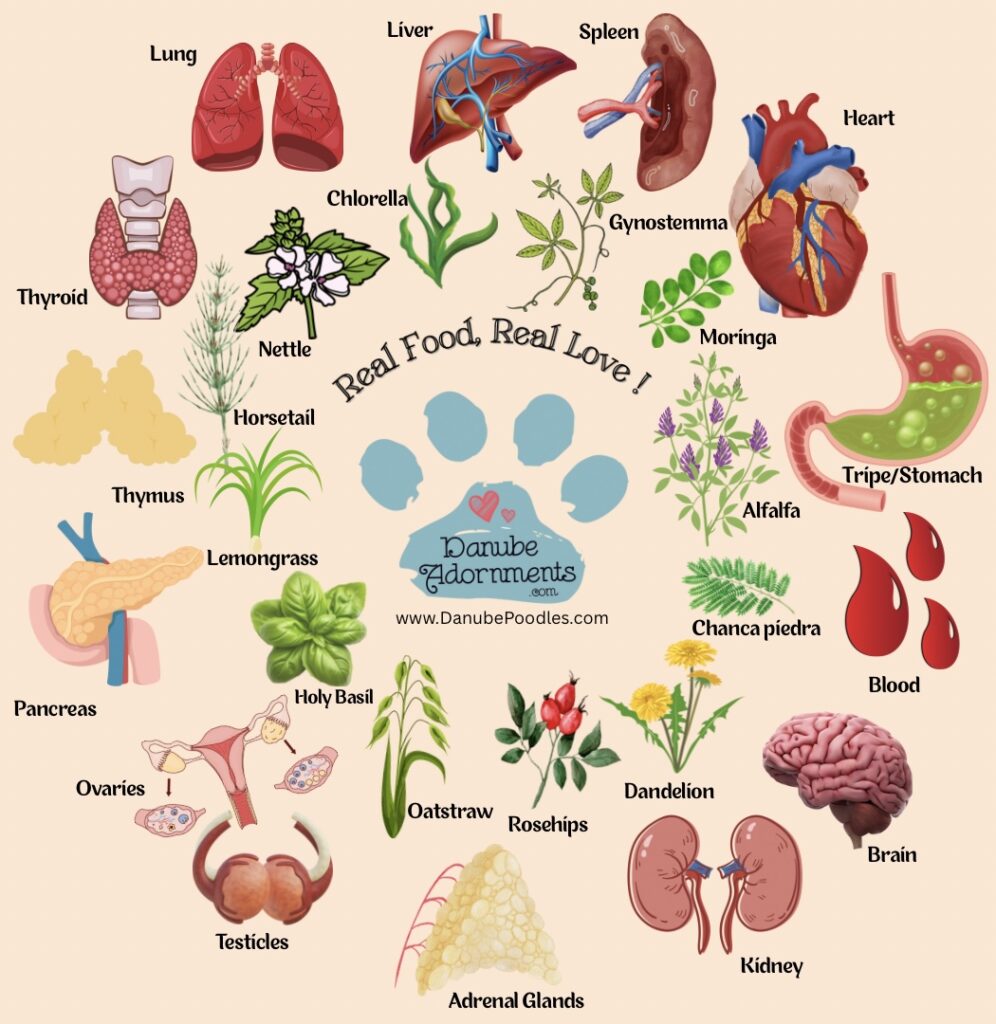
Natural Sources (PMR): Raw spleen (richest in heme iron), liver, heart, green tripe, and blood (beef or pork).
⚡ Potassium Deficiency
Function: Muscle contraction, nerve transmission, and fluid balance.
Signs of Deficiency: Weakness, irregular heartbeat, muscle tremors, “shaky” movement.
Study Example:
In a clinical overview published in Veterinary Medicine, hypokalemia was shown to affect muscle function and recovery in dogs, particularly in cases of kidney disease or chronic vomiting.
→ DiBartola, S.P. (2010). “Fluid, Electrolyte, and Acid-Base Disorders in Small Animal Practice.” 4th Ed.
Natural Sources (PMR): Heart (especially beef), adrenal glands, green tripe, whole prey including digestive organs.
🦴 Calcium Deficiency
Function: Bone growth and maintenance, heartbeat regulation, and nerve signaling.
Signs of Deficiency: Bone fractures, muscle spasms, stiff gait, lameness in puppies.
Study Example:
A study on nutritional secondary hyperparathyroidism in puppies found that home-prepared diets lacking in raw meaty bones led to low bone density and painful deformities.
→ Hazewinkel, H.A.W. et al. (1985). “Nutritional bone disease in growing dogs.” J Nutr, 115(5), 740-745.
Natural Sources (PMR): Raw meaty bones (chicken necks, duck feet, ribs), whole prey, eggshell membrane (for balance with phosphorus).
🛡️ Zinc Deficiency
Function: Skin regeneration, immune response, enzymatic activity.
Signs of Deficiency: Hair loss, flaking skin, crusty paw pads, chronic infections, reproductive issues.
Study Example:
Zinc-responsive dermatosis has been well documented in Nordic breeds and raw-fed dogs lacking dietary zinc variety. One study found dogs fed chicken-heavy diets with no red meat were more prone to deficiency.
→ Scott, D.W. et al. (1995). “Zinc-responsive dermatosis in dogs.” Vet Dermatol, 6(1), 25-31.
Natural Sources (PMR): Oysters (highest), beef, lamb, goat, rabbit, duck. Rotate red meats for bioavailable zinc.
🧠 Magnesium Deficiency
Function: Muscle function, nerve conduction, cardiovascular health, enzymatic activation.
Signs of Deficiency: Nervousness, trembling, stiffness, poor gait, sensitivity to touch.
Study Example:
A 1985 study in American Journal of Veterinary Research showed that magnesium-deficient dogs had increased risk for myocardial infarction and abnormal stress response.
→ Malone, M. et al. (1985). “Influence of dietary magnesium deficiency on myocardial infarct size in dogs.” Am J Vet Res, 46(5), 1053-1056.
Natural Sources (PMR): Brain, pancreas, green tripe, adrenal glands, small whole prey (mouse, rabbit, guinea pig).
🧬 The Interconnected Terrain: Why Balance Matters
Calcium doesn’t work without magnesium. Zinc competes with copper. Iron depends on Vitamin C to be utilized. The body doesn’t work in silos. This is why rotating proteins and feeding the whole animal—organs, glands, bones, blood, and fur—is essential.
Dogs raised on static diets, or limited commercial raw, often show trace imbalances despite the “raw” label. Variety is not luxury—it’s life code.
🌿 Herbs to Support Mineral Absorption & Recovery
Herbs shouldn’t replace food—but they can help the terrain recalibrate during periods of stress or deficiency. These herbs are gentle, supportive, and rooted in long-standing herbal veterinary practice:
• Nettle Leaf – High in iron, calcium, potassium. Used post-anemia, adrenal fatigue, or postpartum.
• Dandelion Root – A classic bitter for liver and kidney drainage; brings calcium, potassium, magnesium.
• Alfalfa – Mineral-rich forage plant used to replenish trace elements during growth or inflammation.
• Horsetail (Equisetum) – Rich in silica to support collagen and bone density. Use only short term, as long-term use can deplete thiamine.
Note: Based on recommendations from Juliette de Bairacli Levy and modern herbalists such as Rita Hogan, these herbs are best used in rotation or short-term therapy, not daily routine.
🍵 Mineral-Rich Infusion (Canine Tea)
Steep these herbs together for 4–6 hours. Strain and pour over raw food or offer separately:
• 1 tsp dried nettle
• 1 tsp dried alfalfa
• ½ tsp dried dandelion root
• Optional: splash of bone broth or green tripe juice (add after tea cools)
Perfect during travel, surgery recovery, rehoming transitions, or seasonal detox.
🧠 Behavior & Mineral Status
Behavior is often biochemical before it is behavioral.
• Low magnesium → muscle twitching, restlessness, irritability.
• Low zinc → poor coat, anxiety, slow immune response.
• Low iron → depression-like withdrawal, exercise intolerance.
• Low potassium → weakness, tremors, fragile recovery.
You cannot out-train a deficiency. But you can feed your way out of it.
🔁 PMR Feeding Guide to Correct Deficiency
• Rotate 3–5 proteins weekly.
• Feed organs from at least 3 species monthly.
• Include raw meaty bones 3–4x/week.
• Use blood-rich cuts (heart, spleen) weekly.
• Add whole prey when possible (feathered, furred, scaled).
• Offer oysters or sardines weekly for zinc and iodine.
• Use herbal infusions during stress, whelping, transition, or recovery.
🐾 Final Word
Minerals aren’t minor. They’re the keys that turn the whole system on. Deficiencies don’t always scream—they whisper through behavior, skin, energy, and mood. If we learn to read the terrain, the body tells us everything.
And the best part? You don’t need a cabinet of synthetic supplements. You just need a plan rooted in nature.
Because nature already created the perfect multivitamin.
It has a liver. And a heartbeat. ❤️🐾❤️


Leave a Reply