

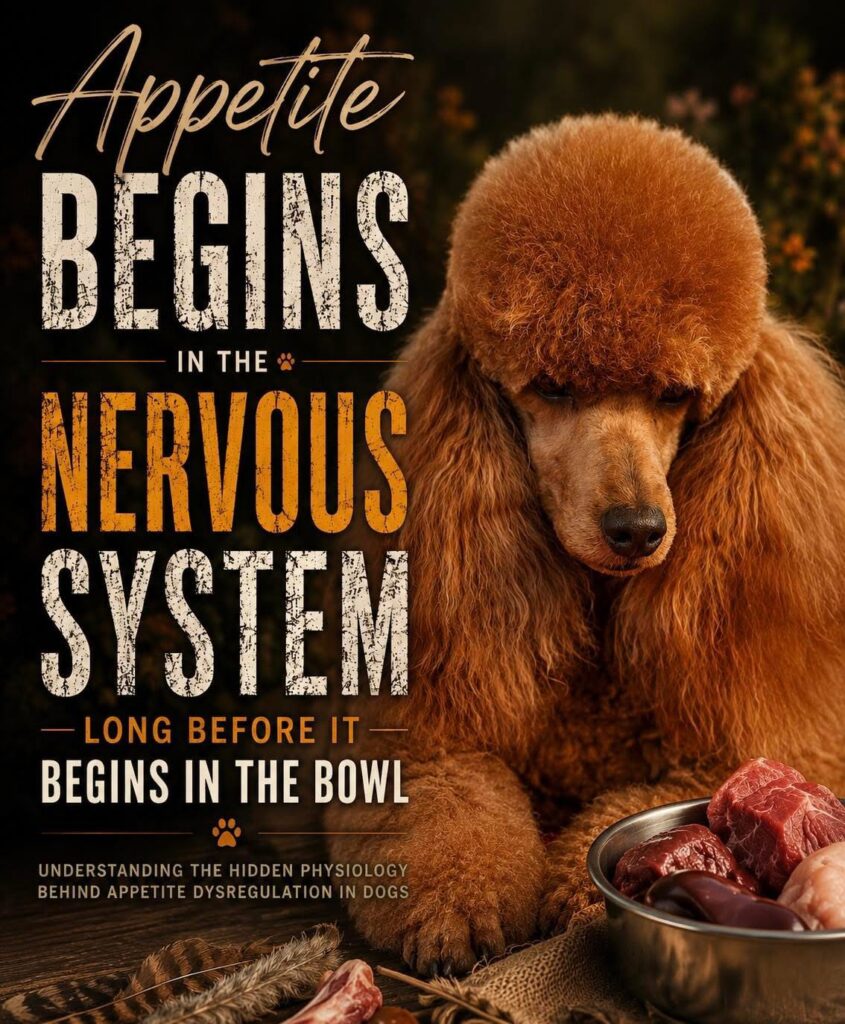
One of the greatest misunderstandings in modern canine nutrition is the assumption that appetite begins in the stomach, when in reality hunger is deeply connected to the nervous system, environmental perception, hormonal signaling, and the biological feeling of safety inside the body itself.
Food matters tremendously.
Nutrient density matters.
Species-appropriate feeding matters.
Yet even the most biologically correct meal can meet resistance when the body interpreting that meal does not feel safe enough to fully receive it.
That is where many conversations around “picky eating” become incomplete, because appetite is not merely a preference issue, and it is not always a disease process either. The nervous system participates in digestion long before the first bite is swallowed, which means feeding behavior often reflects the condition of the entire internal terrain rather than simple stubbornness or taste.
A dog can stand in front of extraordinary food while the body itself remains physiologically unprepared to digest.
That distinction changes everything.
Hunger Is a Survival Mechanism, Not Entertainment
In nature, appetite is tied directly to survival biology.
A carnivore does not casually approach food with indifference when the body is functioning correctly. Hunger activates powerful neurological and hormonal systems designed to preserve life, maintain muscle tissue, support reproduction, fuel movement, and sustain metabolic resilience.
The body must first determine:
- Is the environment safe?
- Is digestion possible right now?
- Is blood flow available for the gastrointestinal tract?
- Is the nervous system operating in repair mode or survival mode?
Only then does the body fully shift into digestive readiness.
Safety precedes hunger.
That reality exists neurologically, hormonally, electrically, metabolically, and biologically far beyond emotion alone.
The autonomic nervous system constantly scans the environment for danger, instability, unpredictability, overstimulation, inflammatory stress, excessive chemical burden, confinement pressure, circadian disruption, or emotional instability within the household itself. Digestive activity becomes secondary once the brain perceives survival pressure because preservation of life always outranks digestion.
A body focused on defense rarely prioritizes appetite.
𝑻𝒉𝒆 𝑽𝒂𝒈𝒖𝒔 𝑵𝒆𝒓𝒗𝒆: 𝑻𝒉𝒆 𝑯𝒊𝒅𝒅𝒆𝒏 𝑪𝒐𝒏𝒗𝒆𝒓𝒔𝒂𝒕𝒊𝒐𝒏 𝑩𝒆𝒕𝒘𝒆𝒆𝒏 𝒕𝒉𝒆 𝑩𝒓𝒂𝒊𝒏 𝒂𝒏𝒅 𝒕𝒉𝒆 𝑮𝒖𝒕 🧬
At the center of this relationship sits one of the most fascinating structures in canine anatomy: the vagus nerve.
f(\text{stress}) \uparrow \Rightarrow \text{vagal tone} \downarrow \Rightarrow \text{digestive readiness} \downarrow \Rightarrow \text{appetite} \downarrow
The vagus nerve acts as the primary communication highway between the brain and the digestive tract, extending from the brainstem through the neck and into major organs including the heart, lungs, stomach, liver, pancreas, and intestines.
Regulation through this nerve influences:
- stomach acid secretion
- enzyme release
- gut motility
- pancreatic function
- bile flow
- swallowing reflexes
- satiety signaling
- inflammatory regulation
- intestinal permeability
- microbiome communication
Digestive readiness rises when vagal tone remains strong. Saliva production improves. Stomach acid increases appropriately. Peristalsis strengthens. Nutrient absorption becomes more efficient. Hunger signals return naturally.
Digestive weakness develops once chronic stress suppresses vagal tone.
Food may sit improperly inside the stomach. Acid production can weaken. Fermentation increases. Nausea rises. Motility slows. Inflammation accumulates. Appetite becomes inconsistent. Some dogs sniff food and walk away despite the body genuinely requiring nourishment.
Many people immediately attempt to solve this through toppers, processed treats, synthetic appetite stimulants, excessive bowl-switching, or highly stimulating commercial foods engineered for hyper-palatability.
The issue is not always the bowl itself.
In many cases, the nervous system has remained in a state where digestion no longer feels safe or efficient.
Stress Redirects Blood Flow Away From Digestion
The sympathetic nervous system, commonly known as “fight or flight,” dramatically alters circulation patterns throughout the body.
Chronic elevation of cortisol and adrenaline redirects blood flow toward skeletal muscles, cardiovascular output, and immediate survival responses rather than toward deep digestive work inside the gastrointestinal tract.
This is adaptive biology rather than dysfunction by accident.
A stressed carnivore in nature would never prioritize heavy digestive activity while danger remained present.
Modern dogs may not face predators directly, though the nervous system still interprets stress biologically through overstimulation, unstable environments, harsh handling, excessive confinement, inflammatory processed diets, poor sleep, chronic gastrointestinal irritation, pharmaceutical overload, environmental chemicals, and even the emotional energy carried within the household itself.
The body keeps score.
Appetite often becomes one of the first visible signals.
𝑾𝒉𝒚 𝑾𝒉𝒐𝒍𝒆 𝑷𝒓𝒆𝒚 𝑪𝒉𝒂𝒏𝒈𝒆𝒔 𝑭𝒆𝒆𝒅𝒊𝒏𝒈 𝑩𝒆𝒉𝒂𝒗𝒊𝒐𝒓 🐇
One of the most overlooked observations among long-term Prey Model Raw feeders is how dramatically feeding behavior changes once dogs return to biologically recognizable food.
Not powdered nutrition.
Or synthetic flavor-coated pellets.
Not industrial formulations engineered inside factories.
Muscle tissue.
Secreting organs.
Blood-rich nourishment.
Collagen and connective structures.
The architecture of whole prey itself.
Canine digestive anatomy was designed around animal tissue recognition.
Stomach acidity reaches extraordinarily low pH levels specifically adapted for breaking down bone, cartilage, muscle meat, tendons, fur, feathers, skin, glands, and organ tissue. Gastrointestinal length remains comparatively short because animal tissue digests rapidly when digestive function operates correctly.
The jaw structure itself tells the story.
Carnassial teeth shear flesh rather than grind vegetation. Salivary amylase activity remains extremely limited compared to omnivorous species because carbohydrate digestion was never intended to become the biological centerpiece of canine nutrition.
PMR principles therefore focus on:
- muscle meat
- raw meaty bones
- secreting organs
- connective tissue
- glands
- blood-rich tissues
- skin
- cartilage
- fur
- feathers
- whole prey diversity
rather than fruits, vegetables, starches, fillers, legumes, synthetic vitamin premixes, or plant-heavy substitutions rooted more in human dietary ideology than canine anatomy.
The body recognizes species-appropriate nourishment differently.
Many dogs labeled “picky eaters” on processed diets become intensely food driven once biologically recognizable prey enters the bowl.
Recognition awakens instinct.
Appetite Is Also Nutrient Intelligence
The body possesses extraordinary biochemical intelligence.
True appetite does not simply reflect caloric desire. Nutritional signaling drives feeding behavior at a cellular level, which explains why diversity matters so deeply within authentic PMR feeding.
Rotational feeding at Danube has included chicken, beef, venison, pork, turkey, lamb, mutton, buffalo, sheep, goat, elk, muskrat, alpaca, guinea fowl, guinea pigs, quail, pheasant, ostrich, llama, camel, yak, hamster, mouse, rat, rabbit, beaver, duck, geese, smelt, oysters, butterfish, sardines, anchovies, squirrels, bison, kangaroo, alongside organs, glands, cartilage, marrow, fur, feathers, connective tissue, blood-rich organs, skin, trachea, brains, reproductive organs, spleen, pancreas, thymus, lungs, and whole prey structures that more accurately reflect the biological blueprint of a carnivore.
The objective has never been novelty for entertainment.
Biological completeness remains the goal.
Nature does not sustain carnivores through isolated chicken breast, synthetic powders, fortified starches, or brightly colored produce marketed toward human nutritional trends.
𝑺𝒎𝒂𝒍𝒍 𝑩𝒂𝒕𝒄𝒉 𝑭𝒆𝒆𝒅𝒊𝒏𝒈 𝑷𝒓𝒆𝒔𝒆𝒓𝒗𝒆𝒔 𝑩𝒊𝒐𝒍𝒐𝒈𝒊𝒄𝒂𝒍 𝑰𝒏𝒕𝒆𝒈𝒓𝒊𝒕𝒚 🌿
Food sourcing matters far more than many people realize because nutritional degradation begins long before food reaches the bowl.
Oxidized fats, prolonged freezer storage, industrial rendering systems, excessive processing, poor farming practices, synthetic preservation methods, repeated thawing cycles, and low-quality sourcing all alter proteins, fats, micronutrients, microbial integrity, and tissue quality at a foundational level.
A carnivore recognizes freshness biologically.
Smell itself activates neurological preparation for digestion before the first bite is ever swallowed. Olfactory signaling immediately influences vagal tone, stomach acid production, pancreatic readiness, bile release, and feeding drive.
The nervous system begins digesting through scent alone.
Small-batch sourcing becomes critical because handling determines integrity.
Lower-stress animal raising conditions often produce healthier tissue quality. Proper freezing practices preserve structural stability more effectively. Cleaner sourcing lowers unnecessary toxic burden. Fresher organs maintain superior nutritional architecture. Reduced oxidation protects fats from degradation.
PMR asks an entirely different question from commercial feeding systems.
Rather than asking how many synthetic nutrients can be added back after industrial destruction of biological complexity, whole prey feeding asks how closely nourishment can return to the structure that originally sustained the species before manufacturing attempted to redesign carnivores into something more convenient for modern production.
Appetite reflects terrain.
Terrain reflects biology.
Biology reflects alignment.
To thriving beasts and lasting health,
Timea R. Bodi 🐩


Leave a Reply