

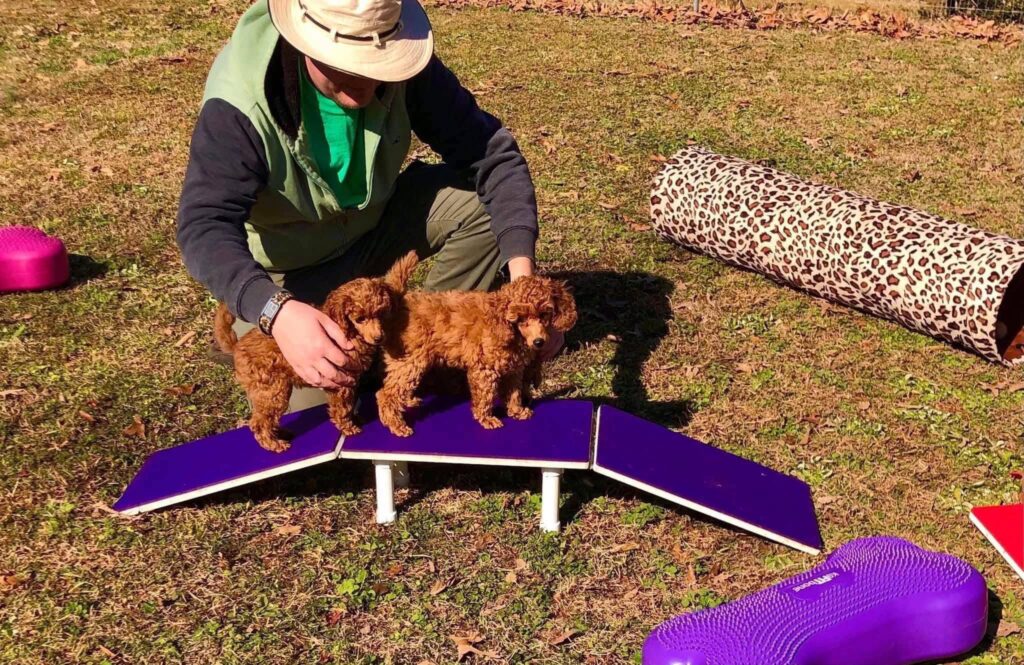
A few evenings ago I was carrying a bucket of chicken feed toward the coop while three guinea fowl conducted what appeared to be an emergency press conference regarding a leaf, which would have been amusing enough had they not displayed the level of urgency usually reserved for tornado warnings, loose predators, or the collapse of civilization.
The poodles were stretched out in the grass, the ducks were waddling around with the confidence of politicians who have never been held accountable for anything, the chickens were scratching beneath the fence line, and yet those ridiculous birds had somehow decided that silence was no longer an appropriate response.
Standing there, listening to all that unnecessary drama, I found myself thinking about the dog world and the strange expectation that preservation breeders should quietly watch what is happening around them while remaining polite enough not to mention it.
That expectation usually arrives dressed as wisdom, professionalism, kindness, or fatigue, but the message beneath the costume rarely changes: stay in your lane, mind your own dogs, avoid controversy, and let somebody else fight those battles.
The problem is that trouble has a habit of climbing fences.
What began as a Poodle problem has become a dog problem, because once consumer demand becomes more valuable than preservation, no breed remains untouched for very long.
Retrievers, Spaniels, Bernese Mountain Dogs, Australian Shepherds, Sheepdogs, Pointers, Setters, Terriers, and nearly every corner of the purebred world are discovering that the marketplace does not stop at one breed once it learns how profitable confusion can become.
That realization keeps pulling me back to the same uncomfortable question: when did watching become enough, and how did we convince ourselves that concern, frustration, criticism, and carefully reasoned explanations about what somebody else should do carried the same weight as actually stepping forward and doing it?
Before I go any further, let me warn you that this is not a short conversation.
In fact, it may be the exact opposite of the kind of writing social media prefers.
The subject is too important for slogans, too complicated for soundbites, and too consequential for the sort of thinking that can be absorbed between advertisements and distracted scrolling.
So stay with me.
I am going somewhere with this.
Because if we are serious about preserving dogs, then we should probably be willing to think about them longer than it takes to order a pizza.
When someone tags me in a doodle discussion, I usually know before I start typing that the loudest person in the room is not likely to change their mind, which is fine because I rarely write for the person speaking.
I write for the person quietly deciding.
The family researching its first dog, the teenager considering a future in breeding, the owner trying to understand why an expensive puppy developed problems nobody mentioned before money changed hands, the future breeder still deciding whether stewardship matters, and the silent observer who has only heard one polished version of the story all matter more to me than the person determined to misunderstand the conversation.
Most meaningful change begins quietly, with a single person reconsidering something they previously accepted without question.
Anyone who gardens understands this. A handful of seeds scattered into soil looks insignificant right up until the moment the landscape changes.
Truth works much the same way.
Most of my articles will never go viral, most of the posts I submit to doodle groups will never survive moderation, and most of my comments disappear shortly after the moderators realize what happened, but ideas have a stubborn way of outliving the posts that carried them.
A question forms, an assumption begins to wobble, a buyer delays sending a deposit, a family starts asking different questions, and a future litter becomes slightly less inevitable than it appeared the day before.
That matters.
Perhaps growing up in Eastern Europe permanently damaged my ability to accept nonsense without investigation, since my Romanian side questions everything, my Hungarian side questions the explanation, and together they create a combination that has occasionally made life difficult for people who would prefer I simply nod politely and move along.
The village where my grandparents lived had little patience for pretending problems improved through neglect; leaking roofs were repaired, sick animals were treated, failing gardens were investigated, and responsibility generally belonged to whoever noticed the trouble first.
That mentality followed me into dogs, which is inconvenient because noticing a problem creates responsibility.
Silence may protect reputations, avoid arguments, and keep everyone comfortable for a while, but it also gives bad ideas open pasture.
Somewhere along the way, many of us began confusing avoided tension with peace. They are not the same thing.
Peace is not the absence of confrontation when harm is moving unchallenged; peace is what exists when truth has been given enough room to stand.
A person standing between a vulnerable animal and a harmful decision is not creating conflict, while a person refusing to speak because conflict feels uncomfortable is not creating peace.
The more years I spend breeding dogs, working in veterinary medicine, studying nutrition, attending seminars, talking with owners, evaluating pedigrees, helping families, sitting beside sick animals, watching trends come and go, and listening to explanations that collapse under even modest examination, the more convinced I become that ignorance is not the greatest threat facing dogs.
Ignorance can be taught.
Indifference disguised as politeness is far more dangerous because it sounds reasonable while quietly transferring responsibility to somebody else. Meanwhile, the dogs continue living with decisions they never made.
A few weeks ago I stood beside Chianti’s whelping box long after there was any practical reason to remain there, watching five black Miniature Poodle puppies sleep with complete trust in a world they did not understand and could not control.
They knew nothing of registries, breeding controversies, designer dog marketing, health testing, puppy-selling platforms, Facebook groups, consumer demand, or the arguments that would swirl around dogs like them.
They had not chosen their pedigree, their breeder, their nutrition, their environment, their socialization, their future homes, or the decisions that would shape their lives.
Human beings chose those things. The dogs simply inherit the consequences.
That reality should humble all of us, because beneath every conversation about doodles, preservation, health, ethics, registries, markets, and stewardship sits one simple truth.
The dog never gets a vote. Which means stewardship belongs to those of us who do.
The older I become, the less convinced I am that doodles are the actual story, because symptoms often receive more attention than causes, and the longer I sit with this issue the more it seems that doodles are not the disease but one visible expression of a much deeper cultural shift in which stewardship steadily gives way to consumerism, a pattern that becomes increasingly difficult to ignore once you recognize it.
A culture that increasingly treats living things as customizable products rather than inherited responsibilities was always going to reach dogs, because consumerism never respects boundaries once desire becomes its own justification.
The question gradually stops being, “What was this breed developed to be?” and becomes, “What would I prefer it to become?”, a shift away from stewardship, preservation, and responsibility toward customization, convenience, and consumer preference that may sound insignificant on the surface yet changes nearly everything downstream.
What saddens me most is not that doodles exist, but how many people no longer understand what preservation means.
Entire generations are growing up surrounded by breeds without realizing that every stable temperament, every predictable trait, every working instinct, every structural characteristic, and every piece of breed identity represents accumulated human responsibility across time.
Every pedigree is a letter addressed to the future by people who knew they would never live long enough to read the reply.
That should humble us.
Instead, modern dog culture often treats preservation like an inconvenience standing in the way of creativity.
Nobody walks into a cathedral and complains that the builders failed to redesign it every generation, studies a symphony and demands the composer’s intent be blended with several unrelated works for wider appeal, or saves seed by mixing everything together and hoping marketing will compensate for lost purpose.
Yet when dogs enter the conversation, many people suddenly abandon principles they would accept almost anywhere else.
Times change, preferences shift, demand grows, and the public likes what it likes, but none of those realities transform marketing into stewardship, consumer desire into biological truth, or centuries of deliberate preservation into something that can be casually dismissed because a trend happens to be profitable, which makes no sense at all.
No serious farmer, gardener, musician, architect, or breeder working with long-term consequences can afford to treat inherited design as raw material for immediate preference.
The dog world contains some of the most knowledgeable people I have ever met and some of the most unnecessary divisions I have ever witnessed, which may be part of the reason commercial breeding advances so efficiently while preservation people exhaust themselves arguing over which room of the house matters most.
Structure, function, temperament, health, longevity, purpose, nutrition, grooming reality, training, veterinary insight, and stewardship all belong in the same room because living systems are rarely understood through a single lens.
A piano does not become music because one key performs exceptionally well. Music exists because different notes serve the same composition without demanding to become the whole song.
Conformation people, performance people, obedience people, hunters, trainers, groomers, veterinarians, nutritionists, owners, and preservation breeders are often carrying different pieces of the same mission, yet somehow the commercial breeding world has managed to convince many of the people who should be standing shoulder to shoulder that their real opponents are each other.
That is backwards.
The enemy of preservation is not the breeder who prioritizes agility, obedience, hunting, show rings, companion placement, raw feeding, conventional veterinary care, or a different doorway into the same house.
The enemy of preservation is the replacement of stewardship with consumerism.
Once consumer demand becomes the primary force driving breeding decisions, health becomes a marketing claim, temperament becomes a marketing claim, ethics become a marketing claim, purpose becomes a marketing claim, and the breed itself becomes an ingredient in someone else’s sales pitch.
People begin treating the Labrador, Poodle, Bernese, Australian Shepherd, Spaniel, or any other breed as pieces to be combined, named, packaged, photographed, and sold, while the serious breeder who spent years studying pedigrees, evaluating structure, testing health, proving dogs, placing puppies carefully, honoring contracts, and accepting lifetime responsibility is presented to the public as though their work is morally equivalent to production with better lighting.
Come on.
A breeder preserving something and a producer selling something are not doing the same work simply because both have puppies.
When enough polish is applied, stewardship and production can look remarkably similar from the road, which may be one of the greatest challenges facing puppy buyers today.
A family opens a website and sees beautiful photographs, soothing language, health promises, temperament claims, and carefully arranged credibility, while a preservation breeder who spent decades building something may appear only a few listings away from a backyard breeder, doodle producer, commercial operation, or puppy mill that learned how to borrow the language of responsibility.
That should concern every one of us.
The public cannot value what nobody explains, protect what nobody defines, or recognize stewardship when stewardship and marketing are presented through the same polished window.
The uncomfortable reality is that many of the people benefiting from preservation have very little idea how much unseen work stands between healthy breeds and the forces constantly trying to reshape them, because healthy breeds, protected standards, educated buyers, preserved records, and better decisions rarely appear by accident. They exist because somebody was willing to answer the phone, write the letter, review the proposal, enter the discussion, challenge the misinformation, absorb the criticism, and continue showing up long after most people had moved on to something easier.
People like Leslie Newing have spent years carrying exactly that kind of burden. As a preservation breeder herself and a representative of the Poodle Club of America, the AKC Parent Club for the breed, she has spent countless hours helping educate prospective owners, supporting preservation breeders, answering questions, and serving as a resource for people trying to better understand responsible dog breeding and stewardship.
The work does not stop there. She continues showing up in online discussions, answering questions in Facebook groups, responding when people are searching for breeders, and helping educate the public one conversation at a time. None of this is part of a marketing campaign, and none of it comes with a paycheck. It continues because someone believes the future of purebred dogs is worth protecting.
Most of the public never sees that work because successful stewardship often looks as though nothing happened at all. A standard remained intact. A breed remained recognizable. A buyer received better information before making a decision. A piece of history survived long enough to be handed to another generation. The outcome becomes visible while the labor that protected it quietly disappears into the background.
Perhaps that is why people carrying those responsibilities are so easy to overlook. We naturally notice the dog standing in front of us far more readily than the years of effort required to keep that dog recognizable, predictable, healthy, and connected to the generations that came before it.
That realization makes me uncomfortable because it forces a question I would rather avoid.
Am I helping carry that weight, or am I simply benefiting from the people who do?
I would love to claim I always volunteer for difficult conversations, never scroll past because I am tired, and never convince myself someone else can handle it, but that would not be true.
Plenty of evenings find me wanting nothing more than to feed dogs, answer puppy inquiries, close freezer doors, water the garden, prepare lessons, practice piano, sit quietly on the porch, and enjoy the peace that comes from minding my own business.
The problem is that every person who decides someone else will speak leaves one fewer person willing to carry the burden, and most things worth preserving are not ultimately lost through dramatic attacks but through gradual abandonment, when exhaustion replaces conviction, politeness replaces courage, and responsibility is quietly transferred to people already carrying more than their share.
That is how important things disappear.
The more I think about this, the more spiritual the conversation becomes, because every pedigree reminds me that none of us created the Poodle, authored its intelligence, designed its structure, invented its instincts, or gave it the ability to learn, retrieve, problem solve, perform, adapt, and bond with people.
We received those things.
Receiving a gift and owning a gift are not the same thing. Ownership asks what belongs to me, while stewardship asks what has been entrusted to me.
That distinction changes everything because the question ceases to be what kind of dog I want to produce and becomes what kind of inheritance I am responsible for preserving, which is why I have come to believe that the defining conflict in the modern dog world is not between preservation breeders and doodle breeders, but between stewardship and consumerism.
Consumerism never stops at doodles because it eventually reaches every breed, every registry, every sport, every institution, and every person willing to ask what can be sold before asking what should be protected.
That is precisely why remaining silent no longer feels like an option.
I am not trying to save every dog, win every argument, change every mind, or fight every battle. But I am trying to reach one more person quietly deciding. One family willing to ask better questions before sending a deposit, one buyer willing to look beyond advertising, one owner willing to understand the difference between preservation and production, one breeder willing to choose stewardship over convenience, one conversation capable of planting a seed, and one future dog whose life may be better because someone cared enough to tell the truth.
So if there is an opportunity to help a family better understand the difference between preservation and production, support a breeder carrying the often thankless burden of defending stewardship, encourage a young person asking honest questions about the future of dogs, or simply help one individual see something they had not previously noticed, tag me, because while I do not enjoy arguments, pretend to have every answer, or expect every effort to succeed, I remain convinced that the dogs deserve people willing to participate rather than merely observe.
When future generations look back on this moment in the history of purebred dogs, I hope they find evidence that we accepted responsibility for what had been entrusted to us instead of quietly assuming someone else would carry the burden, because by the time everyone agrees a fire exists, much of what should have been protected may already be gone, and the real question has never been whether consumerism, apathy, confusion, and the gradual erosion of stewardship are burning through the foundations of the dog world, but whether we intend to spend our time discussing the smoke or picking up a bucket.
The dogs deserve stewards, not spectators.


Leave a Reply