

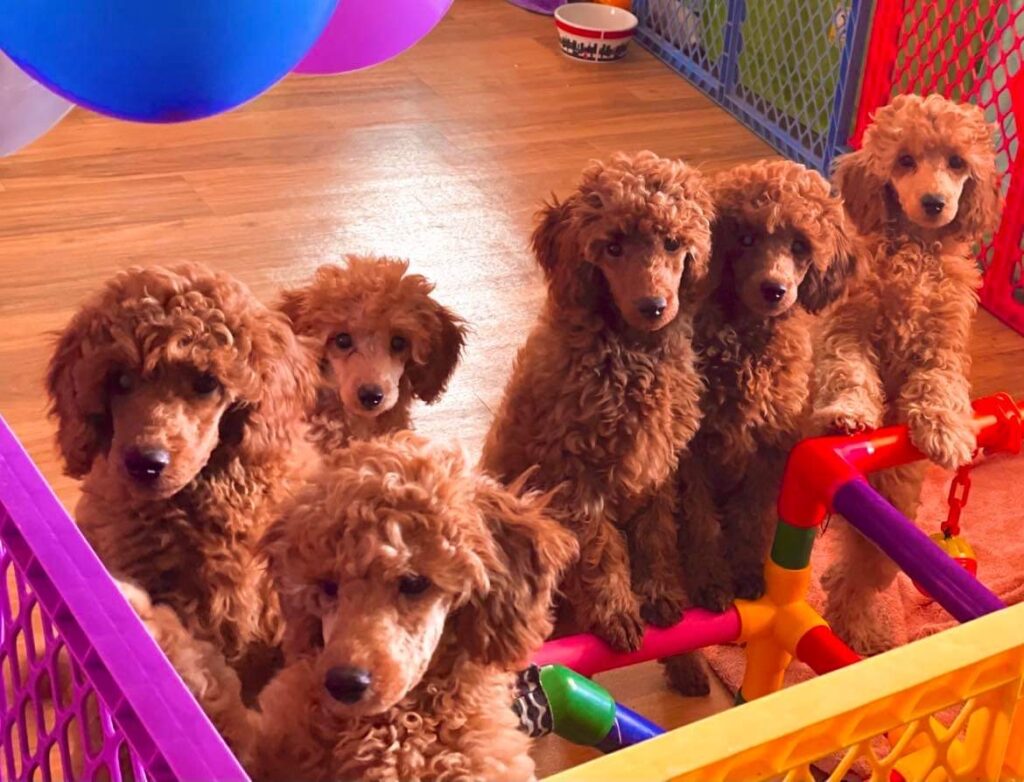
There is something profoundly revealing about a breed as refined as the Poodle, because no matter how breathtaking the grooming, how elegant the outline, or how carefully presented the finished picture may appear, the truth eventually emerges the moment the dog is asked to move, to think, to respond, and to demonstrate whether everything admired in stillness remains intact once function, athleticism, intelligence, and purpose are placed back into the equation.
That reality has fascinated me for years, because nothing meaningful is created in those few minutes of competition, while nearly everything worth knowing is quietly brought into view.
Whether watching rally, obedience, agility, field work, or conformation itself, what becomes visible in those moments was never created there. Communication either exists between dog and handler or it does not. Timing either survives pressure or begins to fracture. Structure either supports movement or exposes weakness. Temperament either remains steady when demands increase or reveals vulnerabilities that presentation alone cannot conceal.
What unfolds before judges and spectators is not being built in real time.
It is being remembered.
Everything visible on that day represents decisions made long before the lead was attached, long before grooming tables filled the building, long before applause followed a placement, and long before anyone gathered to admire the finished result. The qualities that eventually capture attention inside the ring originate in choices regarding structure, temperament, movement, balance, health, instinct, and purpose, preserved carefully across generations or gradually softened through decisions that seemed insignificant in isolation but became meaningful over time.
The longer I spend studying dogs, pedigrees, breeding programs, and the history of preservation, the more convinced I become that most people naturally focus on the individual standing before them while experienced breeders eventually learn to focus on the generations standing behind that individual.
Families often see a beautiful dog, judges evaluate a specimen against a standard, while preservation breeders instinctively look beyond the individual and toward the inheritance standing quietly behind it.
Somewhere within that inheritance stand the animals whose influence continues long after their own careers have ended, shaping outcomes through descendants they never lived long enough to meet.
Among those influences, few carry more significance than the stud dog, not because males are inherently more important than females, but because influence accumulates differently within a breeding population.
The contribution of an exceptional brood bitch is naturally limited by biology, geography, time, and the practical realities of breeding, while a highly sought-after sire can leave descendants across dozens of pedigrees within a remarkably short period, making him one of the most powerful instruments for preservation or deterioration available to any breed. The very qualities that make a dog desirable can also make him dangerous when admiration outruns restraint, because every virtue being concentrated is accompanied by everything else traveling alongside it, whether fully recognized at the time or not.
Lasting change seldom arrives through a single litter; far more often, it enters quietly through a sire whose descendants continue telling his story long after he is gone.
That reality becomes increasingly difficult to ignore once enough pedigrees have passed through your hands and enough generations have been studied closely enough to notice the same names appearing repeatedly behind dogs admired decades apart. Some sires leave behind consistency so reliable that their influence becomes recognizable across multiple generations. Others introduce confusion, instability, exaggeration, or weaknesses that require years of careful breeding to correct. Some strengthen what already exists. Others unintentionally redirect the breed altogether.
Genetics remains remarkably indifferent to human intentions, preserving virtues and flaws, structural strength and instability, with equal loyalty across generations while the pedigree remembers everything, whether breeders choose to acknowledge it or not.
Perhaps nowhere is this more apparent than in the distinction between a dog that wins and a dog that reproduces. Every breeder who has spent sufficient time studying families of dogs has encountered remarkable individuals whose influence faded almost as quickly as their show careers ended, while other sires left a profound and lasting mark through offspring that consistently inherited their balance, soundness, temperament, breed type, working ability, and overall quality. The ring evaluates the individual standing before it, but history ultimately evaluates what that individual leaves behind. A truly influential stud dog is measured not only by his own accomplishments but by his ability to transmit qualities worth preserving across generations he will never live long enough to see.
This responsibility becomes even more significant within preservation breeding because preservation asks fundamentally different questions than production.
What matters is not what happens to be popular, easiest to market, most profitable, or most capable of capturing immediate attention, because those things change with every generation.
What deserves to remain?
The answer cannot be determined by demand because demand changes constantly. It cannot be entrusted to trends because trends possess no loyalty to history, function, or long-term consequence. It cannot be delegated to whatever language happens to resonate most strongly with the current moment.
Any answer worthy of preservation must be anchored to something more durable than popularity, which is precisely the role of a breed standard. Unconcerned with trends, convenience, or changing public taste, it remains fixed in place, quietly serving as both compass and safeguard for those willing to carry a breed forward without losing sight of what made it worth preserving in the first place.
Once that anchor begins to weaken, comparison gradually drifts away from principle and toward preference, allowing subjective taste to assume authority it was never intended to hold. Given enough time, repeated preferences begin to resemble permanent truths, and entire populations can slowly move away from their original purpose while convincing themselves they are progressing.
Deliberate disregard is rarely responsible for significant erosion, which more often arrives disguised as entirely reasonable arguments about broader appeal, greater visibility, expanded opportunities, increased demand, and other forms of success that appear beneficial in isolation yet gradually shift attention away from the very principles responsible for preservation in the first place.
Yet proximity has a way of softening distinctions that once felt obvious. Popularity begins resembling purpose. Production begins sounding increasingly similar to preservation. Market demand begins masquerading as stewardship.
Time eventually exposes the difference.
It always has.
Programs built around demand often rise quickly, adapt easily, and appear strong for a season, whereas preservation guided by a standard unfolds according to a far longer horizon.
It simply remains.
The older I become, the more I admire breeders who think beyond the next litter, beyond the next ribbon, beyond the next championship, and even beyond their own lifetime, because those are the people who understand that stewardship is measured less by what we create than by what remains recognizable after we are gone.
I often find myself thinking back to the days I spent standing ringside watching Kaz Hosaka work, because what impressed me most was never the number of winners that carried his name behind them, but the quiet consistency of his vision. There was no chasing trends, no frantic reinvention, no desire to leave a personal signature larger than the breed itself. Every decision reflected the same hierarchy of priorities, where recognition never outranked the dogs, fashion never displaced the standard, and novelty never surpassed the importance of continuity. Looking back now, I realize that the greatest breeders rarely spend their lives trying to make the breed resemble themselves. They spend their lives making sure the breed continues to resemble itself.
And somewhere behind every generation of dogs worthy of preservation stands a sire whose legacy continues quietly through descendants he never lived long enough to see, shaping the future from a place few people bother to examine, yet reminding us that while a single litter rarely redirects the course of a breed, entire generations have often been shaped by a single stud dog, making the responsibility attached to those breeding decisions far greater than most people realize. ❤️🐾❤️


Leave a Reply