

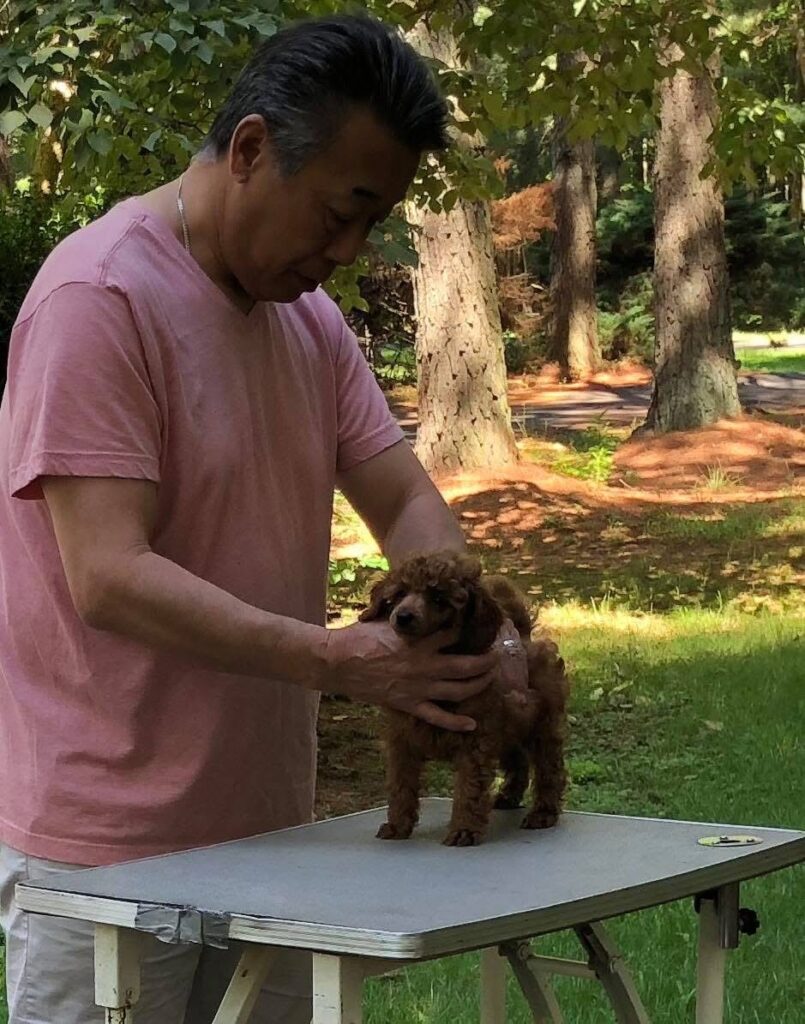
Yesterday I was standing at my grooming table brushing one of my black Miniature Poodles when my phone buzzed with yet another photograph of what was being advertised as a “rare Merle Poodle,” and I found myself staring at that single word far longer than I expected because something about it simply did not sit right with me.
I have inherited many things from my family, but quietly accepting nonsense was never one of them.
The more I looked at that picture, the more one question kept circling in my mind: when did rarity become more valuable than authenticity, and when did preserving what generations before us carefully built become less exciting than creating something new simply because it attracts attention?
That, at least for me, is the real conversation.
Whether Merle is visually attractive has never been the point. The question is whether our decisions are guided by stewardship or by the pursuit of novelty, because those are two very different ways of approaching a breed entrusted to our care.
I have spent most of my life around dogs.
I grew up in Europe where Poodles were simply Poodles. Later I became a veterinary technician, studied canine nutrition, worked with holistic veterinarians, raised generations of naturally reared dogs, stood ringside watching judges evaluate structure, helped families through sickness, celebrated healthy litters, cried over losses, and spent more nights than I care to count beside whelping boxes wondering if everyone would make it until morning.
When you live close enough to dogs, you stop chasing novelty.
You start protecting what works.
The Poodle is one of the oldest and most recognizable dog breeds in the world, with an extraordinary range of historically accepted colors and patterns that have been carefully preserved over generations. That is exactly why I keep coming back to the same question: if the breed has always possessed such remarkable diversity, why was there ever a need to introduce Merle?
After a lifetime spent around Poodles, I have never once looked at the extraordinary palette this breed already possesses and thought, “What it really needs is another color.”
The burden of proof rests with anyone claiming Merle has always existed in Poodles. If a mutation had been present within a closed breeding population for centuries, we would expect to find historical descriptions, paintings, photographs, pedigrees, or preserved bloodlines documenting its existence. Despite the Poodle being one of the best documented dog breeds in the world, no verifiable historical evidence has demonstrated the presence of the merle mutation within the historic Poodle population before modern outcrossing.
This distinction is reflected not only in breed history but also in modern registry policy. In 2020, The Royal Kennel Club announced it would no longer register merle dogs in breeds where there is no documented historical evidence that the pattern naturally existed, specifically noting requests from the Poodle Breed Council. That policy reflects an important distinction. Preservation is determined by documented breed history, not by whether a trait is visually appealing or commercially desirable.
The answer is far less mysterious than many people would like it to be.
Modern molecular genetics has identified the merle mutation as a SINE insertion within the PMEL gene, formerly known as SILV. This is not simply another coat color but a specific mutation affecting pigment development. While the precise historical outcross responsible for introducing merle into Poodles has not been conclusively documented, the available historical and genetic evidence indicates that merle was introduced through crossbreeding with a merle-carrying breed rather than originating within the historic Poodle gene pool.
A pure breed is, by definition, a closed genetic population, and once genes are intentionally brought in from outside that population, the discussion is no longer about preserving the breed that generations before us worked so carefully to establish, but about creating something different altogether.
A closed studbook is not an arbitrary administrative rule. It is the mechanism that allows a breed to retain a recognizable genetic identity across generations. Every purebred breed represents a distinct population shaped through selection for predictable structure, temperament, movement, function, and health. Once outside genetics are intentionally introduced, the population itself changes. Whether that change is viewed as desirable or undesirable is a separate discussion. The biological reality is that the breed no longer consists exclusively of the genetic foundation established by those who created and preserved it.
Every pedigree resembles an old musical score or a handwritten family recipe. Generation after generation, careful people have preserved it so the original can still be recognized. Preservation breeders are not rewriting the score to suit modern tastes. We are custodians making sure the music can still be played by the next generation.
Preservation breeding is not about freezing history or refusing progress. It is about protecting the genetic identity that makes a Poodle a Poodle.
Once we intentionally introduce genes from another breed simply because we find a particular trait attractive, we have stepped beyond preservation and into the creation of something new, which makes very little sense if the stated goal is protecting the genetic identity of the Poodle rather than redesigning it to satisfy changing tastes.
At that point someone almost always says, “But the DNA test says my dog is one hundred percent Poodle,” and while I understand why that sounds convincing, it is also a perfect example of how easy it is to misunderstand what those tests are actually measuring.
Think about your grandmother’s handwritten goulash recipe. Imagine someone quietly substitutes one ingredient for something entirely different, after which every generation carefully copies the recipe exactly as it was handed down. Ten copies later the handwriting still belongs to Grandma, the page looks familiar, nearly every ingredient remains unchanged, yet that substituted ingredient never disappeared simply because the recipe was copied often enough.
That is essentially what happens through repeated backcrossing. The surrounding genetic material becomes overwhelmingly Poodle, but the introduced mutation remains exactly where it was placed, because genetics does not erase history simply because enough generations have passed.
No marketing campaign, registration paper, or breed ancestry report has the power to rewrite history, because genetics remembers every decision long after people have forgotten why it was made. A family tree illustrates the same principle: adding more descendants never erases a great-grandparent, even if everyone else in the photograph belongs to a different generation, and the same reality applies to inherited mutations that continue moving through a population regardless of how many times the surrounding DNA has been bred back to the original breed.
Modern ancestry tests and mutation analysis answer different questions. A breed ancestry test estimates the overall genomic background of a dog, whereas a mutation test asks whether a specific genetic variant is present. A dog may test overwhelmingly Poodle by ancestry while still carrying an introduced mutation preserved through generations of backcrossing. Those findings are not contradictory; they simply measure different aspects of genetics.
That distinction matters because Merle is far more than an unusual coat pattern. The mutation affects pigment development, and pigment is involved in the normal formation of structures within the inner ear and the eye, which is why breeding two merle dogs together can dramatically increase the likelihood of puppies born with severe hearing and vision defects.
To understand why, it helps to look beyond the coat. During embryonic development, specialized cells called melanocytes migrate throughout the body from the neural crest. Most people think of melanocytes simply as the cells that produce pigment in the skin and hair, but their role extends far beyond appearance. They also contribute to the normal development and function of structures within the inner ear and the eye. When pigment cells fail to develop or migrate normally, the consequences may involve far more than coat color. In dogs inheriting two merle alleles, reduced melanocyte function has been associated with congenital deafness, microphthalmia, colobomas, persistent pupillary membranes, retinal abnormalities, and other developmental defects. The visible pattern on the coat is therefore only the outward expression of a mutation that can influence biological systems far beyond what we see.
The situation becomes even more complicated with cryptic merles, which may show little or no obvious outward indication of carrying the mutation while still passing it to future generations. Without appropriate genetic testing, two dogs that appear perfectly ordinary can unknowingly produce double merle puppies with devastating consequences.
Research over the past decade has shown that merle expression exists along a spectrum determined largely by the length of the PMEL insertion. Some dogs display the classic mottled pattern, while others possess cryptic or atypical merle alleles that produce little or no visible change in coat color despite remaining capable of transmitting the mutation to future generations. For that reason, responsible breeding decisions cannot rely solely on appearance. Genetic testing has become an essential tool for identifying dogs that may silently carry the mutation.
Calling attention to those risks is not fearmongering, sensationalism, or an attempt to shame anyone. It is simply acknowledging the biological reality that every breeding decision has consequences, whether we choose to recognize them or not.
There is another consideration that rarely receives the attention it deserves. Several breeds in which the merle mutation naturally occurs also have a higher prevalence of the MDR1 mutation, which affects how certain medications are transported across the blood-brain barrier and can make some drugs dangerous or even life-threatening for affected dogs. Merle itself does not cause MDR1, but intentionally introducing genetics from breeds in which additional inherited concerns are more common raises a question that responsible breeders should be asking long before a litter is ever planned.
Although the two mutations are unrelated, they illustrate a broader principle. Introducing genetics from another breed introduces more than the trait a breeder intended to obtain; it may also introduce additional inherited variants that require long-term management.
For me, that question always comes back to stewardship.
Not fear or fashion.
Stewardship.
I have looked into the eyes of puppies struggling to survive, sat beside families whose hearts were breaking as they said goodbye to dogs they loved beyond words, and stood in veterinary clinics wishing there were treatments capable of undoing decisions that had already been written into an animal’s DNA long before it ever took its first breath. Experiences like those have a way of changing your priorities because once you have lived close enough to suffering, novelty loses much of its appeal.
Perhaps that is why I keep coming back to the same conclusion: this conversation has never really been about Merle.
Merle simply happens to be the latest expression of a much larger problem.
Every generation has its fashionable trait, whether it is an unusual color, exaggerated structure, or some other characteristic that promises rarity and profit. The details change, but the pattern rarely does. Consumers begin asking for something unusual, the market recognizes an opportunity, and breeders willing to satisfy that demand gradually shift their attention away from health, temperament, structure, purpose, and long-term stewardship toward whatever happens to command the highest price at that moment.
As those priorities shift, health, temperament, structure, and functional purpose gradually become secondary because the market rewards whatever appears new, unusual, or exclusive, regardless of whether those qualities contribute anything meaningful to the long-term well-being of the breed.
Breeders certainly bear responsibility for the choices they make, but placing the entire burden on them ignores how markets actually function. Demand always shapes supply, which means every puppy purchased is also a vote cast for the kind of dogs that will be produced tomorrow. If buyers consistently reward rarity over stewardship, someone will eventually recognize an opportunity to satisfy that demand because consumer culture has always been remarkably efficient at turning novelty into profit.
That contradiction is difficult to ignore. We say we love dogs, yet we often reward appearance over soundness. We say we want healthier animals, yet many purchasing decisions are driven by whatever attracts the most attention. We claim preservation matters while celebrating changes that move a breed further away from the very characteristics generations of dedicated breeders worked to protect.
To me, that is backwards.
Some readers may be thinking, “I am never going to breed a litter. Why should any of this matter to me?” The answer is simple. Every purchase influences the direction of the market, and the future of every breed is shaped just as much by the decisions of puppy buyers as by those planning matings.
Preservation breeding has never been about producing the rarest dog. It has always been about preserving the most faithful representation of a breed’s historic genetic identity.
Conservation biology teaches that once unique genetic populations become diluted, restoring their original composition becomes extraordinarily difficult and, in many cases, impossible. The same principle applies to purebred dogs. Every generation inherits a population shaped by those who came before, and every breeding decision either preserves that inheritance or alters it. Stewardship is not about resisting change for its own sake. It is about recognizing that some changes cannot simply be undone once they become established within a breeding population.
None of this is written because I believe Merle dogs deserve anything less than love, compassion, or exceptional care. Every dog is worthy of those things regardless of how it entered the world. The real question is not the value of an individual animal but the responsibility carried by those of us who make breeding decisions, because those choices affect generations of dogs that have not yet been born.
Long before a family hands me a deposit, they hand me something far more valuable: their trust.
My faith has taught me that stewardship has very little to do with following whatever happens to be fashionable and everything to do with remaining faithful to what has been entrusted to our care, because every generation receives gifts it did not create and eventually faces the responsibility of deciding what will be passed on to those who come after.
That is why I keep returning to the same question, and despite looking at it from every angle I can think of, I have never found a different answer.
If our generation knowingly introduces a mutation that future generations will spend decades managing, have we genuinely improved the breed, or have we simply shifted the burden onto breeders and owners who had no part in creating the problem in the first place?
The longer I breed, the more convinced I become that none of us truly owns this breed. We are merely its temporary custodians. We inherited it from people who devoted their lives to preserving its soundness, temperament, structure, and identity, and one day someone else will stand where we stand now, holding the lead of a dog descended from decisions we are making today.
That future dog will quietly carry every choice we made, whether those choices reflected patience or impatience, discipline or convenience, courage or compromise, stewardship or fashion, because breeding is one of the few places in life where tomorrow is already taking shape inside the decisions we make today.
That is the legacy every breeder leaves behind. 💜🐾
REFERENCES
PRIMARY SCIENTIFIC LITERATURE
- Clark LA, Wahl JM, Rees CA, Murphy KE. Retrotransposon insertion in SILV is responsible for merle patterning of the domestic dog. Proceedings of the National Academy of Sciences. 2006;103(5):1376–1381.
PubMed: Retrotransposon insertion in SILV is responsible for merle patterning of the domestic dog - Langevin M, Synková H, Jancušková T, Peková S. Merle phenotypes in dogs – SILV SINE insertions from Mc to Mh. PLOS ONE. 2018.
PLOS ONE: Merle phenotypes in dogs – SILV SINE insertions from Mc to Mh - Varga L, et al. Being Merle: The Molecular Genetic Background of the Merle Mutation. 2020.
Being Merle: The Molecular Genetic Background of the Merle Mutation
VETERINARY GENETICS
- UC Davis Veterinary Genetics Laboratory. Merle Testing.
UC Davis Veterinary Genetics Laboratory – Merle Test - UC Davis Veterinary Genetics Laboratory. MDR1 Testing.
UC Davis Veterinary Genetics Laboratory – MDR1 Test
AUDITORY & OPHTHALMOLOGY
- Strain GM. Prevalence of deafness in dogs heterozygous or homozygous for the merle allele. Journal of Veterinary Internal Medicine. 2009.
- Gelatt KN, Gilger BC, Kern TJ. Veterinary Ophthalmology. Wiley.
- Gilbert SF. Developmental Biology.
- Nordlund JJ, Boissy RE, Hearing VJ, King RA, Oetting WS, Ortonne JP. The Pigmentary System: Physiology and Pathophysiology.
BREED STANDARDS & REGISTRY POLICY
- The Royal Kennel Club. Registration of Dogs of Merle Colouring.
The Royal Kennel Club – Registration of Dogs of Merle Colouring - The Royal Kennel Club. What is Merle?
The Royal Kennel Club – What is Merle? - Poodle Club of America. AKC Breed Standard.
Poodle Club of America – AKC Breed Standard - United Kennel Club. Poodle Breed Standard.
United Kennel Club – Poodle Breed Standard
GENETICS & CONSERVATION
- Ostrander EA, Lindblad-Toh K, Giger U. Genetics of the Dog.
- Frankham R, Ballou JD, Briscoe DA. Introduction to Conservation Genetics.
- Gillespie JH. Population Genetics: A Concise Guide.
BREED HISTORY
- Prinz H. The New Complete Poodle.
- Nicholas AK. The Complete Poodle.
- Burns P. The Poodle: An Owner’s Companion.
- OMIA (Online Mendelian Inheritance in Animals). Coat Colour, Merle (Canis lupus familiaris).
https://omia.org/OMIA000211/9615 - UC Davis Veterinary Genetics Laboratory. Merle Testing.
https://vgl.ucdavis.edu/test/merle - UC Davis Veterinary Genetics Laboratory. MDR1 Testing.
https://vgl.ucdavis.edu/test/mdr1 - Labgenvet. Dog Genetic Profile – Merle.
https://labgenvet.ca/en/dog-genetic-profile-merle/ - George M. Strain. Deafness in Dogs & Cats.
https://www.lsu.edu/deafness - Strain GM, Clark LA, Wahl JM, Turner AE, Murphy KE.
Prevalence of deafness in dogs heterozygous or homozygous for the merle allele.
Journal of Veterinary Internal Medicine. 2009. - Ostrander EA, Lindblad-Toh K, Giger U.
Genetics of the Dog.
CABI Publishing. - Frankham R, Ballou JD, Briscoe DA.
Introduction to Conservation Genetics.
Cambridge University Press. - Frankham R.
Genetics and extinction.
Biological Conservation. - Gillespie JH.
Population Genetics: A Concise Guide.
Johns Hopkins University Press. - Gilbert SF.
Developmental Biology. - Gelatt KN, Gilger BC, Kern TJ.
Veterinary Ophthalmology.
Wiley. - Nordlund JJ, Boissy RE, Hearing VJ, King RA, Ortonne JP.
The Pigmentary System: Physiology and Pathophysiology. - Hearing VJ.
Determination of melanin synthetic pathways.
Journal of Investigative Dermatology. - Baxter LL, Pavan WJ.
Pmel17 expression and melanoblast migration during embryonic development.
Gene Expression Patterns. - Clark LA.
The PMEL Gene and Merle in the Domestic Dog. - American College of Veterinary Ophthalmologists (ACVO).
https://www.acvo.org - Royal Kennel Club.
Registration of Dogs of Merle Colouring.
https://www.thekennelclub.org.uk/media-centre/2020/january/registration-of-dogs-of-merle-colouring/ - Royal Kennel Club.
What is Merle?
https://www.thekennelclub.org.uk/dog-breeding/after-whelping/registering-your-puppies-with-the-royal-kennel-club/what-is-merle/ - Poodle Club of America.
AKC Breed Standard.
https://poodleclubofamerica.org/akc-breed-standard/ - United Kennel Club.
Poodle Breed Standard.
https://www.ukcdogs.com/poodle - Brancalion L, Haase B, Wade CM. Canine coat pigmentation genetics: A Review. Genes. 2021.
- Murphy SC, Evans JM, Tsai KL, Clark LA. Length variations within the Merle retrotransposon of canine PMEL: correlating genotype with phenotype. Mobile DNA. 2018.
- Ballif BC, Emerson LJ, Ramirez CJ, Carl CR, Sundin K, Flores-Smith H, Shaffer LG. The PMEL Gene and Merle in the Domestic Dog. SILV Genetics Conference Proceedings. 2018.
- Ballif BC, Emerson LJ, Ramirez CJ, et al. The PMEL gene and merle (dapple) in the Dachshund: cryptic, hidden and mosaic variants demonstrate the need for genetic testing prior to breeding. Human Genetics. 2021.
- Schmutz SM. Merle Coat Colour Genetics.
University of Saskatchewan. - Pavan WJ, Baxter LL. The Genetic and Molecular Basis of Pigmentation and Melanocyte Development.
- Erickson CA. From the Neural Crest to Melanocytes: Developmental Biology of Pigment Cells.
- Le Douarin NM, Kalcheim C. The Neural Crest.
Cambridge University Press. - Hearing VJ. Biogenesis of pigment granules: A sensitive way to regulate melanocyte function.
Journal of Dermatological Science. - Hearing VJ. Determination of melanin synthetic pathways.
Journal of Investigative Dermatology. - Price ER, Fisher DE. Melanocyte Biology and Pigmentation.
- Bolande RP. Neurocristopathy: Its Growth and Development in Medicine.
Pediatric Pathology. - Gilbert SF, Barresi MJF.
Developmental Biology.
12th Edition. - Sadler TW.
Langman’s Medical Embryology. - Noden DM, de Lahunta A.
The Embryology of Domestic Animals. - Evans HE, de Lahunta A.
Miller’s Anatomy of the Dog. - Sponenberg DP.
Equine Color Genetics.
(Excellent discussion of pigmentation genetics applicable across mammals.) - Carroll SB.
Endless Forms Most Beautiful.
The Science of Evo-Devo. - Carroll SB.
The Making of the Fittest. - Futuyma DJ.
Evolution. - Mayr E.
What Evolution Is. - Dobzhansky T.
Genetics and the Origin of Species. - Frankham R.
Conservation Genetics in the Age of Genomics. - Allendorf FW, Luikart G, Aitken SN.
Conservation and the Genetics of Populations. - Falconer DS, Mackay TFC.
Introduction to Quantitative Genetics. - Lynch M, Walsh B.
Genetics and Analysis of Quantitative Traits. - Wright S.
Evolution in Mendelian Populations. - Kimura M.
The Neutral Theory of Molecular Evolution. - O’Brien SJ.
Conservation Genetics. - Coppinger R, Coppinger L.
Dogs: A Startling New Understanding of Canine Origin, Behavior & Evolution.


Leave a Reply