

Every litter brings the same question.
“Which one is the blue collar?”
“Which puppy is mine?”
Sometimes the question comes from families waiting patiently for updates. Other times it comes from people following along on social media. They simply want to recognize one puppy from the next.
It seems like a perfectly reasonable request, and in many respects it is. Countless conscientious breeders rely on colored collars to distinguish littermates, keep records organized, and help prospective families recognize individual puppies as they follow their development. There is nothing inherently irresponsible about that approach, and I have never believed that thoughtful breeders should all arrive at the same conclusions simply because they share the same profession.
Even so, each time I find myself standing beside another whelping box watching a new litter begin its journey, I quietly return to the same decision.
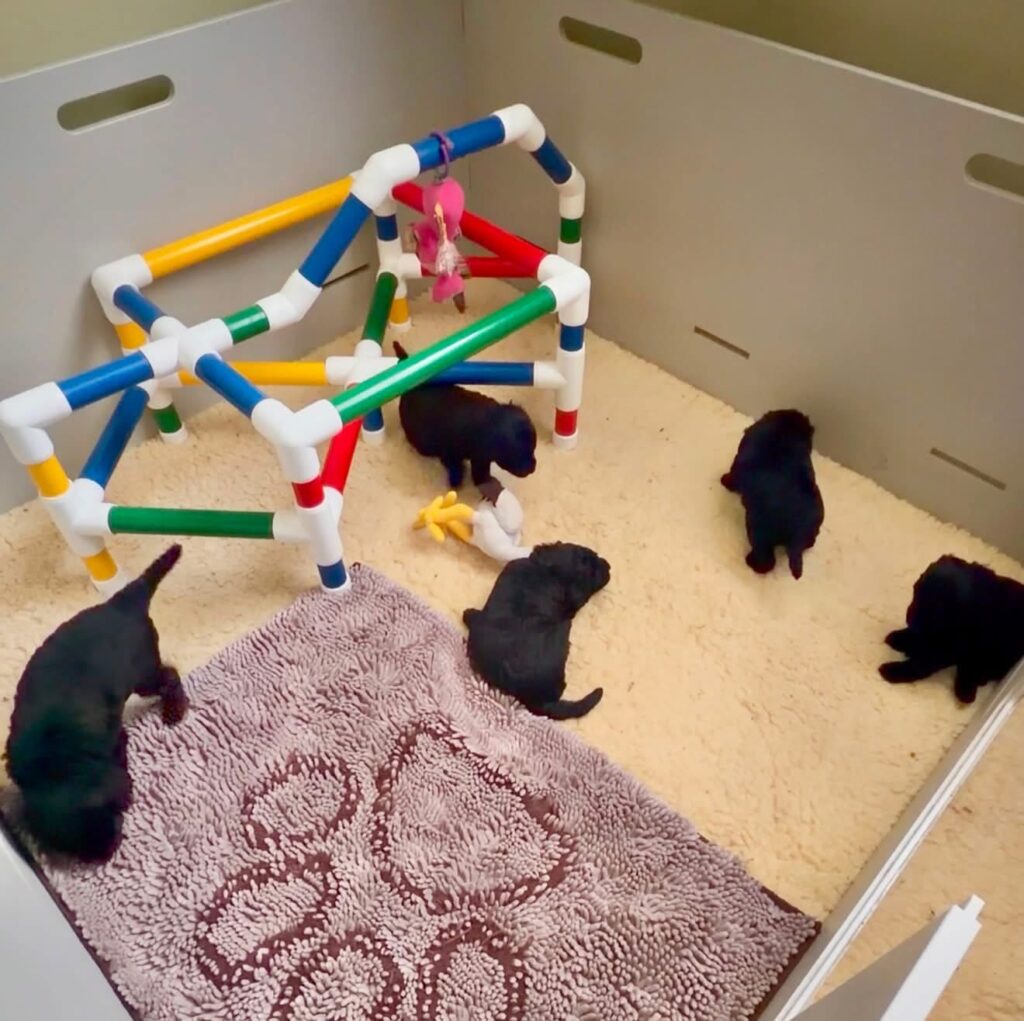
My puppies do not wear colored collars.
To many people, that probably sounds like an insignificant preference. After all, what difference could a narrow strip of soft fabric possibly make during the few weeks before puppies leave for their new homes?
Perhaps very little.
Yet breeding has a curious way of teaching that the smallest decisions often reveal the deepest philosophy. Long before we evaluate a pedigree, assess structure, analyze movement, or decide whether a dog should remain in a breeding program, we have already developed a habit of asking questions about the ordinary details that most people simply accept without much thought.
That habit has become one of the most valuable lessons breeding has ever taught me.
Not because every long-established practice deserves criticism, nor because every modern innovation should be viewed with suspicion, but because responsible stewardship requires distinguishing between what is genuinely necessary and what has merely become customary through repetition.
Good stockmanship has always depended less upon finding quick answers than upon learning to observe quietly before reaching conclusions.
Over time, that way of thinking has quietly shaped nearly every aspect of my breeding program, from the way I formulate diets and introduce environmental enrichment to the methods I use for early neurological development, the criteria by which I evaluate breeding stock, and even the seemingly ordinary decisions that unfold each day inside the puppy room.
And yes, that philosophy extends even to something as seemingly ordinary as whether a neonate should wear an identification collar.
Few periods in a dog’s life rival the pace of change that unfolds during those first weeks inside the whelping box. A puppy enters the world with an immature nervous system, closed eyes and ears, limited mobility, and complete dependence upon its dam. Within only a few weeks, however, that same puppy progresses through the neonatal and transitional periods into an increasingly aware, mobile, and socially responsive individual as neurological maturation, musculoskeletal development, sensory perception, and behavioral responses unfold in remarkable synchrony. For a breeder, this period represents far more than normal growth. It is the stage at which inherited potential gradually begins expressing itself, as genotype slowly gives rise to phenotype through movement, recovery from novelty, social interaction, curiosity, environmental confidence, and countless subtle behavioral tendencies that can only be appreciated through careful, uninterrupted observation.
Perhaps that is why these earliest weeks have always inspired a certain degree of humility in me.
When so much is changing, I have become increasingly reluctant to introduce anything that serves no meaningful purpose for the puppy itself.
That simple question has quietly guided countless decisions throughout my breeding program.
If something is not truly necessary, why add it?
Lightweight identification collars certainly can be used successfully, and many conscientious breeders manage them with great care. They are adjusted repeatedly to accommodate rapid growth, inspected frequently to ensure an appropriate fit, and monitored throughout the day as puppies nurse, sleep, crawl over one another, burrow beneath littermates, stretch, and gradually begin exploring the boundaries of their world.
Could a properly fitted collar remain around a puppy’s neck without incident?
Very likely.
Yet years spent breeding have gradually shifted the question I ask myself. Rather than wondering what usually happens, I find myself considering whether the practical convenience offered by a collar justifies introducing another variable during one of the most dynamic developmental periods a dog will ever experience.
If a collar were to catch on bedding, slip beneath a littermate, tighten unexpectedly, or simply restrict movement until someone noticed, perhaps nothing important would happen.
Or perhaps it would create unnecessary discomfort for a puppy whose body is developing literally hour by hour.
For me, there is simply no meaningful advantage that outweighs eliminating even a small, unnecessary variable during such a critical stage of development.
Perhaps one of the most difficult lessons breeding has taught me is that good husbandry is often defined less by intervention than by restraint.
Identification collars exist primarily because they serve the needs of the people caring for the litter. They simplify record keeping, make individual puppies easier to recognize, and help families follow a particular puppy from one update to the next. Those are practical advantages, and I understand why many excellent breeders choose that approach. They simply do not outweigh the priorities that guide my own program.
My responsibility has never been to make social media easier to follow or to create an experience that resembles selecting a puppy from an online catalog. It is to make thoughtful decisions that place the welfare and long-term development of the puppies above my own convenience and above the expectations of an audience watching from a distance.
If my reasons ended there, however, this would merely be an article about collars.
It is not.
The fabric itself is almost incidental, because the question that has occupied my thoughts for many years has very little to do with collars and everything to do with the way we have gradually come to think about puppies.
The moment a litter becomes “Blue Collar,” “Green Collar,” or “Purple Collar,” the conversation quietly begins to change. Families naturally start choosing favorites, becoming attached to a particular color, replaying the same videos, waiting for updates on one puppy, and imagining a future with an individual whose temperament is still unfolding and whose suitability for their household cannot yet be responsibly assessed.
Many evenings I find myself sitting quietly beside the whelping box long after the day’s work has been finished, watching what at first appears to be nothing more than a sleeping pile of puppies as one stretches, another sighs, a third instinctively burrows beneath a littermate, and their dam gently gathers them closer without ever fully waking. To someone passing by, very little seems to be happening. To a breeder, however, those quiet hours often reveal more than the busiest moments of the day.
That response is entirely human.
It is also the opposite of what I hope families will experience.
I want them to appreciate the litter before becoming attached to an individual puppy, because the puppies themselves are still revealing who they are.
A camera, by its very nature, preserves moments. Breeding, on the other hand, requires observing a process, because temperament does not reveal itself in a single photograph or even in a handful of charming videos, but gradually emerges through countless ordinary interactions that unfold hour after hour and day after day inside the whelping box.
A recording may capture a puppy confidently climbing over a littermate, investigating a novel object, or peacefully falling asleep in someone’s hands, and every one of those images is genuine. What it cannot convey is the context surrounding that brief moment or the hundreds of observations that came before and after it.
Long before anyone else is awake, I have watched which puppy recovers most quickly after an unexpected sound, which one pauses to assess a new environment before moving forward, which littermate naturally initiates play, which seeks reassurance from its dam, which persists when confronted with a small challenge, and which quietly settles once the excitement has passed. None of those characteristics appear on command because a camera happens to be recording. They reveal themselves gradually through repetition, consistency, and careful observation as each puppy progresses through successive developmental stages.
Perhaps that is why I have never believed puppies should be selected from photographs or social media updates.
I believe they deserve to be thoughtfully matched.
There is an important distinction between those two ideas.
Choosing often begins with personal preference, appearance, or an emotional response to a particular moment. Matching requires something quite different. It asks the breeder to consider the developing temperament of each puppy alongside the temperament, expectations, experience, and lifestyle of the family who will ultimately be entrusted with that dog’s future.
Whenever I share photographs or videos, my hope is never that someone becomes attached to a single puppy whose personality is still unfolding. I hope they appreciate the litter as a whole, because these puppies have experienced every stage of early development together. They have nursed beside one another, slept in the same warm pile, explored unfamiliar surfaces together, negotiated their earliest social relationships, and gradually begun discovering both the world around them and their place within it.
By the time families come to meet the litter, I have already accumulated weeks of observations that no camera could ever fully capture. I have watched confidence emerge, resilience strengthen, curiosity deepen, social preferences become more apparent, recovery from novel experiences become increasingly consistent, and individual behavioral tendencies begin to separate from the collective rhythm of the litter.
Those observations carry far greater weight than whichever puppy happened to glance toward the camera at precisely the right moment.
That is why my puppies do not wear colored collars.
Not because I believe breeders who use them are mistaken, nor because I think the collars themselves define good or bad husbandry, but because they encourage a way of seeing puppies that has never reflected my own philosophy.
Perhaps that is what breeding has taught me more than anything else. Every litter presents countless decisions that appear insignificant when viewed in isolation, yet when those decisions are repeated year after year and generation after generation, they quietly become the philosophy by which an entire breeding program is known. For me, every decision ultimately returns to the same question: “What best serves the puppy?” Breeding has taught me that stewardship is often measured less by the things we add than by the things we quietly decide are unnecessary. That is why I would rather spend those first precious weeks learning who each puppy is becoming than teaching the world to recognize them by a color, because every puppy deserves to be understood before it is identified, and thoughtfully matched before it is chosen. 🐾🖤🐾


Leave a Reply