

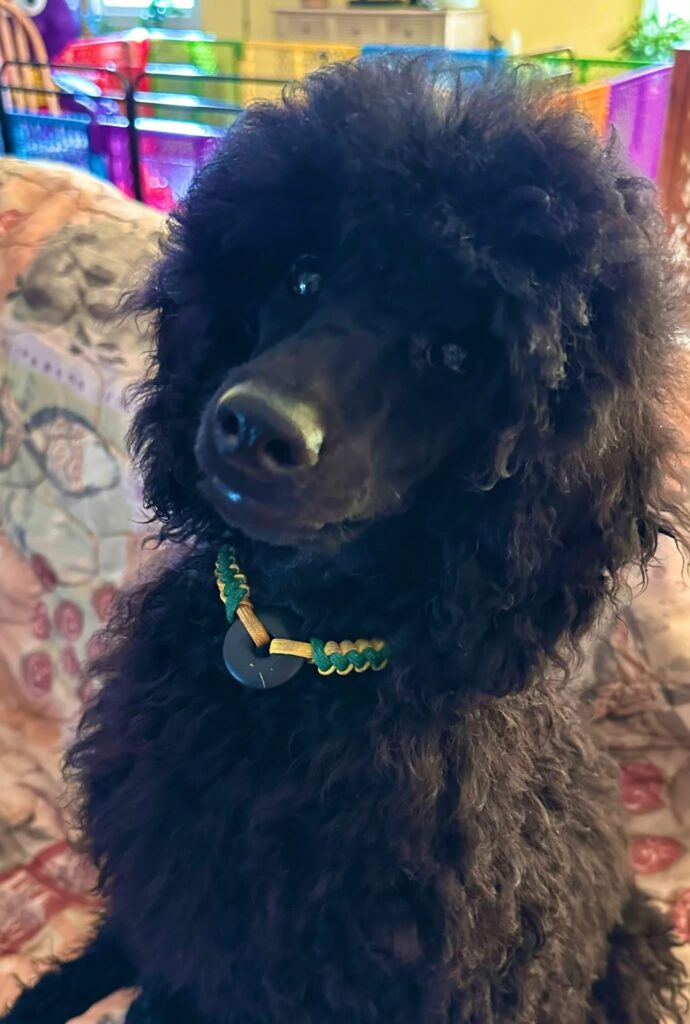
Poodles are capable dogs. They are observant, quick to learn, interested in what is happening around them, and often far more willing to participate than people expect from a dog they first noticed because of its haircut. I love that about them. But owning an intelligent, athletic breed comes with a responsibility to provide a life that allows those qualities to develop without turning every day into either confinement or overstimulation.
I think we sometimes make a strange bargain with our dogs. We want them quiet while we are busy, still while we are tired, entertaining when we need cheering up, and ready for activity when we finally have time. We expect them to move easily between all of those roles, and when they struggle we start looking for something to add. More training, more exercise, another toy, another calming product, another activity to wear them out. Before adding anything, I want us to look honestly at the pattern of the dog’s day.
Does it have opportunities to move at a comfortable pace and investigate its surroundings? Does it know how to rest without being constantly entertained? Is its exercise varied, or are we repeating the same high-excitement game because it is convenient for us? Does it spend time with people in ways that do not always involve commands, restraint, or performance? Is there enough predictability to feel secure and enough appropriate variety to keep life interesting?
With puppies, this requires patience. A young Poodle can learn something quickly and still need time to develop the confidence, coordination, and self-control to manage it in different circumstances. Understanding a command does not mean the puppy has become an adult. We need to be careful about increasing demands simply because the puppy is clever enough to figure out what gets a reward.
I also want us to stop measuring exercise only by how exhausted the dog looks afterward. An outing can be valuable because the dog explored, practiced moving thoughtfully, encountered something manageable, and came home able to settle. The goal should be a capable dog who enjoys its life, rather than a dog we must repeatedly push to exhaustion so that our evening becomes easier.
For older dogs, the question changes again. What can this dog comfortably do now? What modifications would help it continue participating? Is the surface slippery? Is access to a favorite resting place becoming difficult? Has the family reduced activity because the dog is slowing down without asking whether discomfort is contributing? A changing dog needs a changing plan, and that plan is best developed with the veterinary team when medical concerns are present.
There is also a responsibility to recognize when our own household has become too demanding for an individual dog. Several dogs living together does not automatically mean each one feels secure or gets what it needs. Temperaments differ. Relationships differ. A dog that continually avoids interaction deserves our attention, even if the arrangement works well for everyone else.
I want my Poodles to have lives that make sense to them. That requires observing the individual instead of assuming that the breed description, the age, or what worked for another dog tells me everything. Loving an athletic, intelligent breed should make us more interested in meeting those needs thoughtfully, not more confident that the dog will adapt to whatever life we happen to provide.


Leave a Reply