


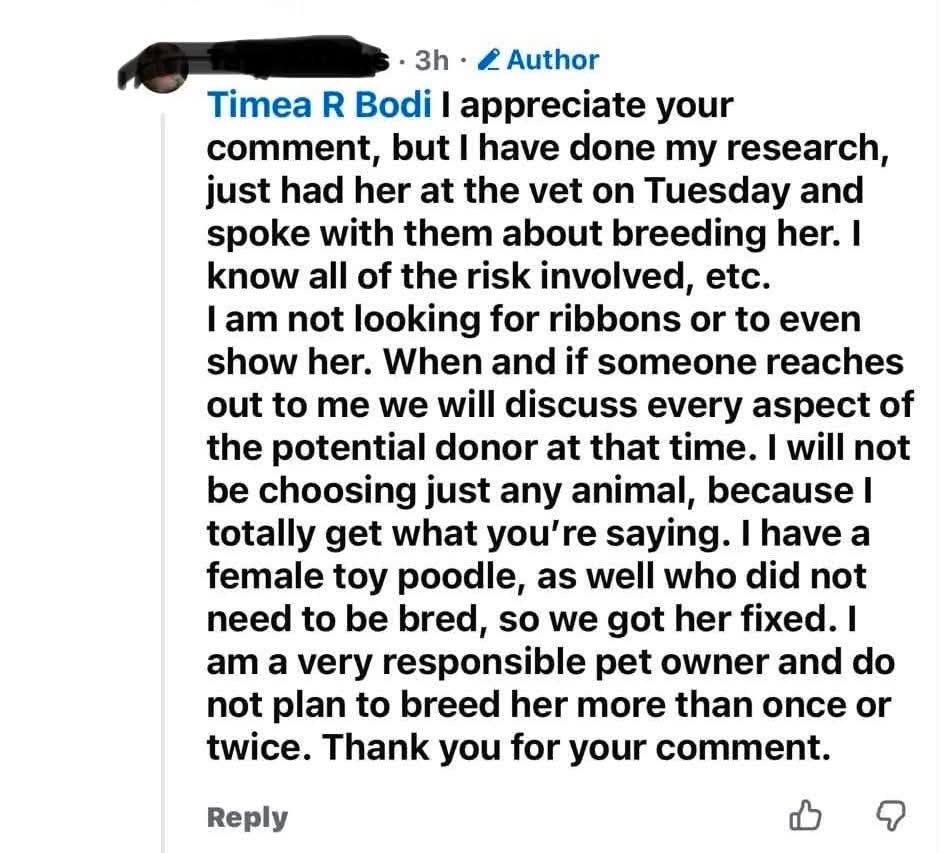
This exchange stayed with me for days.
Not because I think the veterinarian gave bad medical advice. I don’t.
It stayed with me because it reminded me how easily “your dog is healthy enough to carry puppies” can become “my veterinarian thinks my dog should be bred.”
Those are two very different questions.
I have been thinking a lot over the last couple of days about where the responsibility of a veterinarian actually ends. I don’t mean legally. I don’t mean ethically in the broadest sense because I think most veterinarians genuinely want to do what is best for the animals they care for. I mean where we quietly draw the line in our own minds between, “This is my responsibility,” and, “That belongs to somebody else.”
I don’t know exactly why this has been occupying so much space in my head lately. Well, actually I do know. It started with a Facebook post, but the more I thought about that Facebook post the less it seemed to matter because the post wasn’t really the story. It simply reminded me of something I have been watching happen for years without ever quite putting my finger on why it bothered me so much.
A woman had a young merle dog she wanted to breed and was looking for a stud. Within a couple of hours, the comment section filled up exactly the way these conversations so often do, not with thoughtful questions about pedigree, structure, temperament, breed type, or whether the dog had completed the appropriate health testing, but with people advertising their own males and assuring her how wonderful their dogs were. Doodle breeders and backyard breeders crowded into the conversation, each one offering a dog, praising color or personality, and speaking with complete confidence, yet I did not see a single person present meaningful health clearances, discuss the pedigree behind the proposed breeding, or ask what the breeding was actually intended to preserve or improve.
And apparently the fact that the dog was merle, a color that does not belong in the Poodle breed in the first place, was not worth interrupting the sales pitch. Somewhere in the middle of all of that she wrote one sentence.
“My veterinarian said it was okay to breed her.”
I remember reading that sentence and not thinking much of it at first. After all, it sounded perfectly reasonable. The more I thought about it, though, the more I found myself coming back to those eight words. Not because I thought the veterinarian had done anything wrong. Quite the opposite, actually. I suspect they answered the question exactly as they understood it, and I have no reason to believe they answered it incorrectly.
What I started wondering was whether the owner had walked away believing she had received the answer to an entirely different question.
That thought has been rattling around in my head ever since.
When I first became interested in veterinary medicine, I thought the responsibility of veterinary medicine was beautifully simple. Learn enough anatomy that you understood how the body fit together. Learn enough physiology that you understood how it worked. Learn enough pathology to recognize when something had gone wrong. Learn enough about surgery to understand what could be repaired and enough medicine to help relieve suffering when it couldn’t. That seemed like a pretty noble way to spend a life, and at the time I don’t remember questioning it any further than that.
The funny thing about veterinary medicine is that we spend years learning how to recognize healthy animals and diseased animals and somewhere in the middle of all of those anatomy classes and pathology lectures and reproductive physiology and surgery and pharmacology and everything else they somehow manage to cram into our brains, I don’t remember anyone ever stopping to say “Now let me explain something that is going to become incredibly important twenty years from now. A healthy dog and a breeding quality dog are not necessarily the same thing.”
I’ve thought about that many times since, and I still don’t know exactly why that distinction was never emphasized. Maybe everyone assumed it was self-evident. Maybe it belonged to another discipline. Or maybe it was simply one of those things people expected experience to teach. Whatever the reason, I don’t remember anyone ever having that conversation with us.
What I do know is that I don’t remember ever thinking about it when I first became interested in veterinary medicine because, if I am being completely honest, I thought healthy was the finish line. If the dog was healthy and the bloodwork looked good and the heart sounded normal and the hips passed and she was physically capable of carrying puppies, then what else was there to think about?
As it turns out, that wasn’t even the real question.
I remember feeling almost embarrassed when that realization finally hit me because it seemed so obvious once I saw it. I had spent years studying disease, physiology, pathology, surgery, reproduction, and pharmacology. Yet nowhere in all of that training had I really stopped to ask what made one healthy dog worth preserving while another healthy dog was simply healthy.
I didn’t begin to understand that until years later, somewhere between watching my parents preserve bloodlines in Europe while I was trying to do the same here in America.
I grew up listening to breeding decisions discussed around the dinner table long before I understood what any of it meant. Back then they sounded like endless conversations about shoulders, toplines and pedigrees. Years later I realized those conversations were never really about dogs. They were about responsibility.
My friends were spending Saturdays watching football. I was sitting in hotel conference rooms listening to lectures on coefficient of inbreeding, orthopedic biomechanics, population genetics, and reproductive physiology. Looking back, it probably sounded like a terrible way to spend a weekend. To me, it felt like somebody was finally answering questions I didn’t even know how to ask in veterinary medicine.
I filled notebooks with genetics lectures that most people would probably consider painfully boring. I sat ringside at dog shows watching dogs move because I wanted to understand why one dog remained sound at fourteen while another struggled at six. I sought out breeders whose families had spent generations protecting a single breed, and somewhere along the way I realized that no single litter ever changes a breed.
That was the moment I realized medicine and preservation weren’t disagreeing. They were simply asking different questions.
Once I understood that, I began looking at every breeding decision through a different lens.
I think one of the greatest misunderstandings is that people hear the word conformation and immediately think beauty. Yet conformation has never really been about beauty at all. It is anatomy expressed in motion. It is the architecture and engineering of a body expected to perform its job efficiently, year after year.
Every shoulder angle changes how force travels through the front assembly every time a dog lands after a jump. Every pelvic angle changes efficiency, propulsion, and the stress placed on the hips and stifles. Every bite changes how the jaw functions over thousands upon thousands of repetitions throughout a lifetime. Every proportion influences balance, endurance, efficiency, and wear on the body.
The breed standard was never meant to be a beauty contest. It was written to describe the structure that allowed a breed to perform the work it was developed to do while remaining sound for as many years as possible.
We don’t tell someone that because their knees are healthy they are automatically an Olympic runner. We don’t tell someone that because their hands are healthy they are automatically a concert pianist. Physical capability makes excellence possible, but it never defines excellence. Breeding is no different. Good health is the foundation upon which good breeding is built. It has never been the entire building.
Once I understood that, I also understood why a perfectly healthy dog is not automatically a breeding-quality dog. Health answers whether reproduction is medically possible. Structure, temperament, pedigree, purpose, and generations of selection begin answering whether reproduction should happen at all.
The older I get, the more I realize people almost never breed dogs because they’ve spent twenty years studying population genetics. They breed because they love their dog. They want another one just like her. They want their children to experience puppies. Those are deeply human reasons, and I understand every one of them. The problem is that understandable reasons and responsible reasons are not always the same thing.
I don’t think the problem is that veterinarians don’t care. I think the problem is that somewhere over the last few decades we quietly replaced one goal with another and hardly anyone noticed it happening. We became incredibly good at preventing disease, extending life, repairing injuries, managing chronic illness and improving welfare for the individual animal standing in front of us. Those are extraordinary accomplishments and I wouldn’t trade them for anything. But somewhere while we were getting better at protecting individual dogs, I wonder if we slowly stopped asking who was protecting the breed itself.
The strange thing is that none of us intentionally blurred that distinction. I certainly didn’t. When I first became interested in reproduction, I looked at breeding through the same lens veterinary medicine had taught me to use. Was the dog healthy? Were the hips acceptable? Were the eyes normal? Was there a medical reason not to proceed? Those seemed like the important questions because they were the questions I knew how to answer. It took years before I realized I was standing in the wrong room asking the wrong questions.
The more generations of dogs I watched grow up and grow old, the more I noticed that the dogs who seemed to hold onto soundness, resilience, longevity, and stable temperaments rarely got there by accident. They were the product of people who spent years saying no far more often than they said yes. They passed over attractive dogs because the structure wasn’t quite right. They retired promising dogs because the temperament wasn’t exactly what they wanted to preserve. They looked beyond the individual standing in front of them and kept asking what that dog’s grandchildren might inherit.
I don’t think either way of thinking is more important than the other. They’re simply different. Veterinary medicine taught me to look carefully at the dog standing in front of me and ask how I could help that individual animal. Preservation breeding gradually taught me to keep one eye on dogs I would never meet, because every breeding decision reaches farther into the future than any examination ever can.
That may sound like splitting hairs, but I don’t think it is. Every generation inherits the consequences of the generation before it. If the people before us had not been willing to make difficult breeding decisions, there would be no recognizable breeds left to preserve today. We inherited their discipline just as surely as we inherited the dogs themselves.
I sometimes think about old orchards when I think about breeding. A person planting apple trees rarely expects to sit under the shade of the mature trees or eat fruit from every branch they planted. They plant knowing someone else will enjoy much of what they started. If they choose weak rootstock because it is convenient, or neglect the young trees because the damage isn’t immediately visible, the orchard may still produce fruit for a while, but sooner or later the weaknesses reveal themselves. The people walking through the orchard decades later may never know who planted the first trees, yet they live with every decision that person made.
This is why simply saying a dog is healthy has never been enough. If health alone qualified an animal for breeding, then every healthy stray, village dog, mixed breed, or farm dog should have been incorporated into every breeding program simply because nature made reproduction possible. Nobody actually believes that. Deep down we all understand that physical capability is not the same thing as genetic stewardship. Nature makes reproduction possible. Human beings decide what they choose to preserve, and those decisions echo far beyond the lifespan of any one dog.
What struck me most was how quickly the discussion narrowed to what could be measured today. DNA panels. Health testing. Coat color. OFA numbers. Almost nobody stopped to ask the question that had been bothering me from the beginning.
Should this dog be bred at all?
Some of the dogs being recommended were mixed breeds. Others were purebred dogs whose structure had drifted remarkably far from the written standard. Yet those distinctions barely entered the conversation. Health had quietly become the finish line.
And perhaps that is where our profession has an opportunity. No veterinarian can know everything about every breed or replace the knowledge of people who have devoted decades to preserving one. We can, however, recognize that the conversation does not necessarily end when the medical questions have been answered. Sometimes the greatest service we can provide is helping someone think beyond today’s dog toward the generations that will follow and the foundation they will inherit.
I understand why those conversations often don’t happen. I have worked in busy practices. I know what it feels like to glance at the schedule and realize you are already thirty minutes behind before lunch. The phone is ringing, somebody has an emergency squeezing through the front door, another client is waiting for biopsy results, the technician needs an answer, and now someone wants to know whether they should breed their dog. You know before you even begin that an honest answer is no longer just about progesterone timing, cesarean sections, or hereditary disease. You are talking about genetics, structure, temperament, purpose, history, and whether this particular dog leaves the breed stronger than it found it. That conversation doesn’t fit neatly into a fifteen-minute appointment.
I also think veterinarians are, by nature, helpers. Most of us genuinely don’t enjoy disappointing people, and telling someone the dog they adore probably shouldn’t contribute to the next generation feels deeply personal. Medicine often gives us answers grounded in measurable facts. Preservation asks us to make judgments about the future.
“What is it that you are hoping to preserve?”
I keep coming back to those words because they change the conversation without accusing anyone of anything. They invite reflection instead of defense. An owner doesn’t have to abandon the idea of breeding, and a veterinarian doesn’t suddenly have to know the complete history of every breed. The question simply shifts the focus from whether puppies can be produced to whether producing them serves a purpose that reaches beyond this one generation.
The owner may have spent years studying pedigrees, working with mentors, and evaluating structure, health, temperament, and longevity, with thoughtful reasons behind every decision. If so, those are exactly the conversations we should encourage. There may also be no answer, simply because no one has ever asked the question. And if no one asks, how does anyone learn that breeding has always been about far more than reproduction?
Somewhere twenty years from now, a veterinarian will examine a dog that hasn’t even been conceived yet. They may diagnose arthritis, repair a cruciate ligament, reassure an owner about a heart murmur or help manage epilepsy. They will almost certainly never know that the story of that dog began decades earlier in an ordinary fifteen-minute conversation where everyone involved believed they were doing the right thing.
That’s the thing about breeding.
By the time medicine finally meets the patient, genetics has already written the opening chapters.
Looking back, I no longer think our responsibility ends when someone asks, “Can she have puppies?”
I believe it begins the moment someone asks, “Should she?”


Leave a Reply