

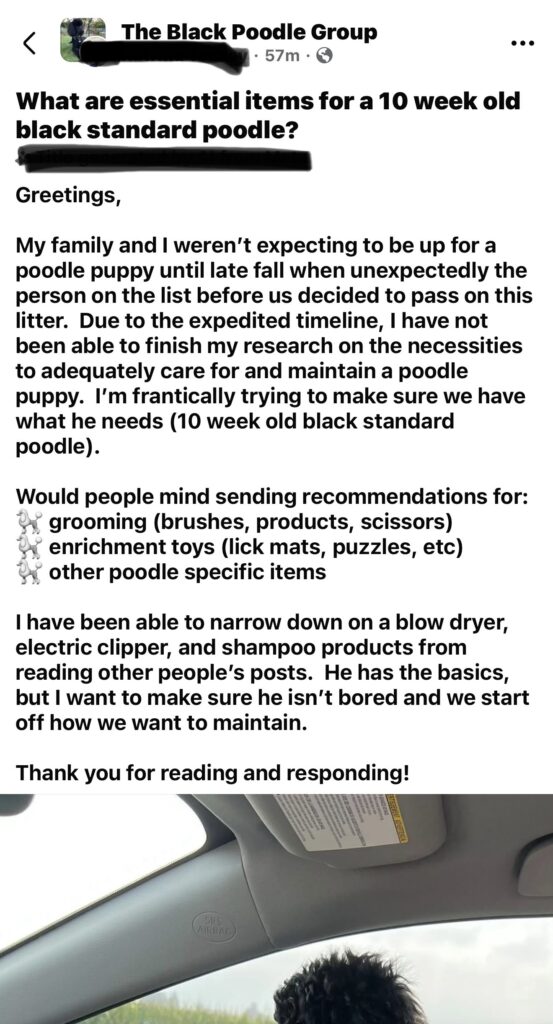
I wonder how many people will read this post and notice what immediately caught my attention, because I have a feeling that most readers will do exactly what we have all been conditioned to do. They will begin answering the question. They will recommend the best slicker brush, their favorite dryer, a shampoo they swear by, nail clippers, lick mats, puzzle toys, enrichment ideas, and every other item they believe a new puppy owner should have waiting at home.
There is nothing wrong with those answers. In fact, many of them are helpful.
But as I continued reading, I found myself asking a completely different question, one that had nothing to do with grooming supplies or shopping lists.
Where is the breeder?
Before someone responds by saying, “Well, the new owners have responsibilities too,” let me say that I could not agree more.
Of course they do.
Bringing a puppy into your home is not a casual decision. It is the beginning of a commitment that will shape the next ten to fifteen years of your life. New owners should read, ask questions, make mistakes, continue learning, seek out good information, and grow alongside their dog because no one is born knowing how to raise a puppy well. Experience is something we all earn over time.
But none of that lessens the responsibility of the breeder.
If anything, it makes that responsibility even greater, because the breeder is the only person in that relationship who begins with years of experience while the family begins with hope, excitement, and often a great deal of uncertainty.
I have often thought that the role of a breeder changes over time.
In the beginning, we are the parents. We are the ones who planned the litter, stayed awake through whelping, celebrated every milestone, worried over every setback, and devoted ourselves to giving each puppy the strongest possible start in life.
But the day that puppy leaves for its new home, something changes. We are no longer the ones making the day-to-day decisions. That is when we become more like grandparents.
We step back just enough for the new family to become the parents that puppy now needs, but we never stop carrying the family history. We remember where that puppy came from, we understand generations of temperament, health, and behavior, and we remain available whenever experience can spare someone from learning the hard way.
To me, that is exactly what a good breeder should become.
Which is why, whenever I read posts like this, my mind goes somewhere completely different.
Not because someone is asking which brush to buy, or which dryer they should purchase, or what kind of enrichment toys their puppy might enjoy. Those are all perfectly reasonable questions for a first-time owner to ask.
What gives me pause is something much deeper.
It is the realization that this family’s first instinct was not to turn to the person who brought this puppy into the world, the person who knows its parents, its pedigree, its temperament, its early development, and the foundation that was carefully laid during those first precious weeks of life.
Instead, their first instinct was to ask hundreds of strangers.
That, to me, is the real problem.
The day one of my puppies leaves my home has never felt like the end of my responsibility.
In many ways, it feels like the beginning of a different one.
That is the moment when my role quietly changes from breeder to mentor. I may no longer be the one feeding that puppy every morning or tucking it into bed every night, but I remain someone who can offer perspective, reassurance, encouragement, and experience whenever a family needs it. Because raising a puppy was never meant to be a journey taken alone, and neither was breeding one.
I want every family who takes one of my puppies home to know that they can call me whenever they need to, whether they are uncertain about something, feeling overwhelmed, celebrating a milestone, worried about a behavior they have never seen before, or simply looking for reassurance from someone who has already walked this road many times before. To me, that has always been part of breeding. Producing a healthy puppy is only the beginning of a breeder’s responsibility. I have always believed that my responsibility extends to helping families become confident, knowledgeable owners because those two things can never truly be separated.
Somewhere along the way, however, I think we quietly lowered the bar without even realizing it. We began accepting the idea that a breeder’s responsibility ends the moment the payment is made, the paperwork is signed, and the puppy walks out the front door, as though everything that follows somehow belongs to someone else.
But if that is true, then I cannot help but ask a much larger question.
If a breeder’s responsibility truly ends the day a puppy goes home, then what exactly are people paying for?
Surely they are paying for far more than the first few weeks of a puppy’s life. They are paying for years of knowledge, experience, careful planning, thoughtful decisions, and a breeder who has spent countless hours studying bloodlines, evaluating temperaments, understanding the strengths and weaknesses within a pedigree, and giving that puppy the very best possible foundation before it ever joins its new family.
A puppy is not a finished product that leaves with a receipt.
It is the beginning of a relationship.
No one should know that puppy more intimately than its breeder. No one should better understand the story that came before it, the generations that shaped it, the temperament inherited from its parents, the developmental experiences it has already had, or the small mistakes that could so often be avoided with nothing more than a simple phone call at the right moment.
Yet far too often, new owners find themselves standing at the edge of the internet, searching for answers from complete strangers and hoping that somewhere among hundreds of opinions they will stumble upon the right one. Some of those opinions come from experienced breeders and professionals, others from people who genuinely want to help but have very little experience, and still others from individuals who speak with great confidence despite knowing very little. For someone bringing home their very first puppy, how could they possibly know the difference?
And then we wonder why so many owners become overwhelmed, why small misunderstandings quietly grow into behavioral problems that might have been prevented, why families begin losing confidence in themselves, why dogs are surrendered, or why people eventually conclude that poodles, or dogs in general, are simply “too much work.”
We spend an extraordinary amount of time trying to repair the consequences of poor beginnings while rarely stopping to ask whether the real problem started long before the puppy ever reached its new home, because perhaps instead of asking how we can fix the outcome, we should first be asking why so many families are left to navigate the beginning without the one person who should still be walking beside them.
Now imagine for a moment what might happen if we truly decided to raise the bar, not just for breeders, but for everyone who becomes part of a puppy’s life from the day it is born until the day it takes its last breath.
Imagine if prospective owners stopped asking only, “Who has puppies available?” and began asking a much more important question: “Who will still be answering my phone calls five years from now? Who will still be interested in this dog’s well-being long after the excitement of bringing a puppy home has faded?”
Imagine if breeders measured their success not by how quickly every puppy found a home, but by how confident, supported, and educated their families felt years later. Imagine if our greatest source of pride was not a waiting list or a full deposit book, but knowing that every family who entrusted us with their future companion also gained a lifelong mentor they never hesitated to call.
Because the truth is that healthy dogs are never created by breeders alone.
A truly healthy dog is the result of an entire community of people who understand that each of them carries a different piece of the responsibility. The breeder needs families who are willing to keep learning long after the puppy comes home. Those families need breeders who remain available to guide them when experience is still being built. Veterinarians need owners who are informed and engaged enough to recognize problems early and ask thoughtful questions. Owners need veterinarians who appreciate that preserving health is just as important as treating disease. Trainers, groomers, nutritionists, breeders, and families all become part of the same story, each strengthening the work of the others until the dog is surrounded by people who are all moving in the same direction.
When I think about it, I don’t see a straight line with one person handing responsibility to the next.
I see a circle.
And at the very center of that circle sits the dog, quietly depending on every one of us to fulfill the role we accepted the day we chose to become part of its life.
The moment one part of that circle disappears, whether it is the breeder who no longer answers the phone, the owner who stops learning, the veterinarian who overlooks prevention, or any of the countless people whose knowledge and experience should complement one another, the dog is almost always the one who pays the price.
We spend an extraordinary amount of time asking ourselves how we can produce healthier dogs, stronger temperaments, longer lives, and happier families, but perhaps we have been asking the wrong question all along.
Perhaps the real question is not simply how we produce better dogs, but how we build better relationships around every dog we choose to bring into this world.
Because no puppy is raised by genetics alone.
A puppy is shaped by the breeder who never stops answering the phone, the family who never stops learning, the veterinarian who continues asking thoughtful questions, the trainer who teaches with patience, the groomer who notices the smallest changes before anyone else does, and every other person who understands that they are not working independently but contributing to something much larger than themselves.
The best dogs are rarely the work of one exceptional individual. They are the result of an entire community that refuses to walk away when the puppy leaves for its new home.
Perhaps the next time we see a new puppy owner asking the internet what brush to buy, what food to feed, or how to solve the latest challenge, before we rush to offer our own advice, we should stop and ask a different question.
Where is the breeder?
Because the answer to that one question often tells us everything we need to know.


Leave a Reply