

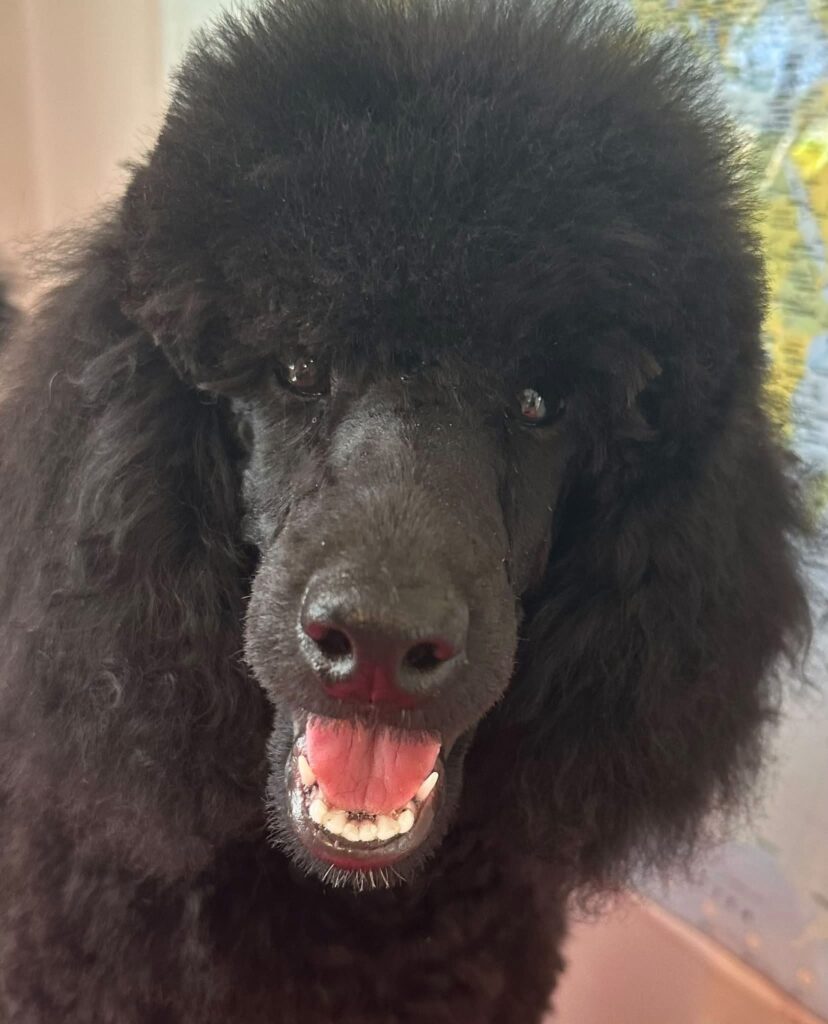
A few mornings ago, one of my young Poodles was watching me from across the grooming room with that suspiciously intelligent look Poodles have perfected. She looked as though she understood the entire situation and was simply waiting to see how long it would take the human to catch up. The dryer was running, towels were turning in the washing machine, something wrapped in freezer paper was thawing in the sink, and the guinea fowl were outside screaming as though a federal crime had been committed near the chicken coop. Nothing had happened, of course. Nothing ever has to happen for guinea fowl to call an emergency meeting.
While brushing through her coat, I kept thinking about something a breeder had written: “I do this because you cannot buy one. You have to make one.”
I knew exactly what she meant. Anyone who stays in a breed long enough eventually develops a picture of a dog that does not quite exist yet. One family may carry the health and longevity you admire, another may have the temperament, and a third may offer the structure. Somewhere in an older pedigree might be a quality the breed is slowly losing because everyone is busy breeding whatever happens to be winning right now. After enough years of studying dogs, pedigrees, health, movement and generations, the thought naturally comes: maybe I could bring those pieces together.
That is the part of breeding most people never see. They see puppies. They see cute photographs, ribbons and litter announcements. They do not see the years spent studying a family of dogs, the expensive prospect who did not turn out, the breeding that never took, the health test that ended a plan or the old dog whose care changed everything. Thoughtful breeders remain involved because the possibility of producing something truly valuable is hard to walk away from, even though breeding has a remarkable ability to consume money, disrupt normal life and defeat carefully made plans.
Unfortunately, that same dream can also get a person into trouble.
A breeder may honestly believe she is protecting an important family of dogs, but that explanation can eventually justify keeping more animals than she can manage well. Devotion can carry a person through difficult years, then become the reason she no longer knows when to stop. A breeding program may give someone purpose and community until so much of her identity is wrapped around it that reducing the number of dogs feels like losing part of herself.
Ambition does not always walk into the room looking ugly. Sometimes it arrives dressed up as preservation, dedication or love.
Most conversations about becoming a breeder begin with evaluating the dog. Does she meet the standard? Is her temperament correct? Has she completed the necessary health testing? Does her pedigree contain something worth carrying forward? Which male would complement her, and what weaknesses might appear? Those are important questions, but perhaps we have them in the wrong order.
Before evaluating the breeding dog, we should probably spend more time evaluating and preparing the breeder.
I am not talking about creating another committee to decide who is worthy of entering the dog world. We already have enough politics, gatekeeping and people guarding pedigrees as though God personally appointed them keeper of the kingdom. My Romanian side questions authority almost automatically, which tends to be inconvenient for anyone hoping I will simply nod and behave.
The evaluation I mean belongs first to the person who wants to breed. Long before the progesterone tests, stud contracts, deposits and carefully staged photographs of newborn puppies, one question needs an honest answer: what is actually pulling you toward this?
Everyone learns to say, “I want to improve the breed.” It sounds respectable and usually ends the conversation. The real answer may involve a messy combination of loving puppies, being fascinated by genetics, wanting recognition, hoping to earn money, enjoying competition, feeling attached to one special dog or believing that something valuable within the breed is disappearing. Most human motivations are not pure enough to fit neatly into the stories we tell about ourselves. I do not think they have to be pure, but they damn sure need to be honest.
Loving puppies does not make someone a bad candidate for breeding, but puppies cannot carry an entire breeding life. Enjoying dog shows is not a character flaw, although ribbons make poor compasses. Making money is not automatically corrupt, but needing the next litter to pay overdue bills creates pressure that should not be ignored. Wanting a puppy from a beloved dog may lead someone into serious study, yet love is not the same thing as an objective breeding evaluation.
A pretty dog is not automatically a breeding dog. A nice pet is not automatically a breeding dog. A championship is not automatically proof of reproductive value, and passing health tests does not mean the dog has nothing else to teach us. Breeding begins to become responsible only when the person can place the needs of the dogs and the breed above whatever she hoped to gain from doing it.
My own opinions were not formed while standing outside this life telling breeders what they should do. They came through veterinary clinics, grooming tables, dog shows, raw food, pedigrees, long drives, European breeding relationships, puppy families, aging animals and enough humming freezers to make the electric company suspicious. Some lessons were wonderful. Others cost a great deal of money, sleep and confidence.
Nature has no respect for our plans. An extraordinary puppy can mature in the wrong direction. A costly prospect may fail the one test that matters. The dog everyone admires may carry a weakness hidden beneath coat, type and presentation. A combination studied for years may produce nothing at all. Meanwhile, keeping one more promising youngster always seems manageable until all those individually reasonable decisions begin demanding attention at exactly the same time.
Capacity is where many good intentions begin falling apart because capacity does not stay the same.
What a breeder managed beautifully at thirty-five may become difficult at fifty-five. A household that worked well with a spouse, kennel helper or family member can become fragile when that help disappears. Eleven compatible dogs may be easier to manage than six who require rotations, separate rooms and constant awareness. Seniors, adolescents, intact males, cycling females and puppies do not take equal amounts of time or emotional energy. Counting heads tells only part of the story.
I currently live with dogs who have different ages, needs and relationships. Two intact males who cannot safely share space create more work than their number suggests. An elderly dog needing daily care changes the household differently from a healthy middle-aged companion. Add puppies, grooming, food preparation, cleaning and the normal disasters of life, and suddenly the tidy number written on paper means very little.
That is why wanting to breed tells us almost nothing about whether a person should start.
The wanting happens before the beautiful piece must be practiced one measure at a time. It happens before the garden produces weeds and insects along with tomatoes, and before adorable puppies demonstrate their astonishing ability to create laundry faster than modern machinery can wash it.
Reality is a much better test.
Serious interest should survive several years without producing a litter. Pedigrees should remain fascinating when no litter announcement waits at the end of the research. Time spent at dog shows should involve studying dogs instead of collecting photographs and compliments. Grooming other people’s animals, helping with kennel work, observing adults as they age and following entire litters beyond puppyhood will teach more than a weekend seminar followed by a breeding contract.
Most of breeding is not birth. The dramatic part may last a few hours, while the responsibility lasts for years.
An aspiring breeder needs to see the mating planned for months that produces nothing, the veterinary bill that swallows every imaginary dollar of profit, the keeper who grows in the wrong direction and the senior needing complicated care while a litter takes over the house. She should hear the phone call reporting a health or temperament problem years after everyone thought the litter had turned out beautifully. Those experiences change the way a person evaluates both dogs and herself.
Could she remove an expensive prospect from breeding after investing two years into that dog, or would she suddenly invent a reason why the failed result does not matter? Could she receive troubling information about a beloved animal without immediately accusing the messenger of jealousy? Would she change direction when new evidence appears? Can she refuse a home that does not feel right, even with bills sitting on the counter? Does she understand that some breeding decisions create consequences no apology can repair?
A good mentor should help uncover those answers. Mentorship should not be about recruiting another breeder quickly, demanding blind loyalty or making newcomers carry equipment for twenty years before being permitted an opinion. That is not education. Sometimes it is insecurity with a kennel name attached to it.
Real apprenticeship develops judgment by exposing people to the decisions nobody celebrates. The future breeder needs to know about the litter that was canceled, the beautiful dog removed from the program, the line abandoned after troubling information surfaced and the puppy retained too long because everyone kept hoping maturity would fix the problem. Watching an experienced breeder admit uncertainty may teach far more than watching that person win.
Still, breeding should not be presented as a miserable punishment that only sufficiently stubborn people deserve to endure. That story is no more honest than the fantasy of effortless puppies and easy money.
Preservation breeding has somehow become trapped between two ridiculous extremes. One side shows puppies, ribbons, travel, gorgeous photographs and perhaps a nice income. The other side seems determined to prove devotion through poverty, exhaustion, ruined vacations, dead puppies and permanent suffering. Real breeding contains both joy and hardship, often in the same room and sometimes on the same day.
Watching a litter develop is extraordinary. Genetics can hold a person’s attention for a lifetime because every answer creates another question. Seeing qualities from several generations appear together in one living dog is difficult to describe to anyone who has never experienced it. Years of planning suddenly become movement, structure, coat, temperament and character.
A photograph from a family showing a twelve-year-old dog still deeply loved can mean more than a ribbon. Satisfaction also comes from recognizing a problem early enough to prevent it from spreading, helping a newer breeder avoid an old mistake or seeing carefully protected genetics continue after the original breeder steps away. Championships, travel and competition bring their own happiness, and nobody needs to pretend those accomplishments mean nothing.
Sometimes, however, the best breeding decision is the breeding that never happened.
There will be no puppy photographs, announcements, deposits or titles to prove that decision was correct. The dogs protected by what was not produced remain invisible. Choosing to cancel a plan can reveal more integrity than everything displayed publicly, but nobody gets applause for the litter they had enough sense not to breed.
Money complicates the situation because breeding costs real money. Food, health testing, veterinary care, shows, travel, fencing, grooming equipment, emergencies and years of maintaining dogs who are not producing cannot be paid with good intentions. Loving dogs does not make bills disappear, and losing money should never be confused with moral superiority.
A reasonable profit can provide emergency reserves, better diagnostics, trustworthy help and enough breathing room to survive a disaster without immediately planning another litter. Financial dependence on expected puppy income creates a different problem because skipping a breeding becomes much harder when the mortgage or feed bill depends upon it. Chronic financial loss can also harm dogs through delayed testing, postponed veterinary care, exhaustion and the temptation to use one litter to repair the cost of the previous one.
The number at the bottom of the page does not settle the ethical question. A profitable breeder may provide exceptional care and make excellent decisions. Another breeder may lose a fortune while creating chaos and suffering. Arithmetic measures money. It does not measure stewardship.
Love does not settle the question either.
Love may keep a breeder beside a sick puppy all night and committed to every family for the lifetime of the dog. That same word can be used to justify keeping an animal who might receive far more individual attention elsewhere. People say they love every dog too much to place one, then add another dog to a household already stretched beyond its limits. Compassion can become enabling, loyalty can become possession, and preservation can become a polite word used to protect ambition from examination.
Labels make this easier to ignore. Ethical, commercial, professional, hobby, backyard and preservation sound as though the entire moral investigation has been completed once the correct word is selected. A title does not feed, groom, exercise or comfort an animal. Health testing cannot guarantee a good daily life. Beautiful facilities reveal very little about whether dogs receive enough attention, freedom, companionship, rest and emotional security.
Good breeders are not a separate species protected from bad outcomes.
A knowledgeable and caring person may function beautifully for years until health changes, money disappears, grief accumulates or dependable help leaves. Decline rarely begins with one dramatic decision. A valuable dog stays because the family should not disappear. Another prospect needs a little more time. Grooming falls behind during a difficult month. Temporary confinement becomes normal after relationships within the group change. One additional litter appears capable of paying an unexpected bill.
Every explanation may contain some truth, which is exactly why the pattern is so difficult to confront. Enough reasonable exceptions eventually create a reality nobody deliberately chose.
Good intentions cannot be the only protection against that progression. Breeders need written capacity limits, financial reserves and trusted people willing to speak honestly. Frozen genetics can preserve a future option without placing another living animal under the same roof. Planned breaks provide time to recover and think. A carefully chosen retirement home may occasionally offer one particular dog a fuller life than keeping that dog simply because placing a retired animal feels disloyal.
Nobody receives a prize for being the breeder who suffers the most.
A program that depends upon one exhausted person remaining healthy, available and emotionally steady every hour of every day is fragile, even when the care still looks beautiful. Human wellbeing belongs inside animal welfare because every dog lives downstream from the breeder’s physical, emotional and financial capacity.
Of course, responsibility requires sacrifice. Difficult whelpings do not respect sleep. Illness cancels plans, and old dogs deserve care whether the timing is convenient or not. A difficult season is part of life.
Permanent crisis is different.
Breeding should demand commitment without destroying the person doing it. A breeder capable of making clear decisions for several decades serves a breed better than someone who collapses after ten years while trying to prove how much she sacrificed.
None of this is meant to discourage thoughtful people from breeding. Breeds cannot preserve themselves. Valuable families disappear when nobody carries them forward. Popular sires can narrow a population while less fashionable but important dogs leave nothing behind. Knowledge accumulated over generations vanishes when experienced breeders retire without teaching anyone what they learned.
Preservation requires reproduction, but reproduction without restraint can destroy the very welfare preservation claims to protect.
That tension is the work.
Population needs matter, but an individual dog cannot be treated as breeding material. Puppy buyers matter because every puppy needs a suitable home, but consumer fashion cannot be allowed to redesign a breed. Appearance matters without being enough. Science deserves respect without pretending every meaningful truth already fits inside a laboratory result. Tradition contains wisdom along with inherited mistakes.
Stewardship requires sorting through all of it.
Ownership tends to emphasize what belongs to us. Stewardship asks what has temporarily been placed in our care and what condition it will be in when it eventually passes beyond us.
My old-world upbringing probably makes that distinction feel especially familiar. Anything passed through generations arrived with the unspoken expectation that the next person would not behave like a fool and leave it worse. Hungarian grandmothers did not present responsibility as a lifestyle choice. They assigned it with a stern look, practical instructions and enough garlic to fix whichever part of the problem might be physical.
Dogs are not heirlooms, obviously. Every dog has needs, preferences, relationships and intelligence deserving respect. Years of natural rearing and Zoopharmacognosy have taught me that good stewardship does not mean controlling every answer. Animals communicate constantly, but people often become so busy managing them that they forget to listen.
Health, fertility, behavior and recovery can expose weaknesses in a plan that looked perfect on paper. Nature does not care about kennel reputation, social standing or how much money was invested. Genetics remain completely unimpressed by confidence, and time eventually reveals what beautiful photographs can hide.
Faith teaches me the same humility. Something placed in my hands does not become mine in the absolute sense simply because my name appears on the paperwork. Creation was not handed to us as material for personal ambition. Responsibility still applies whenever the truth interferes with the future we imagined.
Becoming a breeder begins long before a litter is conceived. A person must learn to look beyond the puppy in front of her and see the generations behind it, the possible lives ahead of it and the consequences traveling in both directions. Breeding decisions stop being private once families, dogs and future breeders inherit the results.
Perfection is not required because perfection does not exist. Mistakes happen despite study. Dogs are misread. Trust is placed in the wrong people. A keeper stays too long, another dog is placed and deeply missed, and information appearing in one generation may overturn everything believed about the previous one.
Humility does not mean pretending to know nothing. It means remaining teachable after other people begin treating you as though you know everything.
My own decisions, attachments, plans, numbers and excuses belong under the same examination I apply to everybody else. Some answers have been uncomfortable because they did not match the story I preferred. That discomfort has value. A mirror does not become cruel simply because the reflection is inconvenient.
This series will not explain how to produce puppies. Reproductive specialists, veterinary books, seminars and experienced mentors can teach timing, pregnancy, whelping and neonatal care. I am more interested in the questions that begin before the practical work and remain long after the puppies leave.
What separates a breeder from somebody who simply produces puppies? What does preservation actually require? How do money, ambition, identity, grief, aging, capacity and recognition alter a breeding program over time? Can the person recognize when yesterday’s responsible program no longer fits today’s available life?
Newcomers are not the only ones who need those questions. Experience does not grant permanent wisdom, and yesterday’s good decisions cannot make today’s choices.
Anybody mainly interested in puppies needs to spend more time with adult dogs. A person encouraged to breed because a beloved pet is beautiful needs to understand why compliments are not evaluations. Those expecting easy money should probably choose a profession involving less laundry, fewer bodily fluids and considerably more respect for weekends. People seeking status eventually discover that applause changes direction quickly while dogs continue exposing what photographs conceal.
A more promising possibility appears when the breed remains interesting during quiet years, disappointing outcomes and plans that never become litters. Pedigrees continue raising questions. Health, structure, temperament and longevity still matter when nothing is available to sell. Correction can be accepted without falling apart, an expensive plan can be abandoned, and responsibility remains even when the result is not what anyone hoped to produce.
That kind of interest may be worth developing.
The first question should not be how quickly somebody can earn the title of breeder. A better question is what kind of person the dogs will require and whether the life being built can support that person for the long distance.
Breeding asks more than most newcomers imagine, but its gifts are also larger than outsiders understand. Meaning, joy, restriction, discovery, disappointment, grief and responsibility all live inside this work.
Scaring thoughtful people away serves no purpose. Helping them enter with open eyes might.
Those of us already breeding need the same reminder. Character is not revealed only by the beauty of what we produce. We learn much more about ourselves after a planned breeding must be abandoned, an expensive prospect fails, a puppy remains unsold, the old dogs need more than expected or our own capacity begins to change without an audience present to admire the decision.
The real question begins before the first litter and remains after the last.
Do you want to breed?
Maybe.
But who will you have to become, what might change you along the way, and will the dogs still be able to trust the person you are becoming? ❤️🐾❤️


Leave a Reply