

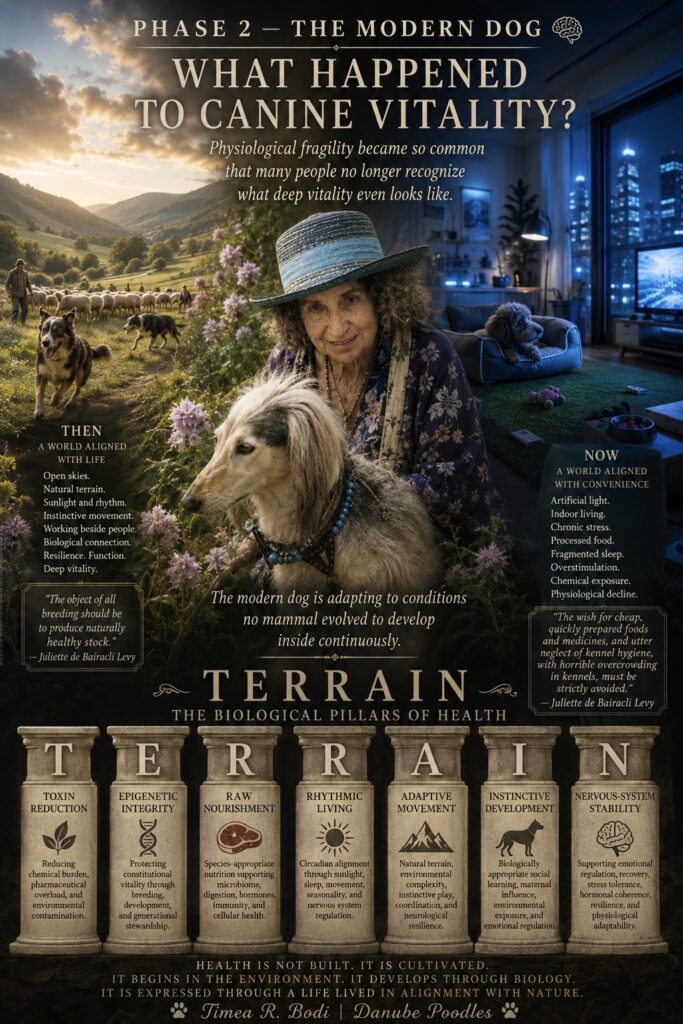
𝐖𝐇𝐀𝐓 𝐇𝐀𝐏𝐏𝐄𝐍𝐄𝐃 𝐓𝐎 𝐂𝐀𝐍𝐈𝐍𝐄 𝐕𝐈𝐓𝐀𝐋𝐈𝐓𝐘?
The deeper I sit with Juliette de Bairacli Levy’s writings, letters, observations, and descriptions of the dogs she spent her life studying, the more I feel like I am watching two entirely different biological worlds standing beside each other and honestly I think that may be one of the reasons her books hit so differently now because once you begin mentally walking beside her through the decades she lived in, it becomes harder and harder not to notice how profoundly modern dogs changed while modern culture simultaneously normalized the resulting dysfunction so gradually that entire generations now experience physiological fragility as ordinary dog ownership simply because they rarely witnessed anything different long enough to recognize what was actually lost.
Juliette was born in 1912.
That means she lived through a world most people today cannot even emotionally picture anymore because this was before modern kibble culture exploded, before chronic pharmaceutical dependency became normalized, before endocrine disease became so common in dogs, before endless behavioral medication became ordinary, before artificial indoor living dominated canine life, and before dogs spent enormous portions of existence beneath LED lighting while sleeping beside glowing televisions and breathing synthetic fragrance compounds inside climate-controlled houses disconnected from almost every biological rhythm mammals originally evolved expecting continuously.
She lived through WORLD WAR II.
Bombing.
Rationing.
Supply shortages.
Destroyed cities.
Food scarcity.
Environmental hardship.
Entire populations trying to survive while industrial systems were rapidly expanding and simultaneously reshaping medicine, food production, breeding culture, farming, animal management, and human life itself underneath the surface.
One of the details that honestly fascinated me most while digging deeper into her history was learning that during the war years Juliette worked with the Women’s Land Army gathering sphagnum moss for wounded soldiers because medical supplies were limited and old-world practical knowledge still mattered enormously during times of crisis. Most people today hear the words “natural medicine” and immediately picture influencer culture, wellness branding, affiliate marketing, aesthetic herbal photographs, or expensive detox kits while Juliette’s relationship with herbs and biological healing developed during an era where traditional medicine often existed because survival required it.
The atmosphere surrounding those years shaped her understanding enormously alongside the villages, shepherd camps, farms, Romani communities, livestock keepers, deserts, mountains, and pastoral regions where dogs still lived connected much more closely to FUNCTION instead of existing almost entirely inside convenience-based modern lifestyles disconnected from biological reality. Observation became the teacher because village dogs, working dogs, breeding stock, and the people raising them all revealed patterns impossible to ignore once entire bloodlines, developmental stages, reproductive histories, environmental conditions, and aging processes were watched carefully across generations.
Shepherds and hunters and rural families became part of the education because observation itself became the teacher. Entire bloodlines unfolded in front of these people across generations. Entire reproductive histories. Entire developmental stages. Entire aging processes. Entire environmental shifts.
Patterns became impossible not to notice.
Digestive resilience changed.
Stress tolerance changed.
Environmental adaptability changed.
Behavioral stability changed.
Recovery capacity changed.
Constitution changed.
That should probably bother us more than it does.
One of the things that keeps standing out to me while rereading Juliette’s work is how differently she viewed dogs compared to how modern dog culture now tends to view them. The organism was never separated from environment in her mind. Health was never isolated from development, constitution, movement, sunlight, emotional stability, breeding, instinctive behavior, terrain, maternal vitality, or biological rhythm shaping the nervous system itself. Everything connected back to the conditions the animal developed within because the organism continuously reflects the environment shaping it whether people emotionally agree with those relationships or not.
That was the ORIGINAL Natural Rearing blueprint because the philosophy centered around building biological resilience through development, environment, constitution, rhythm, movement, instinct, nourishment, and generational vitality rather than reducing health into aesthetics, branding, or simply layering a few “natural” products onto otherwise biologically contradictory lifestyles while expecting the organism to somehow remain unaffected underneath the surface.
Juliette repeatedly described dogs developing beneath open skies while moving enormous distances beside livestock across varied terrain through sunlight, environmental complexity, fresh air, instinctive movement, outdoor rhythm, and stable social structures while remaining behaviorally balanced, emotionally resilient, structurally sound, fertile, environmentally adaptive, mentally steady, and physically durable without endless pharmaceutical maintenance quietly holding physiology together underneath the surface.
Then I look around modern dog culture and honestly I think one of the saddest realities inside all of this is how physiological fragility slowly became so common that entire generations of people now experience chronic dysfunction as though it is simply part of ordinary dog ownership because once increasingly fragile organisms are compared only against other increasingly fragile organisms long enough, the baseline itself quietly changes underneath society without most people fully realizing it happened. Feet licking, chronic ear infections, weak appetite, digestive dysfunction, soft stool, anxiety, behavioral instability, hormonal collapse, environmental allergies, autoimmune disease, and cancer all became increasingly normalized while entire industries formed around managing symptoms afterward instead of asking why the organism itself appeared to be losing resilience in the first place.
And honestly I think one of the saddest realities hidden inside all of this is that many younger owners genuinely have no idea what DEEP canine vitality even looks like anymore because when entire generations grow up surrounded only by physiologically fragile animals, dysfunction eventually stops looking like dysfunction and simply starts looking like “dog ownership.”
I think about apartment dogs hearing unfamiliar footsteps through walls all night long while televisions glow past midnight and elevators open constantly and nervous systems remain hypervigilant without owners even recognizing it. I think about puppies raised almost entirely on artificial turf without touching real earth while developing beneath artificial lighting instead of natural circadian rhythm. I think about dogs staring through windows most of the day instead of moving through environmental complexity while owners later wonder why behavior becomes dysregulated. I think about chronically itchy dogs licking inflamed feet while laying on laminate flooring breathing synthetic fragrance compounds beside laundry detergent residue and chemical cleaning agents people barely question anymore because modern living itself became so normalized that biological contradiction quietly disappeared into the background.
Then society acts confused when physiology starts looking confused too.
The deeper I think about this, the more I realize the organism never separated lifestyle from biology the way modern systems increasingly do. Hormones respond to light exposure whether someone believes circadian rhythm matters or not. Digestion responds to stress physiology whether the nervous system feels safe or not. The microbiome responds to diet, terrain, medication history, environmental exposure, and developmental conditions whether people understand microbial signaling or not. Sleep responds to rhythm. Emotional regulation responds to developmental environment. Behavior responds to nervous-system state. Immunity responds to environmental conditions. Nothing inside the organism operates independently from the rest even though modern dog culture increasingly treats physiology like isolated mechanical failures requiring compartmentalized management instead of recognizing the body as one continuously adapting interconnected biological system unfolding in real time.
Honestly, the more modern science expands through microbiome research, endocrinology, circadian biology, epigenetics, developmental neuroscience, stress physiology, and systems biology, the more uncomfortable Juliette’s observations start becoming because many of the things she repeatedly emphasized decades ago are now resurfacing through entirely different scientific language while modern dogs simultaneously become increasingly fragile physically, emotionally, hormonally, behaviorally, neurologically, reproductively, and immunologically despite living inside the most technologically advanced era canine culture has ever seen.
That contradiction should disturb us more than it does.
Especially because the modern nervous system may honestly be one of the most overlooked conversations in all of canine health right now. A huge percentage of modern dogs now live inside chronic low-grade physiological stress without owners even recognizing it because overstimulation itself became normalized. Artificial lighting extends stimulation long after sunset while televisions run endlessly, apartment walls carry unfamiliar sounds day and night, phones vibrate constantly, leash tension transfers emotional pressure continuously, fragmented schedules remove biological rhythm, crowded environments overwhelm regulation, chronic interruption replaces recovery, and dogs now spend enormous portions of life either neurologically overstimulated or physically understimulated while receiving very little true biological decompression in between.
Then later the resulting behaviors become labels.
“Anxiety.”
“Hyperactivity.”
“Reactivity.”
“Stubbornness.”
Meanwhile the nervous system itself may never actually experience enough rhythm, movement, environmental stability, sleep depth, recovery, or physiological safety to regulate properly in the first place.
This is where Juliette’s writings honestly start feeling almost eerie because she repeatedly described puppies developing through environmental complexity instead of environmental sterilization. Older stable dogs regulated younger dogs naturally. Terrain shaped movement naturally. Outdoor rhythm shaped sleep naturally. Sunlight shaped circadian timing naturally. Environmental exposure shaped resilience naturally. Microbial diversity shaped immunity naturally. Instinctive movement shaped structure naturally.
“The wish for cheap, quickly prepared foods and medicines, and utter neglect of kennel hygiene, with horrible overcrowding in kennels, must be strictly avoided.”
— Juliette de Bairacli Levy
That sentence was written decades ago and somehow feels painfully modern now.
Artificial living increasingly created artificial physiology while modern culture simultaneously built entire industries around compensating for the dysfunction created underneath those conditions instead of asking why degeneration became so widespread in the first place.
Behavioral pharmaceuticals became ordinary.
Permanent symptom management became ordinary.
Specialized diets became ordinary.
Chronic medication became ordinary.
Constant intervention became ordinary.
And none of this means modern medicine lacks value because life-saving intervention absolutely matters. Juliette herself lived through distemper outbreaks, war years, environmental hardship, disease pressure, and periods where entire bloodlines could disappear permanently. What made her observations powerful was not naïve romanticism about nature. What made them powerful was that she continuously returned toward the same biological realization over and over again:
Vitality cannot remain separated from the conditions shaping development indefinitely without consequences eventually appearing somewhere inside the organism.
“The object of all breeding should be to produce naturally healthy stock.”
— Juliette de Bairacli Levy
That sentence alone contains more biological depth than many modern wellness movements combined because it places HEALTH at the point of CREATION rather than merely at the point of maintenance afterward.
That distinction changes everything.
Original Natural Rearing approached health DEVELOPMENTALLY instead of reactively. Environment mattered. Constitution mattered. Breeding mattered. Maternal vitality mattered. Rhythm mattered. Movement mattered. Sunlight mattered. Instinct mattered because the organism eventually reflects the conditions within which it develops.
And honestly I think the modern dog is revealing that reality more loudly every single year because beneath all the branding, products, emotional marketing, pharmaceuticals, supplements, processed feeding systems, algorithms, behavior programs, and endless information overload sits one uncomfortable truth modern culture keeps trying to out-market biologically:
The modern dog is adapting to conditions no mammal evolved to develop inside continuously.
That realization changes everything because eventually the question stops becoming “what supplement fixes this?” and starts becoming “what kind of conditions created this physiology in the first place?”
That question is where TERRAIN begins. ❤️🐾❤️


Leave a Reply