

The deeper I go into rereading Juliette de Bairacli Levy’s books, the more I realize most people today are reading her words without fully stepping into the WORLD that shaped them in the first place and honestly I do not think you can fully understand why she became who she became unless you mentally walk back into those decades beside her for a moment and look carefully at what she was actually living through while modern industrial society was rapidly transforming around her.
Juliette was born in 1912.
That means by the time Europe entered the chaos surrounding World War II, she was already watching medicine industrialize, cities modernize, food systems commercialize, breeding practices change, and animals become increasingly separated from the environments physiology originally evolved expecting continuously. Much of Europe ok was still deeply rural during parts of her early life, yet industrial systems were expanding quickly and changing the relationship between humans, animals, food, medicine, movement, and Nature itself almost everywhere at once.
Then war arrived.
Bombing.
Rationing.
Supply shortages.
Injured soldiers.
Destroyed cities.
Displacement.
Fear.
Scarcity.
Entire populations trying to survive while modern industrial medicine was still developing underneath extraordinarily unstable conditions.
One of the details that honestly fascinated me the most while digging deeper into Juliette’s history was learning that during World War II she worked with the Women’s Land Army gathering sphagnum moss used for soldiers’ wounds because conventional medical supplies were limited and difficult to obtain during wartime conditions. That one detail alone says so much about the atmosphere surrounding those years because today most people hear “natural medicine” and immediately picture influencer culture, social media branding, expensive wellness marketing, trendy detox kits, affiliate links, or aesthetic herbal photographs on Instagram while Juliette’s relationship with herbs and traditional medicine was being shaped inside an era where people often relied upon practical old-world survival knowledge because modern systems were not always available, accessible, stable, or sufficient.
Sphagnum moss itself was historically valued because of its absorbent and mildly antiseptic qualities and during wartime it became useful for wound dressing when resources became scarce. Just imagine that environment for a moment because this was not comfort-based modern living disconnected from reality. Europe was in crisis while Juliette was simultaneously becoming increasingly drawn toward observational medicine, traditional healing systems, herbalism, constitutional vitality, and biological resilience.
That atmosphere matters enormously.
One of the things I keep realizing while rereading her books is that her philosophy was not born from rebellion for the sake of rebellion nearly as much as it was born from OBSERVATION during an era where industrial systems were rapidly expanding while biological vitality often seemed to be deteriorating alongside that expansion underneath the surface.
She was also running a distemper clinic in London during the 1930s and 1940s where dogs were reportedly treated using herbs, fasting, raw foods, sunlight, and natural methods during a time when distemper outbreaks were devastating entire canine populations. Try to really place yourself into those years mentally because this was happening BEFORE modern kibble culture fully exploded into dominance. BEFORE pharmaceutical dependency became normalized inside veterinary medicine. BEFORE modern indoor living became the standard environment for most dogs. BEFORE endocrine disease, chronic inflammatory conditions, behavioral instability, digestive collapse, autoimmune dysfunction, and nervous-system dysregulation became so unbelievably common that people now practically consider them ordinary.
That changes how her writing feels once you realize it.
Suddenly these books stop reading like abstract “alternative health philosophy” and start feeling much more like the observations of someone watching biological decline begin in real time while much of society was still celebrating industrial progress as unquestionably beneficial.
You can actually FEEL the wartime and postwar atmosphere hidden inside many of her writings even when she is not directly talking about the war itself because the themes continuously return toward preserving vitality, protecting constitutional strength, maintaining reproductive integrity, developing environmental resilience, remaining connected to Nature, preserving instinctive nourishment, valuing sunlight and movement, distrusting overcivilized living, and resisting the growing dependence upon artificial systems disconnected from biological design.
Honestly, some of her writing almost feels haunted by what she watched happen to the modern organism during those decades.
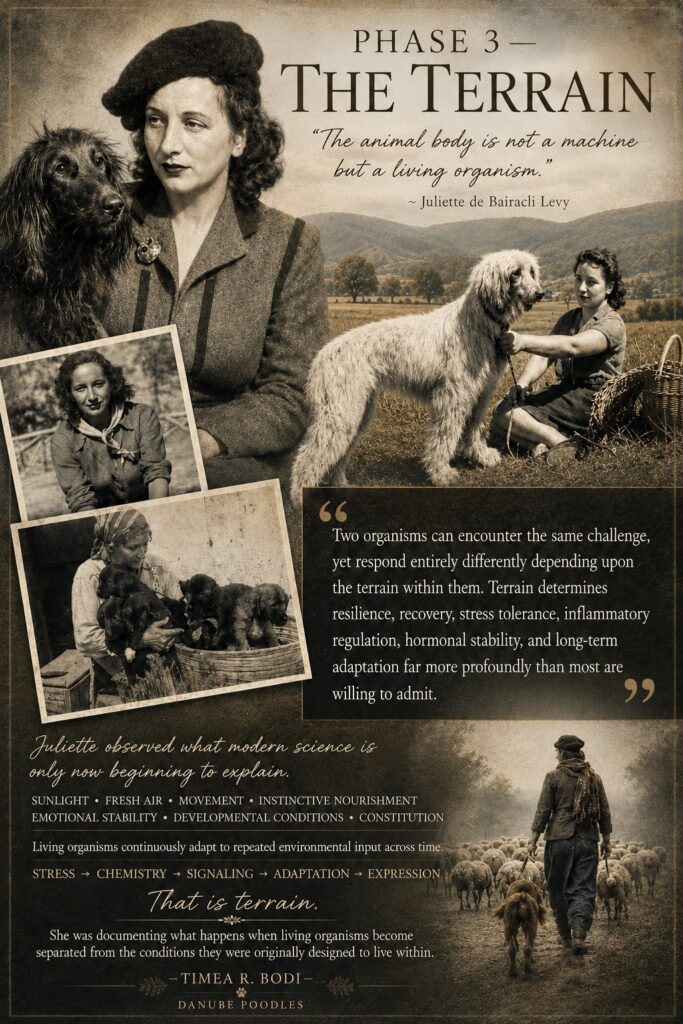
The more I reread her work now, the harder it becomes not to notice how deeply she understood something modern society still struggles accepting which is that living organisms continuously ADAPT to repeated environmental conditions across time whether those conditions support vitality or slowly dismantle it underneath the surface.
Village dogs became part of her education.
Working dogs became part of her education.
Breeding stock became part of her education.
Shepherds, livestock keepers, hunters, nomadic families, Romani camps, and rural breeders all became part of her education because observation itself became the teacher. Entire bloodlines unfolded in front of these people across generations. Entire litters. Entire developmental histories. Entire aging processes. Entire reproductive patterns.
Patterns became impossible not to notice.
Digestive resilience changed.
Stress tolerance changed.
Environmental adaptability changed.
Recovery capacity changed.
Behavioral stability changed.
Constitution changed.
That deeper focus continuously returned toward the condition of the ORGANISM itself rather than becoming entirely hypnotized by the visible symptom sitting on the surface.
That distinction changes everything.
Modern health culture now tends to reduce disease into isolated events while spending surprisingly little time questioning what biological conditions already existed inside the organism BEFORE exposure ever occurred in the first place. Attention immediately rushes toward the visible trigger. The allergy. The parasite. The seizure. The autoimmune condition. The endocrine collapse. The behavioral instability. The digestive dysfunction. The inflammatory disease. The visible event becomes the entire story while the TERRAIN underneath it often receives very little attention despite heavily influencing susceptibility, resilience, recovery capacity, inflammatory regulation, hormonal stability, stress tolerance, emotional regulation, and long-term adaptation far more profoundly than most people are comfortable admitting.
Honestly, the older I get and the more modern dogs I watch struggle physiologically, the harder it becomes not to see exactly what Juliette meant when she repeatedly described the body as a living organism rather than a machine.
Chronic stress slowly alters chemistry while altered chemistry reshapes cellular signaling and over time those repeated signals begin influencing adaptation itself until physiology eventually starts expressing the cumulative story of the environment the organism has been living within all along.
That is TERRAIN.
And perhaps the most chilling realization hidden underneath all of this is recognizing that Juliette was documenting these patterns decades ago long before modern science even had language for microbiome disruption, circadian biology, autonomic nervous-system regulation, developmental neuroscience, mitochondrial dysfunction, endocrine dysregulation, stress physiology, or epigenetic influence.
The warning was already there.
Most people simply were not ready to hear it yet.


Leave a Reply