

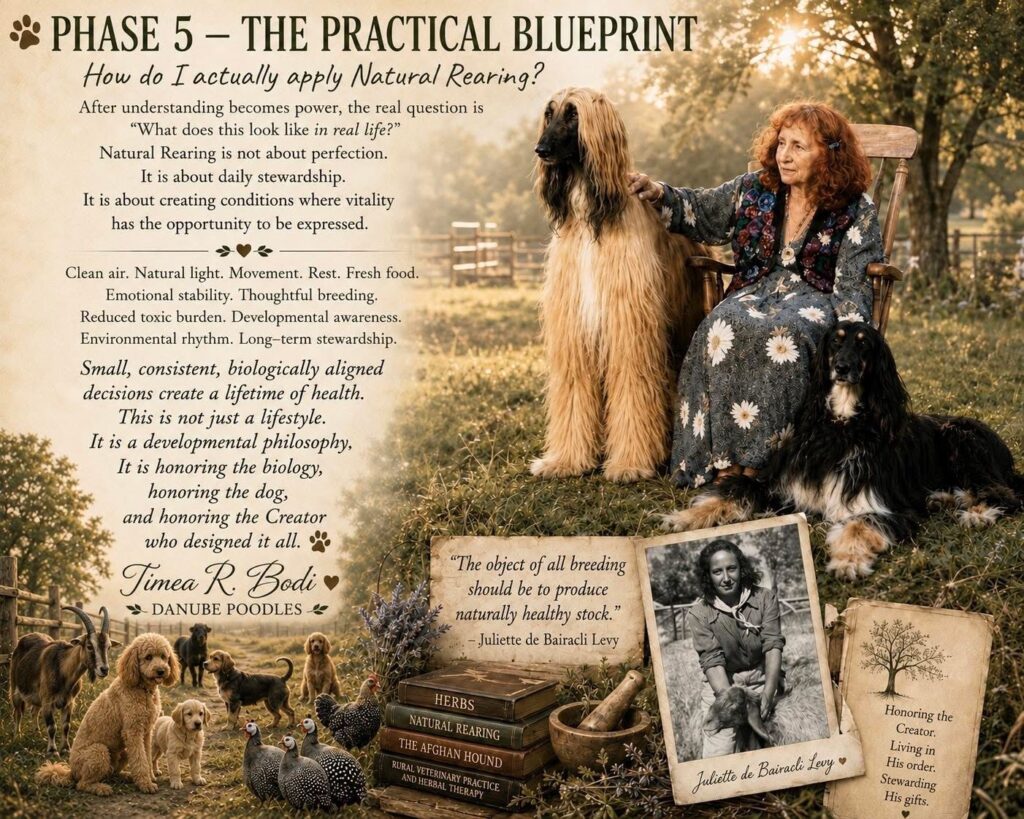
After spending the better part of this week revisiting Juliette’s books, studying old photographs, tracing the historical world that shaped her observations, thinking about constitution, development, preservation, the modern dog, and all the things that seem to have quietly drifted away from canine life while society was busy calling the process progress, I keep finding myself returning to a realization that feels far less intellectual than the conversations themselves because the deeper I go into her work the less interested I become in debating definitions and the more interested I become in understanding why so many of the things she considered ordinary now seem almost radical to modern people.
Part of that may come from the fact that I grew up in a very different world than the one many dogs are now being raised in, because life in Romania was not organized around convenience, endless entertainment, climate-controlled predictability, or the assumption that every discomfort required immediate intervention, but around seasons, weather, responsibility, rhythm, and an understanding that both people and animals existed within an order nobody created and therefore nobody possessed the authority to rewrite according to preference.
Looking back now, what strikes me most is not that people somehow knew more than we know today because they certainly did not possess our diagnostics, specialists, podcasts, online courses, webinars, supplements, pharmaceuticals, social media groups, or endless streams of information, but that many of them seemed to possess a deeper respect for the reality that life itself already contained a structure placed there by God and that thriving most often occurred when organisms remained aligned with that structure rather than continuously attempting to override it.
The older I get, the harder it becomes not to notice that nearly everything throughout creation functions within an extraordinary order established long before human beings arrived, because morning yields to evening, winter gives way to spring, birds travel their ancient routes, new life emerges within appointed seasons, growth unfolds through sequential stages, endocrine pathways communicate according to precise timing, restorative rest follows predictable cycles, and even the process of recovery proceeds according to a schedule that remains untouched by human impatience no matter how urgently results are desired.
What fascinates me about dogs is that they never stopped responding to those rhythms even while the environments surrounding them changed dramatically, because the organism still interprets light, darkness, movement, stress, nourishment, social interaction, challenge, safety, and recovery as biological information while continuously adapting itself according to whatever signals are being delivered through the environment hour after hour and day after day.
Standing outside the other morning while the dogs were spreading themselves across the property according to whatever invisible logic dogs seem to follow, watching one settle into a patch of sunlight that had only just broken through the trees while another worked a scent trail left sometime during the night and a younger dog bounced between the older dogs attempting to involve itself in activities it clearly did not yet understand, I found myself thinking about how little of this required human instruction and how much of it simply reflected an organism responding to information God had already woven into creation from the beginning.
Nothing in that moment felt particularly revolutionary and perhaps that is exactly the point because sunlight reaching the eyes at the proper time of day does not look impressive, fresh moving air passing through healthy lungs does not generate excitement, deep sleep occurring inside an environment quiet enough for the nervous system to finally settle rarely attracts attention, and movement unfolding across varied terrain instead of perfectly controlled surfaces is unlikely to inspire lengthy discussions online despite influencing physiology in ways researchers are still attempting to fully understand.
Modern culture often creates the impression that health arrives through increasingly sophisticated interventions while overlooking the reality that living systems are responding continuously to thousands of environmental inputs each day, with light helping regulate hormonal networks, air quality affecting inflammatory load, emotional climate shaping stress responses, microbial encounters guiding immune maturation, nutritional variety supporting metabolic adaptability, and developmental experiences leaving biological signatures that may remain evident throughout the lifespan of the organism.
That realization sits heavily with me because I do not believe God created living systems randomly, nor do I believe the extraordinary complexity visible throughout creation emerged without purpose, and the more deeply I study dogs the more convinced I become that many of the principles now being rediscovered through circadian biology, developmental neuroscience, endocrinology, microbiome research, stress physiology, and epigenetics are simply revealing pieces of an order that was present long before science developed language sophisticated enough to describe it.
One of the things that strikes me most while revisiting Juliette’s work is how much of her understanding appears to have emerged through observation rather than intervention because she belonged to a generation that spent extraordinary amounts of time simply watching living organisms unfold across entire lifespans, paying attention to mothers, litters, appetite, fertility, movement, recovery, temperament, environmental adaptation, seasonal changes, and the subtle differences that become visible when animals are observed across generations rather than through isolated snapshots, which may explain why so many of her conclusions feel remarkably consistent with discoveries now emerging from fields that did not even exist when she first began recording her observations.
Watching dogs every day has only strengthened my appreciation for that approach because the longer I live with multiple generations under the same roof and across the same property, the more convinced I become that some of the most important information available to us rarely appears inside laboratory reports or social media discussions but instead reveals itself quietly through appetite, recovery, sleep, adaptability, emotional stability, fertility, maternal behavior, resilience after stress, the way puppies respond to novelty, the way older dogs move through challenge, and the countless subtle patterns that only become visible when enough time is spent paying attention.
Perhaps that is why the practical side of Natural Rearing feels so important because eventually every philosophy must leave the page and enter the environment itself, where the home becomes more than a place a dog happens to live and instead becomes a biological environment continuously communicating with the nervous system, endocrine system, microbiome, immune system, and stress-response pathways of the organism living inside it.
Years spent observing dogs have convinced me that physiology does not separate itself from environment nearly as neatly as modern culture often assumes because air quality influences inflammation, lighting influences hormonal communication, environmental complexity influences neurological development, emotional atmosphere influences stress physiology, sleep quality influences recovery, and chronic exposure to synthetic fragrances, industrial cleaning products, artificial lighting, environmental monotony, excessive noise, poor ventilation, and fragmented routines gradually become part of the biological story the body is writing every day.
Walking through many modern environments sometimes leaves me wondering whether one of the greatest misunderstandings surrounding health involves the assumption that an organism can remain biologically unchanged while continuously adapting to conditions that would have been almost unrecognizable to previous generations of dogs, because nervous systems interpret stimulation, endocrine pathways derive information from light, immune function reflects environmental pressures, and the body continues cataloging those experiences long after human attention has moved elsewhere.
The same property that allows me to watch puppies chase leaves, older dogs teach boundaries, chickens scratch through the pasture, guinea fowl announce their presence to the entire county, and seasonal changes alter behavior in remarkably predictable ways also serves as a daily reminder that life itself never stopped operating according to the principles God established from the beginning, regardless of how far modern culture drifts from them.
The conversation surrounding nourishment begins looking different through that lens as well because species-appropriate feeding was never simply about avoiding processed food but about providing the diversity living systems evolved expecting through different prey animals, different organs, different mineral profiles, different fatty acid compositions, different amino acid patterns, and the broad nutritional complexity naturally encountered by carnivores long before convenience reduced nourishment into repetitive formulas consumed year after year without variation.
The same principle appears when nourishment enters the conversation because food was never merely fuel but information continuously shaping microbial ecology, immune regulation, hormonal signaling, structural development, metabolic flexibility, neurological function, reproductive health, and long-term resilience, which is precisely why Juliette repeatedly emphasized fresh species-appropriate nourishment, diversity, observation, and biological appropriateness rather than convenience-based feeding disconnected from the evolutionary history of the organism itself.
Years spent rotating proteins have only strengthened that conviction because each species contributes something slightly different to the nutritional landscape while helping reduce the monotony that often accompanies modern feeding practices, creating opportunities for broader nutritional exposure that more closely resembles the diversity organisms would have encountered throughout nature rather than the uniformity increasingly normalized within contemporary lifestyles.
Another reality that feels increasingly important the longer I study both dogs and biology concerns the role of recovery because creation itself repeatedly demonstrates the importance of rhythm rather than constant abundance, with periods of activity naturally followed by periods of rest, seasonal shifts influencing behavior and availability, landscapes changing according to weather, daylight expanding and contracting throughout the year, and biological repair processes often becoming more active during intervals when outward productivity appears minimal, which may explain why fasting, digestive rest, recovery, and periods of reduced stimulation frequently accomplish far more than modern culture expects despite receiving comparatively little attention.
Constant abundance rarely exists anywhere in nature, yet modern organisms are often expected to live within environments characterized by uninterrupted access to food, endless stimulation, perpetual activity, artificial lighting extending long after sunset, and routines that remain almost identical regardless of season, weather, or biological need, creating circumstances that sometimes appear fundamentally disconnected from the rhythms under which living systems originally developed.
Honestly, one of the thoughts that has stayed with me most throughout this series is the uncomfortable possibility that many of the conditions people now spend enormous amounts of time, money, emotion, and energy attempting to repair may once have been protected through ordinary daily practices that gradually disappeared as convenience became increasingly valued over alignment, because the more I study both dogs and biology the harder it becomes not to wonder whether modern society occasionally mistakes sophisticated management for progress while simultaneously drifting farther from the conditions that originally produced resilience in the first place.
No area illustrates that possibility more clearly than the nervous system because digestion, immunity, endocrine regulation, emotional stability, recovery capacity, learning, adaptation, resilience, and even the ability to utilize nourishment efficiently become increasingly difficult to maintain when an organism remains trapped inside chronic survival physiology, which is perhaps why dogs living within consistent leadership, emotional steadiness, environmental predictability, meaningful movement, restorative sleep, healthy social structures, and opportunities for recovery often appear profoundly different than dogs existing within constant overstimulation, fragmentation, unpredictability, and environmental tension.
Years spent observing dogs have left me increasingly convinced that many behavioral struggles commonly discussed today cannot be fully understood without considering the physiological state through which the organism is interpreting the world, because an animal attempting to process life through a chronically dysregulated nervous system experiences stress differently, learns differently, digests differently, recovers differently, responds to challenge differently, and ultimately adapts differently than an animal operating from a state of relative biological safety.
That observation becomes difficult to ignore when watching puppies develop because confidence, curiosity, adaptability, frustration tolerance, recovery after startling events, willingness to engage novelty, and overall emotional stability often appear connected to far more than training alone, revealing relationships between development, environment, physiology, and experience that continue unfolding long before labels such as anxiety, reactivity, stubbornness, sensitivity, or hyperactivity ever enter the conversation.
Another lesson Juliette seemed to understand long before it became fashionable involves the reality that reducing burden often proves just as important as adding support because the body already possesses remarkable mechanisms for detoxification, repair, adaptation, and recovery when environmental pressures stop overwhelming those systems continuously, making thoughtful decisions about chemical exposure, pesticides, water quality, medications, cleaning products, synthetic fragrances, excessive environmental contamination, and overall toxic load part of stewardship rather than separate from it.
What fascinates me about many traditional healing systems is that they often viewed support through the lens of relationship rather than domination, recognizing that nourishment, herbs, environmental conditions, movement, rest, and observation worked together to help the organism function more effectively instead of attempting to overpower physiology through increasingly aggressive intervention disconnected from the larger biological picture.
Perhaps that is also why breeding occupies such a central place within my own understanding of Natural Rearing because the longer I spend raising dogs the less convinced I become that vitality begins when a puppy enters a new home and the more convinced I become that an extraordinary amount of biological information is already influencing outcomes long before birth through maternal physiology, reproductive integrity, nutritional status, environmental exposures, hormonal communication, emotional stability, constitutional strength, developmental conditions, and countless interactions occurring quietly beneath the surface while most people are still thinking about names, collars, feeding schedules, and training classes.
Living beside multiple generations of dogs has a way of making those influences difficult to ignore because certain traits appear repeatedly within family lines regardless of where the puppies eventually live, with recovery capacity, emotional resilience, stress tolerance, instinctive behavior, appetite, adaptability, maternal ability, and overall constitutional strength often revealing patterns that seem to extend far beyond genetics alone and point toward a much larger developmental story unfolding long before visible outcomes emerge.
Repeated exposure to Juliette’s writings continues bringing me back to the phrase “naturally healthy stock” because the deeper I sit with those words the more difficult it becomes to separate them from reproduction, development, maternal vitality, environmental conditions, constitutional strength, instinctive competence, emotional stability, and the long arc of stewardship extending across generations, all of which influence whether resilience is being strengthened, preserved, weakened, or gradually lost before symptoms ever provide visible evidence of the process.
What continues drawing me back to her work, however, is the realization that naturally healthy stock never begins with a supplement, a protocol, a treatment, or even a feeding program because it begins with stewardship expressed through breeding decisions, maternal vitality, developmental integrity, environmental conditions, emotional stability, constitutional strength, and the willingness to think beyond immediate outcomes toward the generations that follow.
Perhaps that is why the practical blueprint ultimately looks far less dramatic than people expect because it often begins with opening windows instead of purchasing products, allowing morning sunlight to reach sleeping dogs before artificial lighting fills the house, paying attention to appetite before forcing consumption, rotating proteins throughout the year rather than relying upon endless repetition, creating opportunities for meaningful movement across natural terrain, supporting mothers long before pregnancy ever occurs, respecting periods of recovery as carefully as periods of activity, reducing unnecessary chemical burden whenever possible, observing subtle changes before they become crises, and approaching stewardship as a responsibility entrusted to us by God rather than a system of control imposed upon the organism.
Watching the dogs move across the property each morning while the guinea fowl announce their presence to the entire county, younger dogs shadow older dogs through routines nobody formally teaches, seasonal changes alter behavior almost predictably, and sunlight gradually reaches different corners of the pasture depending upon the time of year often leaves me thinking that creation continues offering lessons for anyone willing to slow down long enough to observe them, because thriving rarely appears to emerge from forcing life into submission and far more often reveals itself when living systems remain aligned with the wisdom already woven throughout the design itself.
The phrase “naturally healthy stock” carries more weight every time I read it because achieving that objective requires considerably more than managing problems after they appear and instead demands attention toward the countless influences shaping the organism long before visible results emerge, ultimately reminding us that Natural Rearing was never about perfection but about creating conditions more closely aligned with the design already woven throughout creation.
Perhaps that is why Juliette’s writing still feels so relevant decades later because beneath every discussion about breeding, development, nourishment, vitality, constitution, and preservation sits a much larger question concerning whether human beings still possess enough humility to recognize that the blueprint existed long before we arrived and that genuine stewardship begins not with reinventing creation but with learning how to live in greater harmony with it. ❤️🐾❤️
Juliette de Bairacli Levy


Leave a Reply