

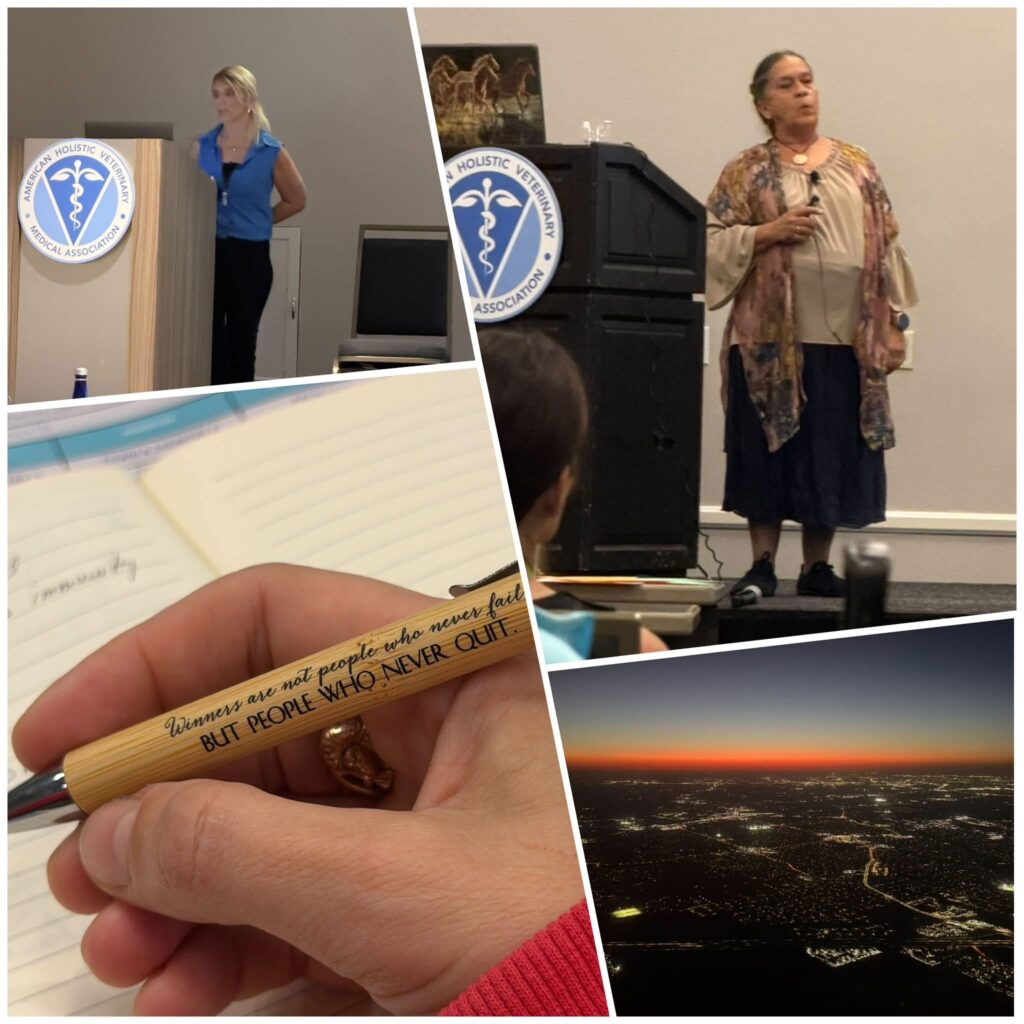
I am home from AHVMA, and I would like to tell you that I came through the door, unpacked everything, organized my notes, and got right back into the swing of things, but let’s not get carried away. I am tired. My brain is still somewhere between a lecture on cancer metabolism and a slide I photographed because I was absolutely certain I would remember why it mattered, and the dogs are interested in approximately none of that. Mom is home, there are things to sniff, and surely we can get back to whatever arrangement existed before she decided to fly across the country to learn more about dogs while leaving her actual dogs behind.
But it was worth it. The travel, the expense, the rearranging of everything at home, and the sitting there trying to fit one more piece of information into a brain that had already put up the “no vacancy” sign. It was worth it because now I get to bring those questions home to the animals who were the reason I went in the first place.
I am still thinking about Dr. P.J. Broadfoot, and I expect I will be thinking about her lectures for quite a while, because once you begin looking at the animal behind the diagnosis, it becomes difficult to go back to looking at a disease as though it exists all by itself. There is a body carrying that disease, and that body has a history. It has been eating and growing and responding to its surroundings for years before somebody found a lump or took a biopsy or said the word that changes the whole conversation.
Cancer.
And if you have ever heard that word attached to an animal you love, you know how quickly your mind starts running ahead while your heart is still trying to catch up.
What stayed with me from Dr. Broadfoot’s presentations was her attention to that larger picture, to the environment around the cells, to immune regulation, to the patient’s history, and to how the animal was actually doing as care continued. Her additional discussions of the thymus, stress, colostrum components, and clinical cases gave me more to study. Those cases covered different illnesses and injuries, and they were reports of her clinical experience, but the question I carried away applies very much to cancer: what does this particular animal need in order to remain as comfortable, nourished, engaged, and functional as possible while we address its disease?
Because the dog still has to live through the treatment plan. The dog still needs to eat breakfast and get comfortable and sleep and go outside, and hopefully have enough interest in life to investigate whatever deeply suspicious thing is happening on the other side of the fence.
Dr. Katie Kangas’s lecture, “Cancer as a Metabolic Disease,” added another piece to that conversation. She took us into metabolism, mitochondria, the Warburg effect, and the ways cancer cells use energy and materials to support their growth. Now, I realize that “mitochondria” is probably not what most people hoped to find in their morning Facebook reading, but hang in there, because this is where the conversation reaches beyond the mass we can see and into what is happening inside the living tissue.
Many cancer cells process glucose differently from healthy tissue, including using a pathway called aerobic glycolysis even when oxygen is available. That is part of the Warburg effect, and it is an important area of research. It also takes more than a catchy sentence about sugar to explain it, because cancer involves complicated relationships among genetic changes, metabolism, and the surrounding tissue. There is a great deal to learn here, and I want to understand it well enough to ask useful questions instead of coming home with a slogan and calling it an answer.
And this is where the other lectures began coming together for me. Dr. Judy Morgan had me thinking about the air in our homes and the exposures we barely notice because they have become ordinary. Dr. Michelle Kutzler had me thinking about endocrine function and the lifelong tradeoffs of reproductive decisions. Dr. Nancy Scanlan brought cellular communication into the picture, and Jim Skoien’s discussions of pain brought me back to comfort and function, while Rita Hogan gave me more questions about plant preparations and how they are used.
Those were different subjects, with different kinds of evidence behind them, but I kept bringing them back to the same dog. The dog facing cancer is also breathing the air in our house, digesting its meals, experiencing pain or relief, resting well or struggling to settle, and living with whatever other health problems it already had before the cancer diagnosis arrived. That is the connection I want to keep exploring.
📊 And yes, we need to talk about the numbers, because approximately one in four dogs will develop cancer during their lifetime, with the risk rising to approximately one in two among dogs ten years of age or older, according to the American Veterinary Medical Association. Those are estimates across populations, rather than a prediction for the dog beside you, but they are enough to make this a conversation worth having before a family is sitting in an examination room trying to make decisions through tears.
Behind those numbers are dogs with names and favorite places to sleep and people who would give just about anything for another good year together.
That is why I keep thinking about longevity, especially in a time when we have access to so much information, so many diagnostics, so many treatments, and more products than anybody could possibly keep straight. Research has documented increases in life expectancy in some dog populations, so I cannot fairly say we have made no progress. But I do want to ask how much healthy life we are gaining, and how we can do better at helping our dogs reach old age with comfort, strength, curiosity, and some enjoyment left in the day.
I want an old dog who still has opinions. Who still wants to go outside. Who still thinks I am taking entirely too long with dinner. I want us to take those everyday signs of well-being seriously, alongside the test results and the birthdays.
As a breeder, that question follows me all the way back to the beginning. It belongs in the pedigrees we study, the health information we collect, the dogs we choose to breed, and the conversations we have with the families who take our puppies home. We need to care about what happens years after the puppy pictures stop getting all the attention, and we need to be willing to learn from those outcomes even when they give us something uncomfortable to reconsider.
And reconsidering our care does not mean blaming ourselves every time a dog gets sick. I want to say that clearly, because people caring for an animal with cancer already have enough weighing on them. A diagnosis does not tell us that someone failed to love enough or try hard enough. We can make thoughtful choices and still face heartbreaking illness, and we can acknowledge that while continuing to look for ways to improve care.
For the animal who already has cancer, there is work to do right now: understand the diagnosis, discuss the available treatments, assess pain, address nausea, support nutrition, and keep checking how the patient is managing. Those things belong throughout cancer care, with a plan adapted to the animal and the family. I want room for careful questions about additional approaches too, with attention to their evidence, their risks, and whether they are actually helping.
Next year, AHVMA will be in St. Louis, Missouri, September 17–19, 2027, and I am glad there will be another opportunity to gather and learn. Between now and then, we get to do something with what we brought home. We get to read further, ask our veterinarians better questions, look closely at our routines, follow our dogs’ progress, and share what we learn with a little more understanding than we had before.
There is almost a year of ordinary days between conferences, and those ordinary days are where so much of our care happens.
So today I am home, tired, grateful, and asking God to help me turn what I have learned into wisdom I can actually use. There will be more posts once my brain and the rest of me agree that we have both arrived back in Tennessee, because I still have plenty to share and apparently very little ability to leave an interesting question alone.
For now, I get to sit with my dogs and remember why all of this matters. They have no idea how many slides are on my phone or how far I traveled, but they will experience whatever good I manage to bring into their lives because of it.
That is what makes the trip worth it. And that is the work I get to come home to. 💚🐾


Leave a Reply