

Some years I have newborn puppies on the ground while I am saying goodbye to an old dog, and let me tell you, there is no nice, organized way to do that. There is no announcement that says, “Everybody settle down, Timea needs a few days to get her heart back together.” The puppies are hungry, their mother needs me, the other dogs need dinner, and the old dog needs the person who has loved them all these years to keep loving them right through the part I would give almost anything to avoid.
So there you are, welcoming life and saying goodbye to it at the same time, and somewhere in the middle of all that, somebody wants to know when you are having another litter.
Well. Let me get through this one first.
I love my dogs, and I love what I do, but I have been burned out as a veterinary technician and I have been burned out as a breeder, and loving the work did not make me immune to what came with it. I wish it did. It would certainly make things easier if caring enough came with an unlimited supply of energy and a guarantee that everybody would live forever, but apparently that package was unavailable when I signed up.
And that is what I want to talk about from day three at AHVMA, because we can spend all day discussing what goes into a dog’s food bowl and still barely discuss what happens to the person who keeps filling it through the illnesses, emergencies, disappointments, and goodbyes. We are pretty good at saying that the animals deserve care. We get a little awkward when the person doing the caring admits that they could use some too.
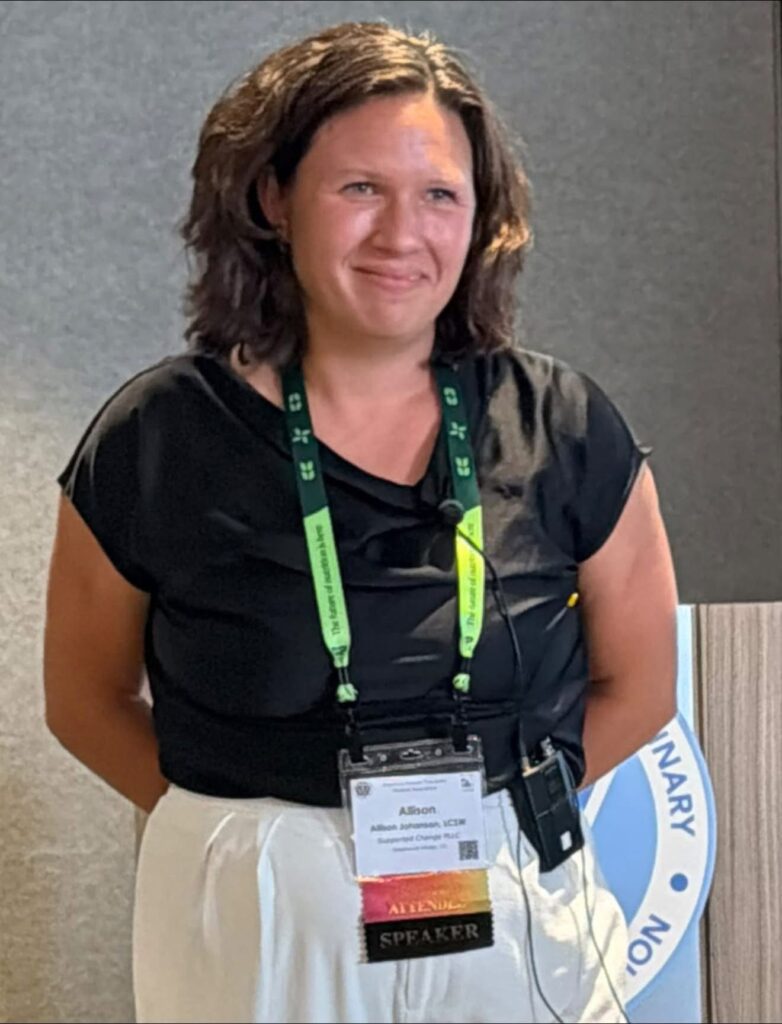
Yesterday at the banquet I met Allison Johanson, and she was so warm and easy to talk to that connecting with her felt natural almost right away. She told me she was born in Tennessee and now lives in Colorado, so of course we had that little connection, but it was her personality that stayed with me. She had that approachable quality that makes you feel you can have a real conversation instead of giving the polished answer you think somebody wants to hear.
Then today I sat down for her presentations, “The How and Why of Grief” and “Practical Skills for Nervous System Regulation in a Stressful Environment,” and the conversation got a whole lot bigger.
Allison is a licensed clinical social worker, trauma specialist, and founder of Supported Change, and she works with veterinarians, technicians, and other animal-care professionals dealing with burnout, compassion fatigue, moral distress, and stress. In other words, she spends time with people who are very good at caring for somebody else and may be having a considerably harder time figuring out what to do with themselves.
One of the first things she took on was the idea that grief in veterinary medicine must mostly be about euthanasia. That is where people’s minds go, and I understand why, but she explained that being able to end an animal’s suffering can also bring relief. The goodbye can still hurt, the family’s grief can still affect you, and some circumstances can be deeply difficult, but the emotional weight of veterinary work does not fit neatly into that one appointment.
Think about an ordinary clinic day. You have an animal you are worried about, another one you have become attached to, a case that is going sideways, and an owner who is frightened and looking to you for an answer. Perhaps you have the answer but cannot make the care happen because of money or resources. Perhaps you have done everything you reasonably can, and the outcome is still awful. Then the phone rings, somebody needs you in the next room, and the day carries on.
You do not get to tell the next patient, “Sorry, my feelings are still in room three.”
You have to be there, and being able to do that takes skill. But what happens to the part of you that was affected by what happened in room three? Does it get any attention later, or does it get shoved aside because room four needs you, and then room five, and then it is tomorrow and we are doing the whole thing again?
That was part of Allison’s point. Grief can be about the patient, but it can also be about the job you thought you would have, the profession you thought you were entering, or the version of yourself who once felt differently about walking through the door. You can still want to help animals while grieving how difficult the work has become. You can miss a colleague, lose confidence in a workplace, or watch years of expectations change while still showing up and doing your job.
And then somebody says, “But you chose this.”
Yes, we did. Choosing something does not mean every part of it stops hurting.
I think we need to remember that when we deal with veterinary teams, because we see our appointment and they have lived the whole day. That does not excuse bad care, and I am certainly not asking anyone to ignore a real problem. I am asking us to remember that the person coming into the room might have just helped somebody say goodbye before they came in to help us say hello to a brand-new puppy. Those are very different moments, and we expect them to move between the two without much time to catch their breath.
Allison also went straight after the idea that grief follows five tidy stages, and she did not exactly tiptoe around it. Her point was that the original model came from work with people facing their own deaths, and it should not be handed to everyone experiencing a loss as though it is a checklist. People can recognize some of those feelings without having every one of them, in the same order, on the same schedule. Research does not support a universal sequence of grief stages.
Honestly, as if losing someone were not enough, now we have to worry about whether we are doing the grieving correctly.
You cried today? Too much. You did not cry today? Not enough. You laughed at something? How could you? You are still sad months later? Shouldn’t you be over it? And heaven help you if you feel relieved, because now your own mind may decide it is time to put you on trial.
If you have cared for an old or seriously ill dog, please give yourself a little room here. You can miss that dog terribly and feel relieved that they are no longer suffering. You can wish they were still here and acknowledge that the constant watching, worrying, and getting up at night took a lot out of you. Both things can be true, even if you do not know what to do with having them both in the same heart.
Feeling relief does not mean you were standing around hoping to be rid of a dog you loved. It may mean that a very hard part of life has ended, and you are feeling the end of that as well as the loss of the dog.
And preparing for a goodbye does not mean you will be prepared for every little thing afterward. You can understand the diagnosis, know the decision is coming, and still get caught by the empty bed. Your head knows what happened, but your habits are still expecting the dog to be where the dog has always been.
You go to get the bowls. You look toward their spot. You hear something and think, for half a second, that it is them. Then you remember again.
Allison even talked about the crumbs on the floor after losing a dog who used to clean them up, and that is such a dog-person detail. Something that would barely have registered before suddenly tells you who is missing. People think about the big goodbye, but sometimes it is the little everyday things that catch you when you were only trying to get through breakfast.
Then she shared a story about losing her own dog, and this is where the conversation about layered grief really came to life. As she worked through it, she realized that this dog had been with her through her daughter’s childhood, and now her daughter was becoming an adult. The dog was part of those years of raising her child, and losing the dog touched that whole chapter of life too.
Oh, that makes sense.
Because a dog can belong to the years when you lived in a certain house, when your children were little, when someone you loved was still here, or when your life looked very different. You are missing the dog, absolutely, but memories of everything you lived through together can show up alongside that loss. Sometimes you do not even realize how much is tangled together until you start talking about it.
Listening to that, I kept thinking about preservation breeders, because our dogs are part of our daily lives and part of the years we spend building something. An old dog may connect you to your parents, a mentor, the beginning of your program, or a time when you were still trying to figure out what kind of breeder you wanted to become. There is history in the pedigree, and there is history in the dog who has been living in your house all these years.
People may know the registered name. You know the habits, the expressions, and the place that dog has occupied in your life.
And my responsibility does not end when a puppy leaves my house, either. I send my puppies home with the reassurance that I am here, that they can pick up the phone, and that they do not have to figure out the natural rearing journey alone. There is so much conflicting information out there that somebody trying to do right by their dog can get completely turned around, especially when it comes to putting together a balanced diet and deciding whose advice to trust. I do not want them guessing their way through it while the dog becomes the experiment, so I make myself part of the support they can count on. The questions, the worries, the “Timea, can you look at this?” messages, and the calls when something has gone wrong all come with that promise. The more puppies I place, the more families have me on speed dial, and those relationships can continue for years. That is a whole lot of lives to care about beyond the dogs currently eating dinner in my own kitchen.
I want those families to call me. I would much rather help them work through a question early than hear later that they were struggling and did not know where to turn. But when they are frightened, when their dog is ill, or when something heartbreaking happens, I am often one of the people helping them pick up the pieces, and I care about the dog on the other end of that phone too. That is the part people do not see when they look at a puppy price and start calculating what a breeder must be making. A breeder who takes the money and disappears can collect a payment without carrying those years of responsibility, while those of us who stay involved keep giving our time, knowledge, and a piece of our hearts long after the payment is forgotten. For me, the money has to help make the work possible, but the commitment is what keeps me involved. And that is exactly why this conversation about burnout matters, because a promise made out of love still takes time and energy to keep.
And a breeder’s grief does not always wait for a death. Sometimes a health result changes the future you thought you were working toward. Sometimes a breeding does not take, or you make the decision that a dog should never be bred, and that is the right decision for the dog but still a painful end to something you had hoped for.
You can choose the dog and still be sad about the plan. That does not make the choice less responsible.
Sometimes a puppy does not survive, and there you are trying to understand what happened while the rest of the litter still needs you. There may be questions to ask and lessons to learn, but there is also a life you were trying to keep here. A puppy does not have to have lived for years for that loss to matter to the person who was there doing everything they could.
Yet how easy is it for breeders to talk about any of this? What if admitting that something was hard brings a bunch of people ready to tell you what that says about you? What if you say you are exhausted and somebody hears “incapable,” or you talk about a loss and somebody decides they have the entire story from one paragraph?
We need honest conversations about breeding, including real accountability when it is needed, but we also need to leave room for somebody to be a human being while having them. If we expect responsible decisions, we cannot act as though responsible people should never feel disappointment, fear, or grief.
And please, do not assume that puppies make losing an old dog easy.
I am grateful for new life. I can be delighted by a puppy and still ache for the dog who is gone. The puppy does not know my history with that old dog, and I do not expect the puppy to repair it. Some years I am carrying the beginning and the ending at the same time, and the fact that there is still noise in the house does not mean there is no absence in it.
That is one reason this lecture mattered to me. The animals still need care, so we keep going, and from the outside it can look as though we are doing just fine. We answered the message. We got the work done. Everybody had dinner. But getting the work done does not tell you everything about what it took to do it.
Allison’s second presentation gave us some ways to notice what is happening before we have pushed ourselves too far. She talked about a “window of tolerance,” which can sound a little technical, but the practical idea is that there is a range where you can feel stress and still think, respond, and stay engaged with what is happening.
You do not have to feel blissfully relaxed while something urgent is going on. A little stress can help you focus. The question is whether you can still work effectively, or whether you have tipped into frantic thoughts, scattered activity, irritability, or that flat feeling of not wanting to deal with one more thing.
Imagine trying to care for an animal while your mind is already racing through every possible disaster. Or trying to finish the day when all you can think is, “Please, nobody ask me for anything else.” Those are worth noticing, with curiosity about what you need rather than another round of telling yourself how badly you are handling things.
Her suggestions were small enough to fit into a real day. Touch the door handle and notice your breath. Finish an appointment and take a moment before starting the next one. Set down the phone, feel your feet, notice how much tension you are carrying, and let yourself recognize that the last interaction affected you.
No elaborate ceremony required. Nobody needs to add “be perfectly calm” to an already impossible to-do list.
But we do need practical help alongside those little moments. You can take all the breaths you like and still need adequate staffing. You can be very good at noticing stress and still need a workload that makes sense. And if you care for dogs at home, a day off requires somebody capable of taking over safely, because the dogs are not going to check the calendar and decide to look after themselves.
That is why “just rest” can sound so simple to the person saying it and so complicated to the person hearing it.
Another thing Allison talked about was the way we put feelings aside, which is sometimes necessary. If a puppy needs immediate help, that is where your attention goes. If a patient needs care, you do the job. The trouble comes when you keep promising yourself that you will deal with how you feel later, and later never gets a turn.
Imagine having a cupboard where you shove everything because company is coming. That works for a while. Eventually you open the door and the whole mess comes at you.
Her point was to check on what you have put away, in manageable amounts. Maybe you write for a few minutes, talk with somebody, make something, or spend a little time in the garden while you actually let yourself think. It does not have to be the same thing every time, and it does not have to look like anybody else’s way of doing it.
I liked that, because an exhausted person does not need another assignment with a gold star at the end. They need something they can actually use.
She also talked about thoughts that keep going around and around, and there is a difference between asking a useful question and replaying the same painful scene without finding anything new. What can I learn? What can I do now? What was mine to handle, and what could I not control? Those questions may lead somewhere. Telling yourself for the hundredth time that you should have somehow known everything may only leave you more worn out.
And if grief comes back on an otherwise good day, that does not mean you have ruined all your progress. A smell, a date, a similar case, or something somebody says can bring a memory forward unexpectedly. You may be doing better and still have a moment where you miss that dog so much it takes your breath away.
You are allowed to have the good day, and you are allowed to have the moment.
Allison spoke about remembering well, and I think that is such an important part of this. We do not have to become glad the loss happened, and we do not have to make the dog less important in order to keep living. We can tell the stories, keep the photographs, write down the little things we never want to forget, and make room for those years without requiring ourselves to stay in the worst day forever.
For me, prayer belongs there too. I can thank God for the years I had and still wish, very much, that there had been more. I can be grateful and sad in the same prayer. I do not think God needs me to pretend my heart is fine before I talk to Him.
And we need people. Good people who can hear the hard stuff, let us be honest, and also help us take a step toward something that helps. Allison made a point about community being more than a bunch of people winding one another up until everybody goes home feeling worse. Sometimes we need to complain, sure, but we also need the friend who says, “Did you actually take that day off?” or “You said you were going to ask for help. Did you?”
We need someone who will listen after the immediate crisis is over, because that may be when we finally have enough room to feel what happened. Professional help belongs here too when distress is persistent, overwhelming, or getting in the way of daily life. You do not have to wait until you cannot do anything before you are allowed to need support.
So what do we do with all this once we leave the conference room?
If you work in a clinic, check on the person who just came out of that difficult appointment. Protect the break they are supposed to have. Make asking for help possible. If you are a fellow breeder, respect the person who says they are taking a pause, and offer practical help when you know how to do it safely. If you are an owner or a friend, remember that somebody can care deeply and still need time to answer, time away, or a boundary.
And when somebody loses a dog, ask again later. The first message matters, but so does the one that comes when the house is quiet and everybody else has moved on.
Death will keep being part of my life, and I know there will be more days when a young dog needs me while I am missing an old one. I cannot arrange every goodbye around a convenient time, and I cannot love my dogs so well that none of them will ever leave me. What I can do is pay more attention to what the caring asks of me, and what it asks of the people around me.
The puppies will still need dinner. The old dog will still need me through the end. The patients will still need skilled hands and someone thinking clearly on their behalf.
But somewhere in all that, we need to make room for the person who keeps showing up.
If you know that person, check on them. And if you are that person, you are allowed to need somebody too. ❤️🐾❤️


Leave a Reply