

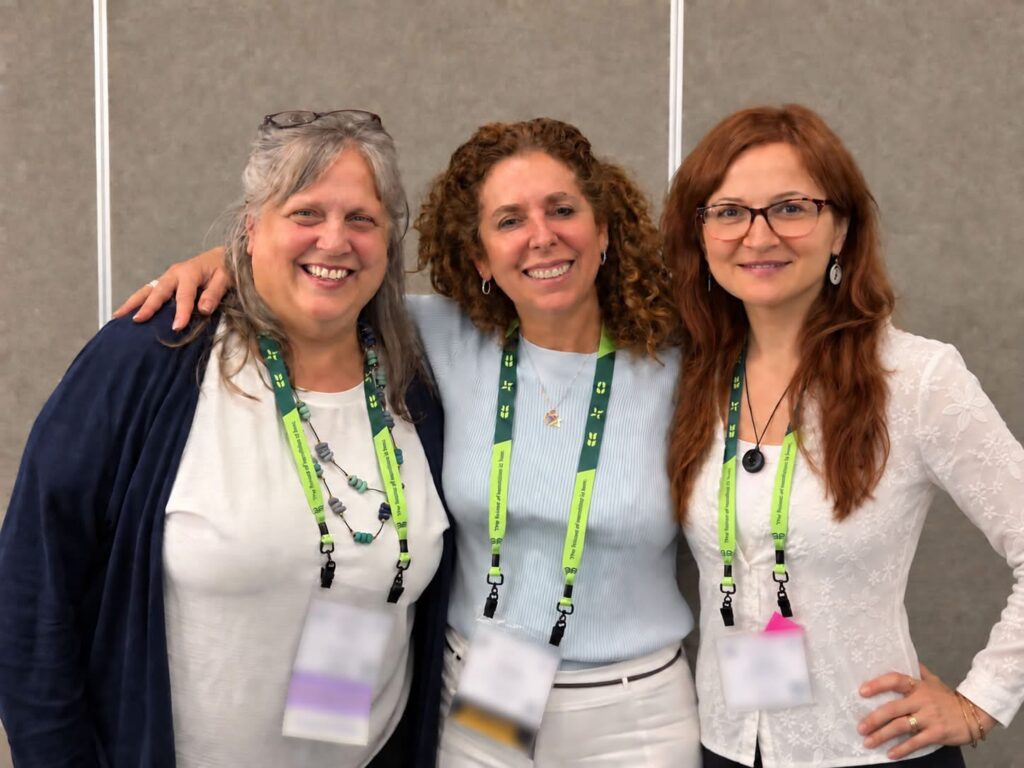
I heard her speak at last year’s AHVMA, and I have been using mistletoe with my own dogs for a couple of years now, so this wasn’t an introduction for me. I went back because experience gives me MORE questions, and I wanted to understand the preparations better, hear how she makes decisions for different patients, and catch the things that might mean more to me now than they did a year ago.
My toolbox is already fairly well stocked. Those who know me can go ahead and laugh, because yes, I am aware that “fairly” is doing a lot of work in that sentence. But having something available and knowing when, why, and how it might fit a particular animal are different things, and that was what kept my attention during Cláudia’s lectures.
She can get into plant chemistry, immune cells, and different ways of administering treatment, but she keeps bringing you back to the animal receiving it. How old is this patient? How strong or weak are they? What else is going on? What can they tolerate, and what are we actually trying to accomplish?
That matters to me. If you have an old dog who is barely eating, losing weight, and already having a rough time, getting the strongest possible reaction out of a treatment may not be much of an accomplishment. I want that dog to feel better. I want them comfortable enough to sleep, interested enough to eat, and able to participate in whatever little routines still make their day worthwhile. We have to think about what we are asking their body to manage.
The mistletoe she discussed is European mistletoe, Viscum album, and there is considerably more to it than a Christmas decoration. It grows on different host trees, and the tree, the season, the parts harvested, and the manufacturing process can all influence the finished preparation. So when somebody says they are using “mistletoe,” that doesn’t tell us everything we need to know.
This is something I wish we talked about more with natural products in general. We see the same plant name on two bottles and assume we are looking at the same thing, but are we? Where did it come from? What was harvested? How was it extracted? What is actually in there? Those questions matter, especially when we are using something medicinally.
Cláudia explained components called lectins and viscotoxins, which have different effects in experimental research, and discussed the immune system and other compounds in the plant too. I won’t drag everybody through the biochemistry here, although you know perfectly well I took notes on it. 😂 What interested me was understanding why the preparation matters and why one product cannot automatically stand in for another.
She discussed mistletoe from fir, apple, and pine trees, known as A, M, and P, and how she chooses between them in her practice. Her approach considers the animal’s condition and the goal of treatment, along with the disease itself. Those selection principles aren’t a universally proven chart for every cancer, but they gave me more questions to ask about what we choose and why.
And honestly, that is useful far beyond mistletoe. We can become awfully attached to a plan once we have decided it is the right one, and then keep following it even when the animal in front of us has changed. The dog who tolerated something well last month might be struggling now. The weak patient we started with might be doing better and able to manage something differently. We have to keep looking, and we have to be willing to adjust.
She shared cases too, including Chanel, a senior Shih Tzu with a stomach tumor whose updates described improved appetite, energy, and weight, and Tico, a Golden Retriever with hepatic hemangiosarcoma whose final update reported about sixteen months without chemotherapy or further hemorrhages.
Of course I paid attention to those stories. When you have dogs at home and have lived through worrying about them, you listen differently to an owner talking about their old dog eating again or seeming more interested in life. I wanted to know more about their care and how their disease was followed. These were individual cases, with other care involved, so they cannot tell us what another dog will experience, but they certainly give us something worth discussing and investigating.
There is published research on mistletoe, including veterinary studies, but substantial gaps remain in the evidence. It hasn’t been established as a cure or a proven way to extend survival in dogs, and mistletoe extracts are not FDA-approved cancer treatments. I want more research, and I want people to understand what the existing research actually says, because we don’t help anybody by turning an encouraging observation into a guarantee.
One thing I particularly appreciated about Cláudia was her willingness to discuss experiences that hadn’t gone well. Give me that part too. Tell me what happened, what you reconsidered, and what you do differently now, because that is information the next person needs. When somebody with years of experience is willing to explain where they changed their approach, I am going to listen.
She also emphasized paying attention after treatment begins. A reaction needs to be understood, and a fever doesn’t automatically mean a tumor is responding. An animal not developing a fever doesn’t automatically mean the treatment isn’t working either. We still need to watch the patient, follow the disease, and investigate unexpected changes.
Cancer patients can develop infections, heart problems, and other illnesses too. If a dog starts coughing, develops a persistent unexpected fever, or suddenly behaves differently, we cannot shove every symptom into the cancer box or assume it is an acceptable treatment reaction. Somebody needs to check what is going on.
And then there is the person caring for that dog at home. Can they manage what we are asking? Can they afford repeated visits? Have they actually been shown how to do something, and has anybody watched them try? Do they know when to call for help?
Cláudia talked about teaching owners and checking their technique, and I kept thinking about the person standing in their kitchen, trying to follow instructions while frightened of losing their dog. We can explain something clearly in a clinic and still have somebody struggle when they get home. That deserves patience and support, because the plan has to work in the household where the animal lives.
She also spoke about the family system and the connection with the animal, and she had quite a bit to say about protocols. She definitely wasn’t shy about that. What I took from it was that knowing the steps doesn’t excuse us from thinking about the patient. We need evidence, good technique, monitoring, and clear instructions, but we also need to notice when something needs to change.
That applies to integrative care just as much as anything else. I can believe in an approach, be hopeful about it, and still have a responsibility to reconsider it if my dog isn’t doing well. My dogs need me paying attention more than they need me defending a decision I made three months ago.
So yes, I went back to hear more about something I was already using, and yes, I came away with more to think about. Cláudia brought the knowledge, the experience, and plenty of personality, and I appreciated having another opportunity to learn from her.
When I get home, I want to understand my options better and be more thoughtful about the decisions I make with the veterinarians helping my dogs. I want to know what to watch for, what questions to ask, and when to change course. Mostly, I want more comfortable days for my dogs, with food they want to eat, decent sleep, and enough interest in life to get up and see what everybody else is doing. Those ordinary things become a very big deal when you are caring for an older or ill animal.
Thank you, Dr. Cláudia Costa, for giving us so much to think about, and for reminding us to keep looking at the animal while we are learning about the treatment. 💚🐾
P.S. I put the longer article on my blog, with more about the plant chemistry, the different preparations, the cases, and the research discussed. If this post wasn’t quite enough mistletoe for you, apparently I have that covered too. Grab a coffee and head over here: https://www.blog.danubepoodles.com/2026/10/05/mistletoe-at-ahvma-we-can-know-the-steps-and-still-miss-the-dog/
☕💚🐾
Dr. Cláudia Costa, DVM, MSc, is quite the international veterinary superstar, and after listening to her again this year, I have plenty to say about why. She has been working with mistletoe and integrative oncology since 2008, brings years of clinical experience to her teaching, and has a way of making you reconsider something you thought you already understood. And apparently, on top of all that, the woman can dance too. Some people really do get more than their fair share of talents. 😂💚
I heard her speak at last year’s AHVMA, and I have been using mistletoe with my own dogs for a couple of years now, so this wasn’t an introduction for me. I went back because experience gives me MORE questions, and I wanted to understand the preparations better, hear how she makes decisions for different patients, and catch the things that might mean more to me now than they did a year ago.
My toolbox is already fairly well stocked. Those who know me can go ahead and laugh, because yes, I am aware that “fairly” is doing a lot of work in that sentence. But having something available and knowing when, why, and how it might fit a particular animal are different things, and that was what kept my attention during Cláudia’s lectures.
She can get into plant chemistry, immune cells, and different ways of administering treatment, but she keeps bringing you back to the animal receiving it. How old is this patient? How strong or weak are they? What else is going on? What can they tolerate, and what are we actually trying to accomplish?
That matters to me. If you have an old dog who is barely eating, losing weight, and already having a rough time, getting the strongest possible reaction out of a treatment may not be much of an accomplishment. I want that dog to feel better. I want them comfortable enough to sleep, interested enough to eat, and able to participate in whatever little routines still make their day worthwhile. We have to think about what we are asking their body to manage.
The mistletoe she discussed is European mistletoe, Viscum album, and there is considerably more to it than a Christmas decoration. It grows on different host trees, and the tree, the season, the parts harvested, and the manufacturing process can all influence the finished preparation. So when somebody says they are using “mistletoe,” that doesn’t tell us everything we need to know.
This is something I wish we talked about more with natural products in general. We see the same plant name on two bottles and assume we are looking at the same thing, but are we? Where did it come from? What was harvested? How was it extracted? What is actually in there? Those questions matter, especially when we are using something medicinally.
Cláudia explained components called lectins and viscotoxins, which have different effects in experimental research, and discussed the immune system and other compounds in the plant too. I won’t drag everybody through the biochemistry here, although you know perfectly well I took notes on it. 😂 What interested me was understanding why the preparation matters and why one product cannot automatically stand in for another.
She discussed mistletoe from fir, apple, and pine trees, known as A, M, and P, and how she chooses between them in her practice. Her approach considers the animal’s condition and the goal of treatment, along with the disease itself. Those selection principles aren’t a universally proven chart for every cancer, but they gave me more questions to ask about what we choose and why.
And honestly, that is useful far beyond mistletoe. We can become awfully attached to a plan once we have decided it is the right one, and then keep following it even when the animal in front of us has changed. The dog who tolerated something well last month might be struggling now. The weak patient we started with might be doing better and able to manage something differently. We have to keep looking, and we have to be willing to adjust.
She shared cases too, including Chanel, a senior Shih Tzu with a stomach tumor whose updates described improved appetite, energy, and weight, and Tico, a Golden Retriever with hepatic hemangiosarcoma whose final update reported about sixteen months without chemotherapy or further hemorrhages.
Of course I paid attention to those stories. When you have dogs at home and have lived through worrying about them, you listen differently to an owner talking about their old dog eating again or seeming more interested in life. I wanted to know more about their care and how their disease was followed. These were individual cases, with other care involved, so they cannot tell us what another dog will experience, but they certainly give us something worth discussing and investigating.
There is published research on mistletoe, including veterinary studies, but substantial gaps remain in the evidence. It hasn’t been established as a cure or a proven way to extend survival in dogs, and mistletoe extracts are not FDA-approved cancer treatments. I want more research, and I want people to understand what the existing research actually says, because we don’t help anybody by turning an encouraging observation into a guarantee.
One thing I particularly appreciated about Cláudia was her willingness to discuss experiences that hadn’t gone well. Give me that part too. Tell me what happened, what you reconsidered, and what you do differently now, because that is information the next person needs. When somebody with years of experience is willing to explain where they changed their approach, I am going to listen.
She also emphasized paying attention after treatment begins. A reaction needs to be understood, and a fever doesn’t automatically mean a tumor is responding. An animal not developing a fever doesn’t automatically mean the treatment isn’t working either. We still need to watch the patient, follow the disease, and investigate unexpected changes.
Cancer patients can develop infections, heart problems, and other illnesses too. If a dog starts coughing, develops a persistent unexpected fever, or suddenly behaves differently, we cannot shove every symptom into the cancer box or assume it is an acceptable treatment reaction. Somebody needs to check what is going on.
And then there is the person caring for that dog at home. Can they manage what we are asking? Can they afford repeated visits? Have they actually been shown how to do something, and has anybody watched them try? Do they know when to call for help?
Cláudia talked about teaching owners and checking their technique, and I kept thinking about the person standing in their kitchen, trying to follow instructions while frightened of losing their dog. We can explain something clearly in a clinic and still have somebody struggle when they get home. That deserves patience and support, because the plan has to work in the household where the animal lives.
She also spoke about the family system and the connection with the animal, and she had quite a bit to say about protocols. She definitely wasn’t shy about that. What I took from it was that knowing the steps doesn’t excuse us from thinking about the patient. We need evidence, good technique, monitoring, and clear instructions, but we also need to notice when something needs to change.
That applies to integrative care just as much as anything else. I can believe in an approach, be hopeful about it, and still have a responsibility to reconsider it if my dog isn’t doing well. My dogs need me paying attention more than they need me defending a decision I made three months ago.
So yes, I went back to hear more about something I was already using, and yes, I came away with more to think about. Cláudia brought the knowledge, the experience, and plenty of personality, and I appreciated having another opportunity to learn from her.
When I get home, I want to understand my options better and be more thoughtful about the decisions I make with the veterinarians helping my dogs. I want to know what to watch for, what questions to ask, and when to change course. Mostly, I want more comfortable days for my dogs, with food they want to eat, decent sleep, and enough interest in life to get up and see what everybody else is doing. Those ordinary things become a very big deal when you are caring for an older or ill animal.
Thank you, Dr. Cláudia Costa, for giving us so much to think about, and for reminding us to keep looking at the animal while we are learning about the treatment. 💚🐾
P.S. I put the longer article on my blog, with more about the plant chemistry, the different preparations, the cases, and the research discussed. If this post wasn’t quite enough mistletoe for you, apparently I have that covered too. Grab a coffee and head over here: https://www.blog.danubepoodles.com/2026/10/05/mistletoe-at-ahvma-we-can-know-the-steps-and-still-miss-the-dog/
☕💚🐾


Leave a Reply