

A few evenings ago I was walking through the house turning off lights long after everyone else had settled down for the night when I noticed one of Juliette de Bairacli Levy’s books still sitting open on the kitchen table exactly where I had left it earlier that morning. The tea beside it had gone completely cold, the dogs were stretched out across the floor in their usual spots, the chickens had long since disappeared into their coop, and for whatever reason I found myself standing there staring at the same paragraph again even though I had already read it several times before.
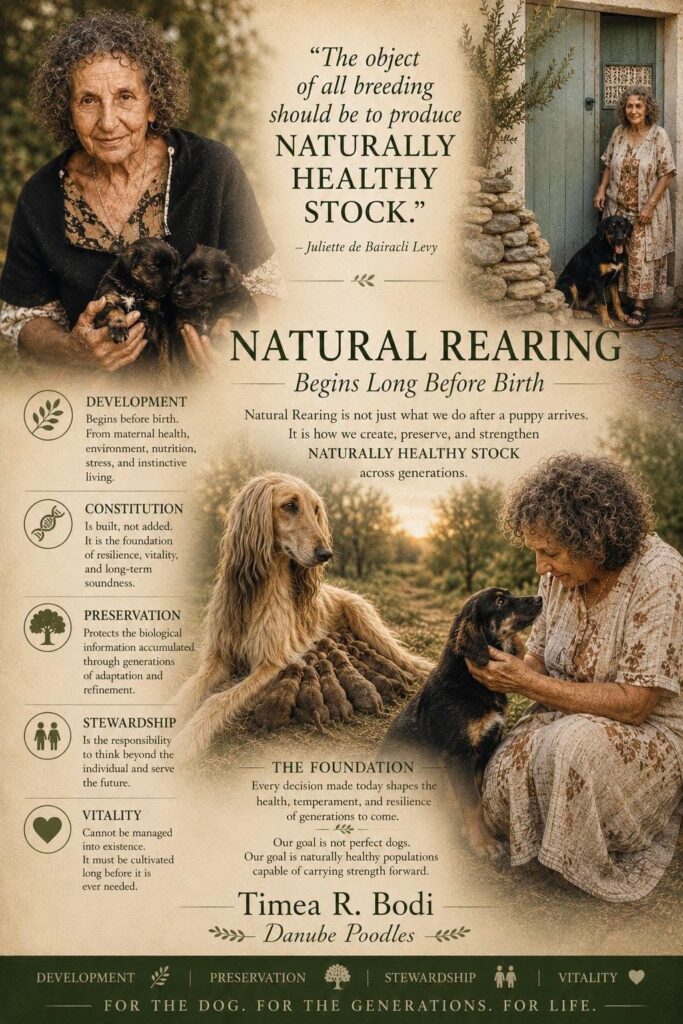
The words staring back at me were simple enough: “The object of all breeding should be to produce naturally healthy stock.” I have read that sentence many times before, yet for some reason it landed differently that evening. Juliette was not talking about managing disease more effectively, building better supplement protocols, perfecting detox programs, or finding new treatments. She was talking about producing animals that possess health as their natural state. The longer I sat there looking at those words, the more I found myself wondering whether we are still having the same conversation she was having when she wrote them.
The strange thing about growing older is that certain ideas which once seemed straightforward begin revealing layers that somehow escaped notice for years, and one of those ideas for me has been Natural Rearing because the more time I spend revisiting Juliette’s work, the more difficult it becomes to ignore how dramatically the conversation surrounding her philosophy has shifted away from the very foundations upon which it was built.
Perhaps part of that reaction comes from where I started because I do not remember a time when poodles were not part of everyday life, having grown up in Romania during the communist years inside a household where breeding plans, pedigrees, litters, structure, movement, grooming, and generations of dogs were discussed with such regularity that none of it seemed unusual or particularly important at the time, despite the fact that those conversations were quietly shaping my understanding of stewardship long before I possessed the language to describe what I was learning.
Ironically, very little of my attention was focused on becoming a breeder because music occupied nearly every corner of my world, eventually carrying me into a boarding school for classical piano where endless hours of practice, competitions, examinations, performances, train rides, and lessons gradually narrowed my vision toward what appeared to be a very predictable future, while a veterinary school application submitted almost absentmindedly lingered in the background until an acceptance letter arrived and presented an alternative version of life that felt both fascinating and strangely unfamiliar.
Choosing music ultimately set in motion a sequence of events that led me to the United States, introduced me to people and experiences I never could have anticipated, and eventually brought me back to dogs through a route so indirect that it sometimes feels almost humorous when viewed from a distance, yet sitting here decades later I find myself returning to the same question over and over again because something about the current state of Natural Rearing feels increasingly disconnected from what Juliette was actually trying to protect.
What troubles me has very little to do with raw feeding, supplements, vaccines, detoxification protocols, flea and tick products, environmental toxins, herbal remedies, alternative therapies, or any of the countless subjects that dominate discussions today because those conversations almost always begin after the organism already exists, whereas Juliette repeatedly directed attention toward a much earlier point in the story where development, inheritance, maternal influence, environmental conditions, constitutional strength, and biological continuity were already shaping outcomes long before a puppy ever entered a new home.
“The object of all breeding should be to produce naturally healthy stock.”
Those words have followed me around for days because they reveal something that seems almost forgotten in modern discussions, namely that Juliette’s philosophy was never centered around managing dysfunction after the fact but rather around preserving VITALITY before decline ever appeared, strengthening CONSTITUTION before weakness became visible, protecting RESILIENCE before intervention became necessary, and safeguarding the biological inheritance passed from one generation to the next through decisions extending far beyond any individual dog.
That distinction matters more than I think many people realize because a philosophy concerned with NATURALLY HEALTHY STOCK cannot easily separate itself from the process through which that stock is created, maintained, refined, and protected over time, which is precisely why I struggle when Natural Rearing becomes attached to breeding programs built upon the intentional mixing of unrelated populations while simultaneously claiming continuity with a worldview that repeatedly emphasized preservation, developmental integrity, and generational stewardship.
Looking through photographs of Juliette surrounded by Afghan Hounds, I do not see someone searching for the newest combination of traits or attempting to reinvent dogs according to changing fashions, market demand, or personal creativity, but rather a woman captivated by enduring vitality, functional soundness, instinctive behavior, reproductive strength, environmental adaptability, and the remarkable durability found within populations that had already demonstrated their ability to sustain health across generations under conditions far more challenging than those experienced by most modern dogs.
That observation stays with me because preservation requires a fundamentally different mindset than invention, demanding humility in places where novelty often seeks recognition, patience where immediate results are desired, and a willingness to protect accumulated biological wisdom rather than constantly rearranging it in pursuit of outcomes that remain largely theoretical until decades of observation reveal their consequences.
The more I sit with that idea, the more I find myself wondering when breeding became separated from development because somewhere along the way those two conversations seem to have drifted into completely different worlds even though biology never stopped treating them as the same thing.
A puppy arriving at eight weeks of age already carries a developmental history stretching back long before birth, through maternal physiology, environmental influences, nutritional status, endocrine signaling, microbial inheritance, stress exposure, and countless biological interactions occurring quietly beneath the surface while most people are focused on preparing a crate, choosing a food, scheduling training classes, or debating which supplements belong in the bowl.
Watching litters over the years has made that increasingly difficult for me to ignore because certain puppies seem remarkably comfortable in their own skin from the beginning while others require considerably more time to process change, recover from surprises, adjust to unfamiliar situations, or regain confidence after stress, and although genetics certainly contribute to those differences, experience has convinced me that development contributes far more than modern conversations are often willing to acknowledge.
Pregnancy itself begins looking very different once the focus shifts away from producing puppies and toward constructing organisms because an entire nervous system is taking shape, immune function is being calibrated, hormonal communication networks are being established, metabolic flexibility is developing, sensory processing pathways are forming, and biological information is continuously flowing between mother and offspring through mechanisms that science is still struggling to fully understand.
Juliette seemed fascinated by that reality long before developmental biology acquired sophisticated terminology for describing it, repeatedly directing attention toward sunlight, movement, fresh air, emotional stability, instinctive behavior, environmental freedom, and maternal well-being as though she understood that life was already learning about the world long before conscious awareness existed.
Spending time with that thought has left me increasingly puzzled by the way BREEDING and DEVELOPMENT are now discussed as though they belong to separate conversations when every observation emerging from biology continues pointing toward an inseparable relationship between the two, with one shaping the conditions under which the other unfolds long before visible outcomes appear for anyone to evaluate.
By the time a puppy leaves for a new home carrying a name, a collar, a carefully selected feeding plan, and all the hopes attached to its future, an extraordinarily complex developmental journey has already been underway for months through maternal physiology, environmental influences, nutritional inputs, endocrine communication, microbial inheritance, adaptive responses, and countless interactions occurring beyond direct observation while attention is frequently directed toward decisions taking place much later in the story.
Years spent raising litters have made this increasingly difficult for me to dismiss because differences become apparent long before formal training, structured socialization programs, behavioral protocols, or carefully designed enrichment plans begin exerting their influence, with certain individuals moving through novelty with remarkable ease while others require additional time to regain equilibrium following unexpected challenges, navigate unfamiliar experiences, process environmental change, or recover from moments of uncertainty, leaving me increasingly convinced that forces operating during early development deserve far greater consideration than they currently receive.
Viewing pregnancy through the lens of organismal construction rather than simple reproduction transforms the entire conversation because what appears externally as a mother carrying puppies is simultaneously the formation of neurological architecture, calibration of immune function, establishment of hormonal communication networks, development of metabolic flexibility, organization of sensory processing systems, and transmission of biological information through pathways that science continues working to understand with increasing precision.
Long before developmental biology acquired sophisticated language for describing these processes, Juliette repeatedly directed attention toward sunlight, movement, fresh air, instinctive living, emotional steadiness, environmental freedom, and maternal well-being in a manner suggesting a deep appreciation for the reality that life begins gathering information about the world from its earliest stages, absorbing signals long before conscious awareness exists and responding to influences that ultimately help shape the trajectory of the organism becoming.
Following that trail of thought eventually leads me toward another question that becomes increasingly difficult to ignore the longer I spend revisiting Juliette’s work because if development, constitutional strength, maternal influence, environmental conditions, instinctive behavior, adaptive capacity, and long-term vitality occupied so much of her attention, then why was she not focused on creating entirely new dogs?
Looking through old photographs of Juliette standing beside her Afghan Hounds has a way of stopping me every time because what I see reflected in those images is not somebody searching for novelty, chasing trends, reinventing populations, or attempting to improve upon nature through increasingly creative combinations, but rather a woman captivated by something far older and perhaps far more valuable.
Constitution.
That word seems almost forgotten today despite the fact that generations of breeders, shepherds, stockmen, hunters, and working dog people understood exactly what it meant.
Constitution was never about a laboratory result, a marketing claim, a social media trend, or a carefully curated health guarantee, but rather the observable ability of an organism to withstand challenge, recover from adversity, reproduce successfully, adapt to environmental pressures, maintain functional soundness, and continue thriving without requiring constant intervention from the outside.
Juliette appeared fascinated by populations that possessed those qualities because they represented something modern society increasingly struggles to produce.
Vitality that did not need to be manufactured.
Resilience that did not need to be purchased.
Health that existed before management became necessary.
Perhaps the central point I am struggling to articulate is that NATURAL REARING was never merely a collection of practices applied after a puppy arrived, nor simply a discussion about food, vaccines, supplements, environmental toxins, or alternative therapies, but rather a philosophy concerned with the creation, preservation, and strengthening of NATURALLY HEALTHY STOCK across GENERATIONS, with every lifestyle decision serving that larger objective rather than replacing it. Viewed through that lens, breeding ceases to be a side conversation and becomes the FOUNDATION upon which development, constitution, resilience, longevity, reproductive integrity, and enduring vitality ultimately depend.
The deeper I go into her writings, the less convinced I become that Natural Rearing was ever intended as a collection of practices applied after the fact and the more convinced I become that it was fundamentally an attempt to understand how naturally healthy populations were created, maintained, and protected across generations.
That realization hits me harder every time I read her because modern discussions frequently revolve around managing decline while Juliette seemed far more interested in understanding how decline could be prevented from becoming established in the first place.
Perhaps that difference explains why preservation occupied such an important place in her thinking.
A population carrying centuries of accumulated adaptation contains information that cannot easily be recreated once it is lost, and safeguarding that inheritance requires a very different mindset than continuously rearranging biological pieces in pursuit of something new.
Following this line of thought eventually brings me to a place that feels increasingly difficult to avoid because the deeper I immerse myself in Juliette’s writings, the harder it becomes to reconcile her relentless focus on DEVELOPMENT, constitutional strength, maternal influence, environmental adaptation, instinctive behavior, reproductive integrity, and enduring vitality with a modern culture that often seems preoccupied with novelty, reinvention, and the continual rearrangement of biological histories that took centuries to establish.
Photographs of Juliette standing beside her Afghan Hounds have a way of capturing my attention for reasons that extend far beyond the beauty of the dogs themselves because what emerges from those images is not the impression of a person searching for innovative combinations, fashionable experiments, or increasingly creative methods of reshaping established populations, but rather someone profoundly fascinated by organisms carrying generations of accumulated adaptation, resilience, purpose, and inherited wisdom that could not easily be recreated once lost.
Beneath nearly every observation she recorded sits an appreciation for CONSTITUTION, a concept that feels strangely absent from many contemporary discussions despite representing one of the most important characteristics any living organism can possess, encompassing the capacity to withstand challenge, recover from adversity, reproduce successfully, adapt to environmental pressures, maintain structural soundness, preserve emotional stability, and continue functioning without requiring an ever-expanding catalogue of interventions designed to compensate for underlying weakness.
Careful study of her work gradually reveals an intellectual pursuit centered less on managing dysfunction after its appearance and far more on understanding how naturally healthy populations emerge, persist, and strengthen through thoughtful stewardship extending across generations, a perspective that feels increasingly relevant as modern conversations devote extraordinary amounts of attention toward repairing problems while dedicating comparatively little energy toward understanding the conditions that prevented those problems from becoming established in the first place.
Biological systems derive much of their strength from continuity, accumulated adaptation, environmental compatibility, reproductive success, and long-term refinement occurring across extended periods of time, which stands in stark contrast to a cultural tendency that frequently assumes innovation itself represents progress regardless of whether the underlying organism ultimately benefits from the changes being introduced.
Centuries of selective pressure, environmental influence, functional requirements, successes, failures, refinements, and adaptive responses exist behind every established breed, creating developmental histories far more complex than appearance alone and carrying information that influences temperament, behavioral tendencies, stress tolerance, reproductive capacity, structural integrity, instinctive expression, and countless other characteristics that become increasingly visible with the passage of time.
Predictability emerges from accumulated biological information, purpose emerges from accumulated biological information, understanding emerges from accumulated biological information, while continuity provides the framework allowing those qualities to remain recognizable across generations rather than becoming increasingly difficult to evaluate beneath layers of uncertainty.
My concern has never centered on individual dogs because every dog deserves love, respect, and thoughtful care regardless of pedigree, but rather on whether Natural Rearing was originally intended as a philosophy of preserving and strengthening established populations across GENERATIONS or whether it can be separated entirely from the concept of PRESERVATION without fundamentally changing what Juliette was trying to achieve.
Discomfort surrounding the modern tendency to attach Natural Rearing to intentional crossbreeding has very little to do with individual dogs because wonderful companions can emerge from many different circumstances, but considerable concern arises when a philosophy historically rooted in preserving NATURALLY HEALTHY STOCK becomes separated from preservation itself, leaving unanswered questions about whether the original objective remains intact once continuity is replaced by perpetual reinvention.
Decades spent observing shepherd camps, village dogs, remote farming communities, working populations, ancient landrace animals, and established breeds did not lead Juliette toward increasingly complex methods of combining unrelated histories, but rather toward a deeper appreciation for VITALITY, LONGEVITY, ADAPTABILITY, INSTINCTIVE COMPETENCE, REPRODUCTIVE STRENGTH, and FUNCTIONAL SOUNDNESS expressed consistently across generations without requiring escalating levels of management merely to sustain what once occurred naturally.
Repeated encounters with her work leave me returning to the same realization because the philosophy she described appears fundamentally concerned with beginnings rather than repairs, developmental trajectories rather than corrective measures, generational stewardship rather than temporary management, and the preservation of biological inheritance rather than the continual creation of new variables whose long-term consequences remain largely unknown.
Eventually the conversation arrives at a place where breeding can no longer be treated as a minor detail sitting somewhere in the background because every future outcome rests upon decisions made long before a puppy receives a name, enters a new household, attends a training class, or encounters the countless interventions that modern culture increasingly relies upon to address challenges whose origins often reach much further back than most people realize.
Perhaps the realization that stays with me most is not connected to any individual breed, specific feeding program, particular health protocol, controversial veterinary topic, or disagreement between competing philosophies, but rather the growing awareness that an extraordinary amount of energy is now devoted to managing problems that previous generations spent far more time trying to prevent from becoming established in the first place.
Conversations surrounding allergies, digestive dysfunction, reproductive struggles, behavioral instability, chronic inflammation, autoimmune conditions, endocrine disruption, environmental sensitivities, orthopedic weaknesses, shortened lifespans, emotional fragility, and declining RESILIENCE seem increasingly common despite unprecedented access to information, diagnostics, products, therapies, specialists, supplements, medications, consultants, educational resources, and intervention strategies designed to support canine health.
Nobody doubts the devotion people feel toward their dogs, nor the willingness to invest remarkable amounts of time, money, emotion, and effort into helping them thrive, which makes the situation all the more perplexing because greater investment somehow appears to coexist alongside organisms that often seem less robust than the populations described by earlier generations of breeders, shepherds, stockmen, hunters, farmers, and naturalists whose observations were formed long before modern technology promised answers for nearly every challenge.
An entire economy now exists around correction, compensation, management, optimization, supplementation, treatment, behavioral modification, environmental modification, nutritional modification, pharmaceutical intervention, diagnostic investigation, and endless attempts to restore capacities that once appeared more abundant, more naturally expressed, and perhaps more deeply rooted within the organism itself.
That observation is not intended as criticism because many of those tools have genuine value and countless animals benefit from them every day, yet a lingering question continues surfacing whenever I revisit Juliette’s work, namely whether a culture can become so focused on maintaining VITALITY that it gradually forgets how VITALITY was originally created, preserved, strengthened, and carried forward through successive GENERATIONS.
Repeated exposure to her writings leaves me with the impression that preventing decline occupied far more of her attention than developing increasingly sophisticated methods for managing its consequences, which may explain why her observations continually returned to mothers, DEVELOPMENT, CONSTITUTION, environmental conditions, instinctive living, reproductive integrity, biological inheritance, and the gradual shaping of POPULATIONS through thoughtful STEWARDSHIP extending far beyond any individual dog.
What becomes increasingly difficult to ignore is the reality that RESILIENCE originates somewhere, CONSTITUTION originates somewhere, enduring VITALITY originates somewhere, long-term soundness originates somewhere, and sustainable health originates somewhere, with each of those qualities emerging from developmental influences established long before symptoms appear, long before interventions become necessary, and long before visible outcomes reveal the biological story unfolding beneath the surface.
A thriving organism does not suddenly emerge at the conclusion of a management protocol any more than a mature oak suddenly appears at the conclusion of a watering schedule because both outcomes depend upon conditions established much earlier in the process, when foundations are still invisible and developmental pathways are still being shaped.
Reading Juliette often feels less like studying dog care and more like being reminded that LIFE follows principles extending beyond individual animals, revealing patterns through which maternal influence, environmental exposure, adaptive pressures, nutritional inputs, emotional stability, instinctive expression, and developmental experiences accumulate quietly over time until they eventually become visible through behavior, reproductive success, recovery capacity, structural integrity, stress tolerance, longevity, and overall VITALITY.
What continues drawing me back to her work decade after decade after decade after it was first written is the sense that she was asking a fundamentally different question than the one modern dog culture often asks because her attention remained fixed upon the creation and preservation of NATURALLY HEALTHY STOCK capable of carrying strength forward through GENERATIONS rather than becoming increasingly dependent upon outside support to maintain capacities that earlier populations inherited more readily.
That distinction feels profoundly important because the future of dogs may depend less upon discovering another INTERVENTION and more upon remembering how CONSTITUTION, RESILIENCE, LONGEVITY, REPRODUCTIVE INTEGRITY, and enduring VITALITY were cultivated through DEVELOPMENT, PRESERVATION, and responsible STEWARDSHIP long before management became the primary focus of the conversation.


Leave a Reply