

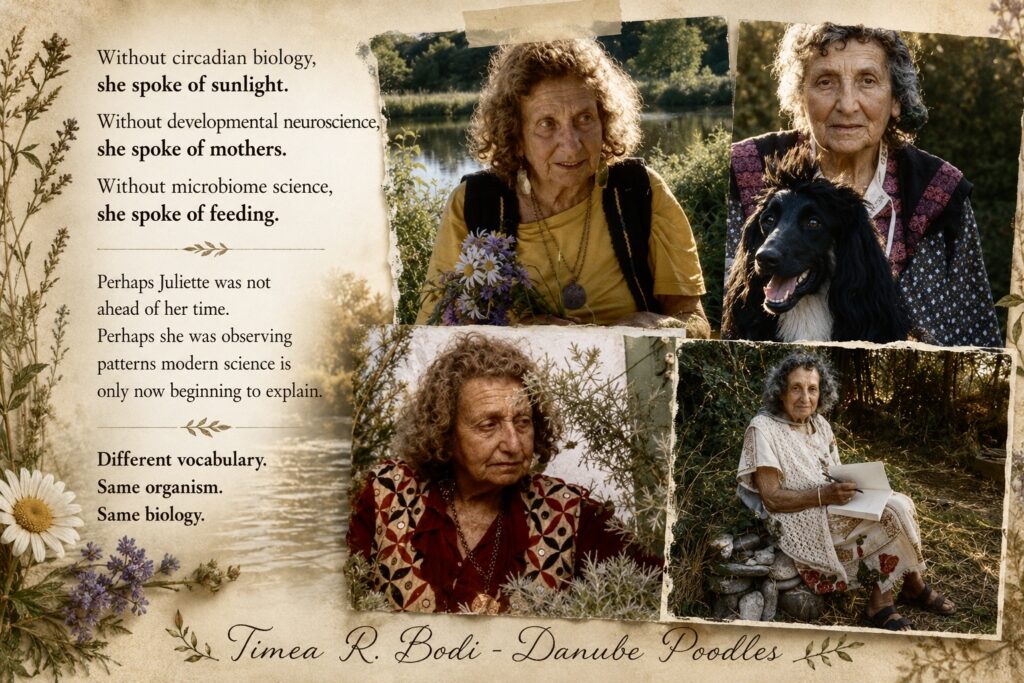
A few evenings ago I found myself doing something that has become entirely too common around here, which is sitting down with the intention of reading a few pages before bed and somehow ending up several hours later surrounded by books, notes, open browser tabs, cold tea, sleeping dogs, and the growing realization that whatever plans I had for a reasonable bedtime had quietly left the building sometime around chapter three.
The original goal was simple enough. I wanted to revisit some of Juliette de Bairacli Levy’s writing because I had been thinking about a conversation that keeps resurfacing whenever Natural Rearing comes up. One person insists the philosophy is outdated. Another argues that modern science has moved beyond those ideas. Someone else points to new research as though it automatically invalidates observations made decades ago, and before long the discussion starts feeling less like an exploration of biology and more like two groups of people speaking entirely different languages while somehow believing they are debating different subjects.
Truth be told, the farther I dug into the literature, the stranger that assumption started to feel.
Research papers discussing developmental physiology sat beside passages written by Juliette half a century ago. Articles on microbiome communication ended up next to old notes about constitution and vitality. Neuroscience findings shared space with observations collected from generations of breeders, shepherds, farmers, stockmen, and naturalists who spent far more time watching living organisms than explaining them.
Somewhere in the middle of all that reading, the whole picture started looking different.
The disagreement was not always occurring at the level of biology.
Much of the disagreement seemed to be happening at the level of vocabulary.
An endocrinologist discussing hormonal resilience, a neuroscientist studying adaptive capacity, a breeder describing strong nerves, and Juliette talking about thriving animals may sound as though they are having completely separate conversations, yet the farther one follows each line of thought, the more frequently those roads seem to arrive at remarkably similar destinations.
That possibility fascinated me because modern culture often treats explanation as though it were synonymous with discovery.
Once language becomes more sophisticated, pathways can be traced and mechanisms quantified, yet all that has really changed is our ability to describe a process that existed long before we learned how to measure it.
Suddenly the impression emerges that the phenomenon itself somehow began existing at the moment science learned how to describe it.
Meanwhile, biology continues going about its business with complete indifference to whether human beings happen to understand the mechanisms involved.
Gravity was shaping the world long before anyone described its mathematics. Ocean tides responded faithfully to lunar cycles long before charts and measurements explained the relationship. Across thousands of years of canine history, development unfolded according to the same biological principles that govern life today, despite the complete absence of laboratories capable of sequencing DNA or mapping molecular pathways.
Living systems have never depended upon scientific understanding in order to remain alive.
Looking back through Juliette’s work with that perspective in mind revealed something I had not fully appreciated before.
Judging observations by the sophistication of their terminology can be misleading because accurate pattern recognition often precedes the language required to explain it. Careful observers frequently notice relationships, tendencies, and recurring outcomes decades before mechanisms become measurable and pathways receive official names.
What initially appeared to be a lack of scientific explanation increasingly looked like an explanation waiting for science to catch up.
Rather than being disproven by the absence of modern vocabulary, many of those observations seem to have arrived before the vocabulary itself existed.
One sentence in particular kept bouncing around in my head while I read.
“Without sun there can be no life.”
The funny thing is that statement lands very differently today than it probably did when she originally wrote it.
Years ago people may have interpreted those words philosophically, perhaps spiritually, perhaps poetically, perhaps as one of those pieces of old-fashioned wisdom that sounds pleasant without requiring much thought.
Modern biology keeps making that sentence look less poetic and more literal.
Researchers now spend enormous amounts of time examining circadian rhythm, hormonal signaling, immune regulation, neurotransmitter production, reproductive health, mitochondrial function, inflammatory pathways, sleep architecture, cognitive performance, and metabolic regulation, only to repeatedly discover that light influences virtually every one of those systems in ways that are difficult to overstate.
Suddenly an observation recorded decades ago starts sounding suspiciously current.
Sunlight did not reinvent itself. Biology never altered its fundamental rules. The patterns being described remained exactly where they had always been.
Only the vocabulary changed. The organism never did.
Oddly enough, that realization ended up leading me toward another quote that initially appears so obvious most people read right past it.
“The mother is the maker of the puppy.”
At first glance there seems to be very little left to discuss.
Pregnancy matters; Nutrition matters; Development matters.
Case closed.
Except the farther modern science travels into developmental biology, the more astonishing that simple statement becomes.
Entire fields of research now revolve around understanding how information reaches a developing organism long before birth, revealing that hormonal signals, nutritional status, inflammatory activity, environmental conditions, microbial inheritance, stress physiology, circadian rhythm, and maternal stability all contribute pieces to a biological conversation already taking place long before the first breath is ever drawn.
That idea becomes increasingly difficult to ignore once it settles into your mind because development starts looking less like construction and more like preparation.
Throughout early life, the organism is collecting evidence, organizing patterns, forecasting what kind of world it expects to inhabit, and adjusting itself according to the signals surrounding it.
A growing puppy is not sitting passively waiting to be assembled like furniture arriving in a flat-packed box from a warehouse. Living systems spend extraordinary amounts of energy attempting to understand the environment they expect to enter, continuously adjusting according to information flowing in from the world around them.
No experience arrives without consequence.
Signals of safety, episodes of chaos, access to abundance, exposure to stress, and the presence of stability each leave their own imprint, contributing another layer to a portrait that is steadily emerging from within.
Reading modern developmental science sometimes feels remarkably similar to reading Juliette, except one version speaks through research papers while the other speaks through observation.
The destination remains surprisingly familiar.
Strong beginnings matter. Maternal well-being influences offspring, stable surroundings support development, and proper nourishment improves the capacity to adapt. Disturbances seldom remain isolated, with repercussions often unfolding long after the initial cause has disappeared.
That realization creates a fascinating challenge for anyone interested in breeding because attention gradually shifts away from viewing genetics as destiny and toward seeing inheritance as potential interacting continuously with experience.
Pedigrees matter.
Health testing matters.
Structure, temperament, and genetics deserve every bit of attention responsible breeders give them because each contributes something meaningful to the foundation an animal carries through life.
Reducing development to DNA alone, however, feels a little like standing before a grand piano and assuming the music already exists simply because the instrument is sitting in the room.
Within that instrument rests tremendous potential, a wide range of possibilities, and an intricate framework capable of producing something beautiful.
The melody, however, has not happened yet.
No keys have been pressed, no notes have been played, and no audience has heard the performance.
Eventually the environment places its hands on the keys.
The image of that piano stayed with me longer than I expected because it captures something that feels increasingly absent from many modern conversations about health, development, breeding, and vitality, namely the recognition that potential and expression are not the same thing even when people use those words as though they are interchangeable.
Inherited traits matter.
No reasonable person would argue otherwise.
At the same time, spending enough years around animals makes it impossible to ignore how dramatically outcomes can diverge despite similar starting points, particularly when environmental conditions begin shaping development long before anyone notices the influence taking place.
That thought eventually brought me back to another one of Juliette’s observations that used to strike me as almost annoyingly obvious.
“Animals thrive best under natural conditions.”
Well, yes. Of course they do.
Water is wet.
Fire is hot.
Dogs are dogs.
The statement feels so self-evident that many people read straight past it without realizing how uncomfortable its implications become once applied honestly to modern life.
A funny thing happens whenever a condition remains familiar for long enough.
What was once remarkable gradually fades into the background, daily routines begin feeling unremarkable, curiosity loses some of its urgency, and assumptions quietly take root without much resistance.
Before long, the extraordinary has successfully disguised itself as ordinary.
Nobody stands beneath artificial lighting late at night, surrounded by glowing screens, climate-controlled air, processed food, constant stimulation, disrupted sleep schedules, reduced movement, diminished environmental diversity, and shrinking microbial exposure while suddenly wondering whether biology anticipated any of this.
The routine feels ordinary because everyone else is participating in the same routine.
Normal and natural parted ways quite a while ago.
That distinction matters far more than many people realize because organisms continue carrying ancient biological expectations regardless of how rapidly technology changes the world surrounding them.
Thousands of years shaped physiological systems around sunlight, darkness, movement, environmental variability, microbial diversity, seasonal shifts, social interaction, resource acquisition, recovery periods, and countless other inputs that arrived with remarkable consistency throughout evolutionary history.
Modern living introduced a completely different set of circumstances in what amounts to the blink of an eye from a biological perspective.
Meals arrived without the need to hunt, forage, or search. Artificial light extended activity long after sunset. Movement became increasingly optional, seasonal rhythms lost much of their influence, and stimulation began arriving with a frequency unmatched by anything found in nature.
Against that backdrop, many of the feedback loops that once helped organisms calibrate themselves to the world gradually slipped into the background.
Living creatures spend unprecedented amounts of time disconnected from the environments that originally shaped their physiology.
Viewing canine health through that lens starts making certain patterns look less random.
Behavioral instability appears with greater frequency. Digestive complaints become increasingly familiar. Environmental hypersensitivities continue rising. Chronic inflammatory conditions show up in more animals. Hormonal dysregulation becomes harder to ignore, while orthopedic weakness seems to appear with surprising regularity.
At first glance, those challenges seem unrelated because they emerge in different body systems, express themselves through different symptoms, carry different diagnostic labels, and are often managed by entirely separate specialties.
Yet beneath those distinctions, a different possibility begins to emerge—one suggesting that multiple expressions may sometimes reflect a shared pattern rather than a collection of isolated problems. Or more concise:
Viewing canine health through that lens starts making certain patterns look less random.
Rising rates of behavioral instability, digestive dysfunction, environmental hypersensitivities, chronic inflammation, hormonal dysregulation, and orthopedic weakness begin appearing less like isolated events and more like recurring themes.
At first glance, those challenges seem unrelated because they involve different systems, present with different symptoms, receive different diagnoses, and frequently fall under the care of different specialists.
The deeper view, however, raises the possibility that many branches may ultimately trace back to the same roots.
The farther research travels into systems biology, the harder it becomes to maintain the illusion that those systems are operating independently.
Communication seems to be occurring everywhere.
Microbial communities influence immune responses, immune responses affect neurological function, neurological function shapes endocrine activity, endocrine activity regulates metabolism, and metabolic processes contribute to inflammatory tone, which often influences behavior in return.
Rather than operating as independent departments, those systems begin looking more like participants in an ongoing conversation where every message has consequences beyond its original destination.
The whole arrangement starts looking less like separate departments occupying the same building and more like family members constantly talking behind each other’s backs.
That realization dramatically changes the way environmental influences are viewed because organisms are never responding to a single variable in isolation.
Every day delivers a continuous stream of information.
Signals arrive through exposure to light, patterns of movement, nutritional inputs, social connections, microbial encounters, emotional stressors, and the quality of rest, each contributing information about the environment in which the organism is expected to function.
The body listens to all of it, whether conscious awareness is involved or not.
Perhaps that explains why Juliette’s work continues resurfacing generation after generation despite repeated predictions that modern science would eventually leave those ideas behind.
Rather than directing most of her attention toward interventions, treatments, or increasingly sophisticated methods of managing symptoms after they appeared, her focus remained centered on the conditions, environments, and developmental influences that determine whether vitality has the opportunity to emerge naturally in the first place.
A subtle difference in perspective may not seem particularly important at first glance.
The consequences of that distinction, however, reach far beyond semantics.
One line of inquiry begins with disease and works backward in search of explanations, while the other begins with health and asks what circumstances allow resilience, adaptation, and biological stability to develop before dysfunction ever enters the picture.
Although those approaches sound remarkably similar when reduced to a few sentences, the paths they follow and the conclusions they produce often diverge in profound ways.
Following that trail eventually leads back to another observation that appears almost too ordinary to deserve serious consideration until modern science begins uncovering the astonishing complexity concealed beneath its simplicity.
The maintenance of health depends upon proper feeding. Few statements sound less revolutionary.
Almost nothing about that idea appears controversial, groundbreaking, or likely to capture attention in a world captivated by technological breakthroughs, sophisticated diagnostics, and increasingly specialized interventions.
Yet beneath those seemingly unremarkable words lies an entire universe of developmental biology, immune regulation, endocrine signaling, neurological function, microbial ecology, cellular communication, and adaptive physiology quietly unfolding every day whether anyone notices or not.
Yet the farther researchers dig into microbiome science, immunology, metabolism, endocrine communication, neurological regulation, and inflammatory signaling, the more astonishing that simple observation begins to look.
Because what enters the mouth does not merely provide fuel.
A conversation begins.


Leave a Reply