

Three boys.
Two girls.
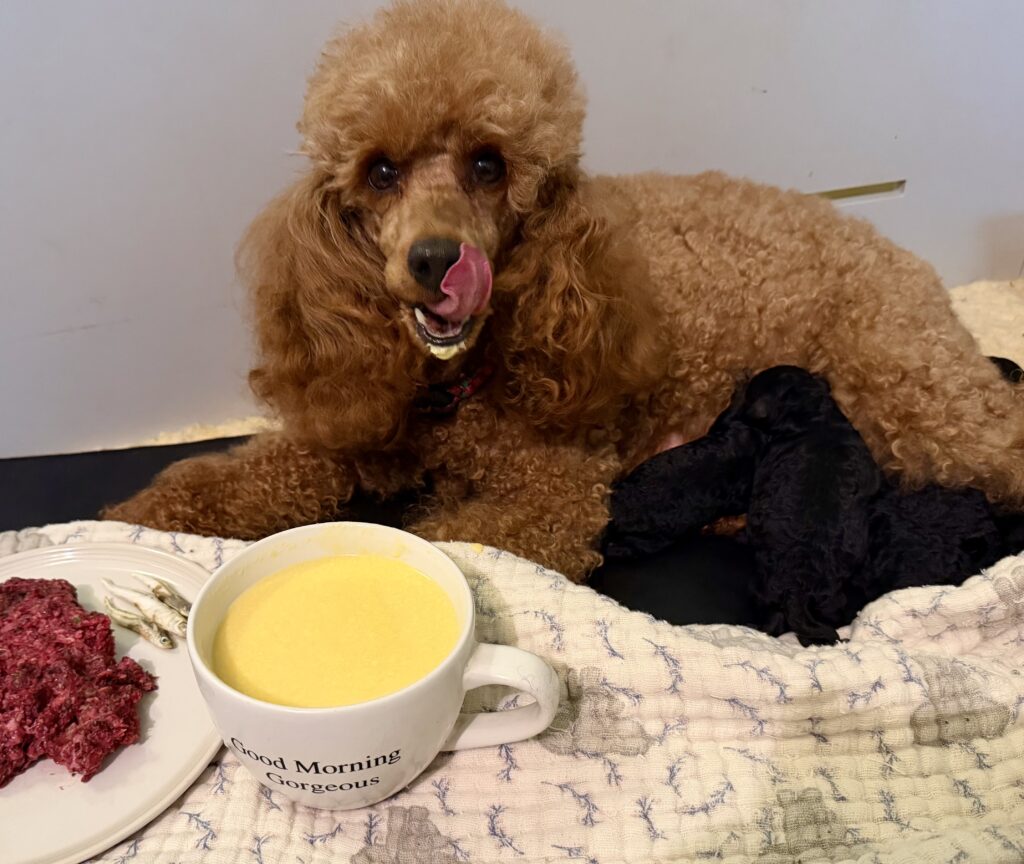
Five healthy puppies safely arrived, nursing, sleeping, squeaking, and carrying on as though entering the world is the most ordinary thing imaginable while the rest of us stand around completely amazed that nature somehow keeps pulling this off generation after generation.
Around three o’clock this morning I was parked on the floor beside the whelping box with a puppy in one hand, a towel in the other, and a cup of coffee I’d already forgotten existed. Chianti was locked in, handling business like a pro, while I looked like I’d been hit by a small tornado. Honestly, the funniest part was that she was far more organized than I was, despite being the one who had just delivered five puppies.
The thing nobody really tells you is that relief, gratitude, exhaustion, pride, and pure awe all show up at the same time. Watching a newborn puppy somehow find a teat before its eyes are even open, seeing a mother immediately switch into full-time caretaker mode, and looking at five tiny pups piled together in a warm little puppy puddle never gets old. Not once.
Most people scrolling these photos are going to see adorable puppies, which is fair because they absolutely are. My brain, though, always goes straight to everything that happened before this moment. The months of planning, years of learning, mistakes that turned into lessons, tiny adjustments that added up over time, stacks of books, freezer inventories, nutrition plans, endless conversations, and all the behind-the-scenes decisions nobody notices because when things go right, the work is invisible.
And yes, there’s a food bowl photo in the mix. Seems random until you realize it’s not. That bowl sitting in front of Chianti this morning is part of the reason those puppies are here. It may not look flashy, but her body just spent nearly two months building five puppies from scratch and then worked through the night delivering them. No miracle powder. No celebrity endorsement. No slick marketing campaign taking a victory lap. Just biology doing what biology does when it’s properly supported.
Looking at those puppies this morning got me thinking about something that has bugged me for years. People love to call healthy outcomes “luck,” but a mother’s ability to carry a litter, maintain pregnancy, produce milk, recover from delivery, make colostrum, and labor effectively isn’t luck. It’s resources. The body needs what it needs when it needs it. Not crossed fingers. Not good vibes. Not Mercury being in retrograde or whatever explanation is trending this week.
Nature is actually pretty darn good at building healthy animals when it’s given the right raw materials. That’s why I’ve always found it strange that modern animal care is obsessed with fixes after the fact.. supplements, treatments, interventions, medications, emergency protocols, miracle cures… while showing a whole lot less interest in what creates resilient animals in the first place.
That line of thinking eventually brought me back to a lesson I learned during my first litter here in the United States in 2007 because, like most newer breeders, I was listening carefully, taking recommendations at face value, trying not to make mistakes, and assuming that if enough experienced people were doing something then it was probably the best option available.
One calcium product seemed to be everywhere. Breeders recommended it, supply companies sold it, catalogs promoted it, and conversations rarely extended beyond “make sure you have this on hand,” which seemed reasonable enough until curiosity finally got the better of me years later and I decided to stop reading the marketing material and start reading the ingredient panel.
What I found was interesting.
The front of the package talked about calcium, labor support, and contractions. The ingredient panel started with water and then moved through calcium carbonate, calcium lactate, dextrose, flavorings, gums, preservatives, and various additives, which immediately made me wonder why nobody had ever wanted to discuss sourcing, biological availability, absorption, mineral forms, or whether there might be a meaningful difference between calcium sources beyond whatever happened to be printed on the label.
Perhaps it helps in the moment.
Bodies are remarkably good at compensating in the moment.
The part that interested me was what happens afterward, because every shortcut eventually submits an invoice and biology always collects payment somewhere.
What fascinates me was how quickly the conversation stopped once a product recommendation entered the room because nobody seemed particularly interested in discussing physiology. Questions about how uterine contractions actually work, why a mother’s calcium demands increase during labor, what forms are most biologically useful, or how nutritional preparation before whelping influences outcomes rarely seemed to appear.
Apparently if enough people repeat the same recommendation often enough, curiosity quietly packs its bags and leaves.
Funny how that works.
The same pattern shows up throughout veterinary medicine because a symptom appears, a product appears shortly afterward, money changes hands, everybody feels productive, and remarkably few people stop long enough to ask what created the problem in the first place or whether the situation might have been avoided entirely through better management, nutrition, environment, breeding decisions, or preparation.
That realization slowly changed how I approach reproduction because collecting products became considerably less interesting than collecting answers. Understanding physiology became far more valuable than memorizing brand names. Reading ingredient panels became more useful than reading advertisements. Asking why produced better results than asking what everybody else was buying.
One thing sitting beside the whelping box last night was MCHA, because after spending enough years studying nutrition and watching outcomes you eventually realize that calcium is not simply calcium any more than hamburger and filet mignon are identical because they both came from a cow. Source influences biological usefulness. Preparation influences effectiveness. Timing influences outcomes. Small details that appear insignificant on paper often become surprisingly important when a mother’s body is doing the extraordinary work of bringing new life into the world.
Perhaps the greatest lesson breeding has taught me is that biology pays attention to details whether people do or not. ❤️🐩❤️


Leave a Reply