

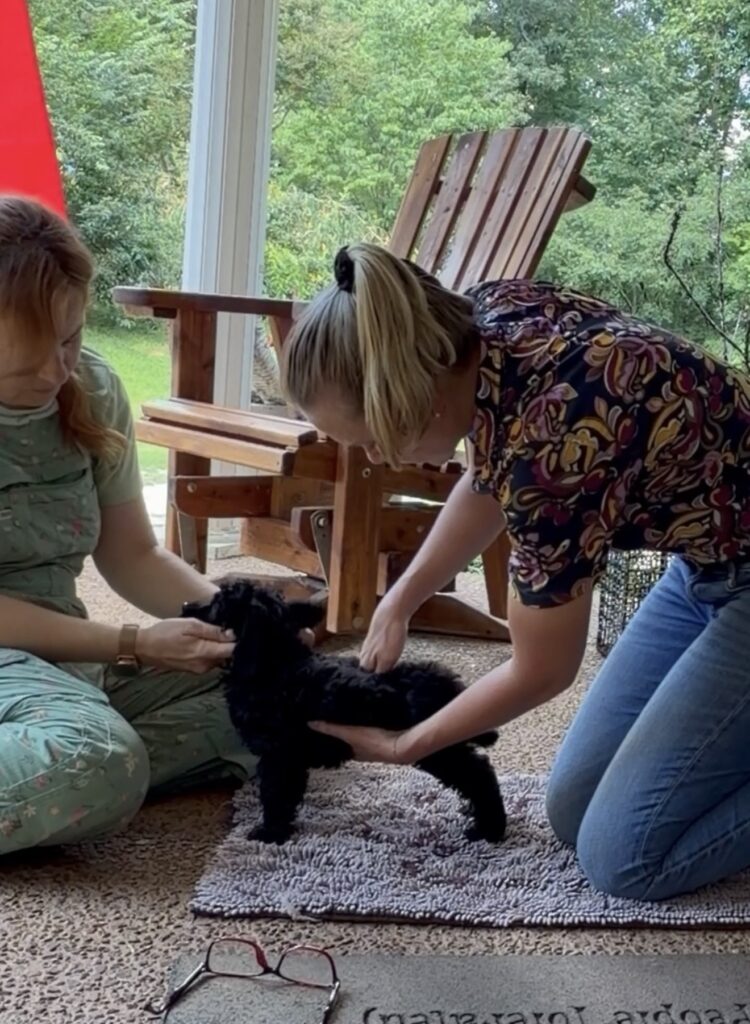
People sometimes ask why a puppy would need chiropractic care when it has only been alive for a few weeks and seems perfectly capable of rolling over its siblings, falling asleep in impossible positions, missing the edge of the bed, and getting back up as though nothing happened.
The answer is not that every puppy is injured or “out of alignment.” Puppies are remarkably resilient, but they are also building the movement patterns they may carry for life. Unlike an adult returning to an established pattern, a young puppy is still learning the mechanics of standing, walking, balancing, turning, and coordinating both sides of the body.
For me, raising a litter responsibly does not end with producing puppies from health-tested parents, feeding them well, and keeping their environment clean. It also means paying attention to how each puppy is developing within that environment, because genetics provides the foundation, but daily experience helps shape how that foundation is expressed.
Birth itself is a major physical transition. Some puppies arrive after prolonged labor, unusual positioning, breech presentation, assisted delivery, or a cesarean section, and while none of those experiences automatically means that something is wrong, they become part of the history worth remembering when a puppy later favors one direction, struggles to nurse comfortably, or begins moving differently from the rest of the litter.
Nursing requires far more coordination than it appears to from the outside because the jaw, tongue, neck, shoulders, spine, limbs, breathing, and nervous system must work together while the puppy maintains its position against the dam and the pressure of littermates. A puppy who repeatedly loses the latch, prefers only one side, holds the head unusually, or tires before the others needs medical causes ruled out first, but once those concerns have been addressed, restricted motion or muscular tension may also deserve consideration.
Within only a few weeks that same puppy goes from crawling to standing, walking, turning, climbing, wrestling, stopping, and recovering after a fall. The brain is constantly receiving information from the joints, muscles, tendons, eyes, skin, and inner ear while learning where the body is in space. This is proprioception, and it is one of the foundations of balance and confident movement.
All of this happens while the puppy is growing rapidly and living in a physically active litter. Puppies climb over one another, twist while competing for a nipple, become pinned beneath siblings, tumble from bedding, and attempt to support a body that is becoming heavier almost every day. Most of this is normal, but it creates constant opportunities for the puppy to practice either balanced movement or compensation.
Joints do more than permit motion. They continually send sensory information back to the brain, which means restricted movement may influence not only how the puppy uses the body in that moment, but how the nervous system begins organizing future movement around it.
Puppies are excellent at adapting, which is both their strength and the reason small problems can be missed. A puppy may not stop playing when something feels uncomfortable. He may shorten a stride, shift weight away from one limb, turn more easily in one direction, sit with the same leg displaced, or find another way to complete the movement without ever appearing obviously lame.
Ordinary clumsiness is expected. Puppies stumble, roll, misjudge distances, sit unevenly for a moment, and fall during play while strength and coordination develop. What matters is whether a difference persists, repeatedly appears on the same side, changes how the puppy moves, or is accompanied by discomfort. Restlessness, resistance to being picked up, withdrawal from play, or sudden reluctance to climb may deserve attention, although pain, illness, orthopedic problems, neurologic conditions, fatigue, poor footing, and normal developmental awkwardness must also be considered.
The body becomes skilled at whatever it practices, including compensation, and timing matters because a young puppy is still learning the basic mechanics of movement rather than merely returning to a pattern that was already established.
Because I raise the litter within my daily life rather than observing the puppies only during scheduled handling sessions, I develop a picture of each puppy’s normal movement over time. I watch patterns rather than isolated moments, compare each puppy with its own previous development as well as with littermates at a similar stage, and pay attention when something that was easy yesterday becomes consistently different today. The practitioner brings training and clinical judgment, while I bring the puppy’s birth history, developmental context, and hundreds of ordinary observations that cannot be recreated during a brief appointment.
That is why I watch how puppies crawl, nurse, stand, turn, reach, climb, sit, rise, play, and move after ordinary falls or rough interactions. I am especially attentive following a difficult birth, assisted delivery, significant fall, sudden change in gait or posture, persistent asymmetry, or nursing difficulty that has already been medically evaluated.
These observations also become part of how I understand the whole puppy. The way a puppy approaches an obstacle, recovers after losing balance, responds to handling, persists through difficulty, and adapts to a changing environment tells me something about physical development, but it may also help me recognize the kind of home, activity, and support in which that individual puppy is most likely to flourish.
A proper chiropractic evaluation should not involve dramatic twisting, aggressive neck rotation, forcing bones back into place, or using the same pressure that might be considered appropriate for a mature animal. A growing puppy has open growth plates and developing tissues, so treatment should be calm, precise, gentle, brief, and suited to the size and age of the puppy.
It should be performed by a veterinarian trained in veterinary spinal manipulation, or by a properly certified animal chiropractor, because confidence and a willingness to manipulate an animal are not substitutes for education, anatomy, diagnostic judgment, or an understanding of when treatment should not be performed.
An evaluation also does not automatically mean an adjustment. Sometimes the most valuable conclusion is that the puppy is developing normally and nothing needs to be done. At other times the findings may point toward imaging, rehabilitation, rest, environmental changes, orthopedic care, or another form of veterinary treatment.
This approach is not about doing more procedures to puppies. It is about noticing more, understanding more, and becoming more deliberate about when intervention is useful and when normal development should simply be allowed to unfold.
When restricted motion is appropriately restored, the puppy may be able to distribute weight more evenly, move through a more comfortable range, reduce muscular guarding, and stop building every new skill around an unnecessary compensation. That is the potential benefit, not the idea that a practitioner is creating perfect alignment or preventing every future problem.
A chiropractic evaluation is only one small part of a much larger developmental picture. It cannot replace sound genetics, maternal health, correct nutrition, lean growth, secure flooring, appropriate traction, natural movement, rest, thoughtful handling, and an environment that changes as the puppies become more capable. Every surface, obstacle, nursing position, play experience, and opportunity to recover from ordinary movement becomes part of what the puppy is practicing.
Research specifically examining chiropractic care in young puppies remains limited, so I do not present it as a cure, a guarantee, or something every puppy automatically needs. The most reasonable discussion involves mobility, comfort, joint function, muscular tension, proprioception, compensation, and the relationship between the musculoskeletal and nervous systems, while remaining honest about how much is still unknown.
I do not have puppies evaluated because I believe they are fragile or defective. I do it because they cannot tell me that one direction feels different, that a shoulder is carrying more work, or that a fall changed the way the pelvis moves. They adapt and continue being puppies, sometimes so successfully that the compensation is missed until it has been repeated long enough to become familiar.
Puppyhood is not only the period in which the body grows larger. It is the time in which the nervous system learns how that body will move through the world.
I am not trying to create a perfectly aligned puppy who never stumbles. I am trying to make sure that while the body is learning how to stand, balance, turn, climb, recover, and move with confidence, it is not being asked to build every future movement around a restriction that could have been recognized and addressed early.


Leave a Reply