

Saturday morning I woke up before the alarm and my mind immediately began going through the dogs. Who needed to go outside first, which boys could be out together, what food needed to come out of the freezer, which dog needed grooming and whether the older dog I had checked before bed had rested comfortably through the night. I stayed there for a few minutes trying to convince my brain that none of it had to happen quite yet, but once my mind starts making the list there is really no going back to sleep.
I got up, made my coffee and started letting dogs outside. I have two boys who no longer get along, so there is no opening the door and sleepily allowing everyone to run out together. They have to be rotated, gates have to be checked and I have to know exactly where everyone is before another door opens. It is a system that works because I respect it every single day. The one morning I become careless could be the morning something terrible happens.
While one group was outside, I started pulling food from the freezers. When you make your dogs’ food, feeding them involves a little more than scooping something out of a bag. I have to think ahead about what needs thawing, what has already been fed, what proteins need rotating and whether I have enough muscle meat, bone, liver, other secreting organs, fish, eggs, colostrum and everything else I use. I have fifteen freezers, and somehow I am still always rearranging them, checking what is getting low and planning the next trip to a farmer.
There is an art to making something this complicated look ordinary. The dogs only know that breakfast arrives. They do not know how many miles I drove to find it, how many conversations I had with farmers, how much lifting and cutting went into preparing it or how carefully I calculated what each dog needs. That is as it should be. Their lives should feel safe and predictable even when the work behind them is neither.
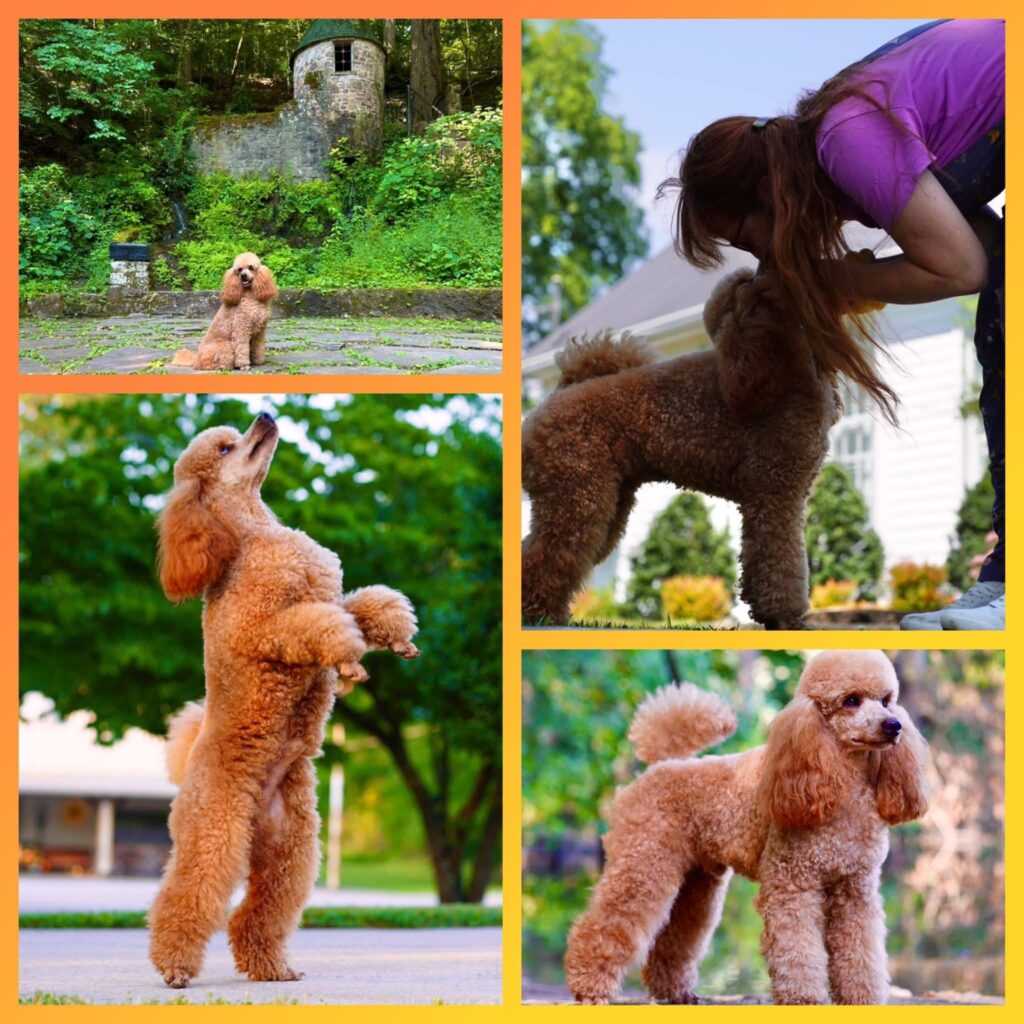
After everyone ate, I checked the dog who had worried me the night before and then looked over the Poodles who were beginning to resemble sheep. Poodle hair does not care that I am tired or that the week did not go according to plan. Faces, feet, nails, ears, baths and haircuts continue arriving on the calendar whether I am ready for them or not. When you have several Poodles, grooming is practically another full-time job living inside the first one.
One of the girls watched me moving around the room and followed every step. Poodles notice everything. They study your face, your breathing, the way you walk and the energy you bring into the house. If I am carrying stress, they will try to carry it with me. If I am unsettled, the whole house can become unsettled. Caring for their mental health sometimes requires me to manage my own, because these dogs are far too intelligent and connected to live beside a person without being affected by what that person feels.
That does not mean they all live together like characters in a children’s story. Dogs have relationships, hormones, preferences and disagreements of their own. I have a scar on my right foot from getting between two girls who fought. The bite was not meant for me, but teeth do not stop in the middle of a fight to ask who the intended recipient was. I stepped between them because I had to, and my foot still carries the reminder.
This is also breeding. Not only beautiful puppies, ribbons, carefully planned pedigrees and photographs of a peaceful pack lying across the sofa. Sometimes it is rotations, separated personalities, veterinary emergencies and learning how quickly an ordinary moment can become dangerous.
As I moved through the morning, I thought about how most people begin breeding. There is no breeder school where someone sits you down and explains what this life may look like twenty years from now. Most people think they will have three or four dogs, raise a litter occasionally and never allow the number to become unmanageable. That sounds very reasonable in the beginning.
Then you keep a puppy because she represents the next generation. You bring in a dog because your program needs genetic diversity. Another prospect does not develop as you hoped, but you love him and he remains. The breeding dogs eventually retire, and if you believe as I do that they are family, they remain too. Three or four dogs can become eight or ten without anyone intentionally setting out to build a large kennel.
The difficulty is that every dog is not simply another bowl at feeding time. Every dog adds grooming, training, exercise, veterinary care, emotional needs and another aging body that will one day require more from you than it did when it was young. The number of dogs grows quietly, but the work multiplies.
I have read the old books and seen the pictures of famous kennels with row after row of dogs. People sometimes point to those kennels as proof that breeders have always kept large numbers. What gets forgotten is that many of those places had kennelmen, attendants, grooms and other employees. The breeder was not necessarily preparing every meal, scrubbing every run, grooming every dog, raising every puppy and sitting up alone with every sick animal.
I have also seen large modern kennels, especially with larger breeds, where the dogs were beautifully cared for because there were employees, good systems, enough space and the financial means to maintain it all. I do not believe a number alone tells us everything. Ten dogs with one exhausted person can receive less care than thirty dogs surrounded by a skilled and dependable staff.
The real question is whether the resources grew when the number of dogs grew.
A full-time job, major outside responsibilities and many dogs do not mix easily. Something eventually has to give unless there is reliable help. Maybe grooming begins falling behind. Maybe individual time slowly becomes group turnout. Perhaps rotations become longer, training is postponed and the little change in an old dog is missed because the person caring for everyone is simply too tired to notice it.
That is sometimes how a good breeder becomes a hoarder. It does not always begin with a filthy house or someone who does not love their dogs. It can begin with a respected breeder who keeps one too many, loses some income, becomes sick, loses their help or refuses to admit that their abilities have changed. The dogs continue aging, the bills continue arriving and the work continues multiplying. One difficult season becomes a permanent way of living, and eventually love is buried beneath filth, untreated illness and more responsibility than one person could possibly carry.
Love is essential, but love is not staffing. Passion is not money. Experience is not physical strength, and good intentions do not add more hours to a day.
I have always known that I would have Poodles. I also knew I was not independently wealthy, so I understood early that I needed to know enough to care for them responsibly. I went to school. I worked in veterinary medicine. I became educated in canine and feline nutrition and continued studying reproduction, genetics, holistic care and every subject that could help me make better decisions for the dogs depending on me.
I did not do that because I thought I would ever know everything. The more I learned, the more I understood how much there was still to learn. I did it because veterinary bills are real, emergencies are real and loving animals without understanding their bodies can leave you helpless when they need you most.
Knowing more did not spare me from losing them.
Nothing truly prepares a breeder for that part. We spend so much time planning life that we can forget how closely breeding makes us live beside death. I keep my old dogs. I do not rehome them when their reproductive years are over because they did not stop being my family when they stopped being useful to a breeding program. They remain beside me until the end, and that decision naturally limits how quickly I can grow.
It also means I have had to learn how to piece my heart back together.
Some years I feel as if I am saying goodbye to someone every year. Sometimes I am caring for an elderly dog while raising a litter. I may be weighing puppies, changing bedding and watching new lives discover the world while helping an old dog stand, cleaning up after them or wondering whether the kindest thing I can do is let them go. I may be teaching a new family how to care for the puppy they are excited to bring home while quietly preparing to whisper to one of my own, “I’ll see you again soon.”
Birth and death can exist under the same roof. One room may be filled with puppies learning to walk while another holds a dog whose legs no longer work as they once did. There is tremendous joy in that circle, but there is grief too, and neither one waits politely for the other to finish.
I have learned that grief does not mean I chose the wrong life. It means I stayed. I was there for the first breath and I remained for the last one. That is the promise I make when I keep a dog, even though I know from the beginning exactly how the story will eventually break my heart.
After breakfast, rotations and checking the older dogs, there are messages waiting. A family has a feeding question. Someone is worried about loose stool. Another person needs help understanding something their veterinarian said. Because I teach my families how to feed raw food and care for their dogs holistically, I am often on their speed dial for the life of the dog.
I am not the kind of breeder who sells a puppy, closes the door and decides the rest is no longer my concern. That puppy may no longer live under my roof, but I brought it into the world. The relationship can last fourteen or fifteen years, and every litter expands the circle of people and dogs for whom I remain a resource.
People sometimes calculate breeding income by multiplying the number of puppies by the price and assume they have discovered a wonderfully profitable business. They do not subtract the years when there is no litter, the reproductive attempts that produce nothing, the health testing, equipment, grooming, travel, emergency veterinary care or the retired dogs who may live another ten years after their last litter. They do not count the puppy who returns during a family crisis or the dog who needs expensive medical care when there is nothing left in the breeding account.
Money does not make someone a bad breeder. A breeding program has to be financially sustainable because depending on love alone is unfair to the dogs. There must be enough money for food, testing, veterinary care and emergencies, including emergencies that happen at the worst possible time. Wanting to breed without honestly examining the finances is not passion. It is gambling with lives that cannot choose whether we are prepared.
By the time I finish the immediate work, part of the day is already gone. There may be grooming ahead, piano lessons to teach, phone calls to return or puppies needing new experiences. My so-called vacations are usually dog shows, veterinary seminars or some other event involving animals. I travel to learn, evaluate dogs, study pedigrees and find better ways of doing what I already do.
Some people might look at that and wonder where my life ends and breeding begins. I am not certain there is a clean line anymore.
Breeding became part of the rhythm of my life slowly, one dog, one lesson, one heartbreak and one dream at a time. It filled my freezers, shaped my schedule, changed how I travel and taught me to notice things most people never see. It asks me to think in generations while never overlooking the individual dog standing in front of me.
That is where I believe breeding becomes an art.
The art is not producing the greatest number of puppies or collecting the greatest number of champions. It is learning how to hold ambition and restraint in the same hand. It is understanding pedigrees without reducing dogs to names on paper. It is seeing what could exist several generations from now while remaining responsible for every life already here.
I want preservation breeders to dream bigger, but bigger does not always mean more dogs or more litters. Sometimes the bigger dream is deeper knowledge, healthier generations, greater honesty and better support for the families who trust us. Sometimes growth means developing the wisdom to keep fewer dogs beautifully instead of keeping many adequately.
The breeding world has spent years dismissing backyard breeders and laughing at doodles, yet dismissal did nothing to stop either one from growing. While preservation breeders spoke mostly to one another, other breeders learned how to speak directly to families. They became accessible, answered questions and sold people a story that felt understandable, even when the breeding behind that story lacked substance.
We cannot preserve our breeds from behind a closed door. We have to educate without making people feel stupid. We have to explain why health testing, structure, temperament and genetic diversity matter. We must be willing to look critically at our own programs instead of assuming that a pedigree, title or reputation automatically places us above accountability.
People who want to become breeders need dreams. They also need preparation. They need mentors who will tell them about the joy without hiding the cost, the work or the heartbreak. They need to understand that keeping the old dogs changes the speed of a program, that every keeper occupies space long after the excitement of that litter is gone and that a breeder’s responsibility grows faster than the number written on a kennel list.
Some days this balancing act is not easy. Sometimes the freezers need filling, grooming is behind, two dogs must be rotated, a puppy family needs help and an old dog is looking at me in a way that makes my heart sink. There are days when I am physically tired, emotionally stretched and wondering how one person can be needed in so many places at once.
Most days, however, I cannot imagine living any other way.
I love seeing a puppy take its first breath. I love watching an intelligent young dog begin to understand the world. I love studying a pedigree and imagining what could be improved without losing what generations of breeders protected before me. I love watching one of my dogs bring joy to a family and knowing that something I cared for with my own hands has become deeply loved somewhere else.
Breeding has scarred my body, emptied my wallet, filled my freezers, interrupted my sleep and broken my heart more times than I can count. It has also given my life purpose, curiosity, joy and a closeness to the circle of life that I would not trade for something easier.
The goal is not balance in the sense of giving every part of life an equal number of hours. This life will never divide itself that neatly. The balance comes from knowing my limits, continuing to learn and making sure my passion never asks the dogs to pay a price I am unwilling or unable to carry myself.
I absolutely love what I do.
That is why I want to keep becoming better at it, why I remain accountable to the dogs already here and why I believe the greatest dream a breeder can have is not simply to produce more.
It is to build something worthy of the lives entrusted to us.


Leave a Reply